Managerial Cognitive Bias and Behavioral Design
🗂️ Interactive Notebook: Open Study Companion (Video Summary, Flashcards, Mind Map) ↗
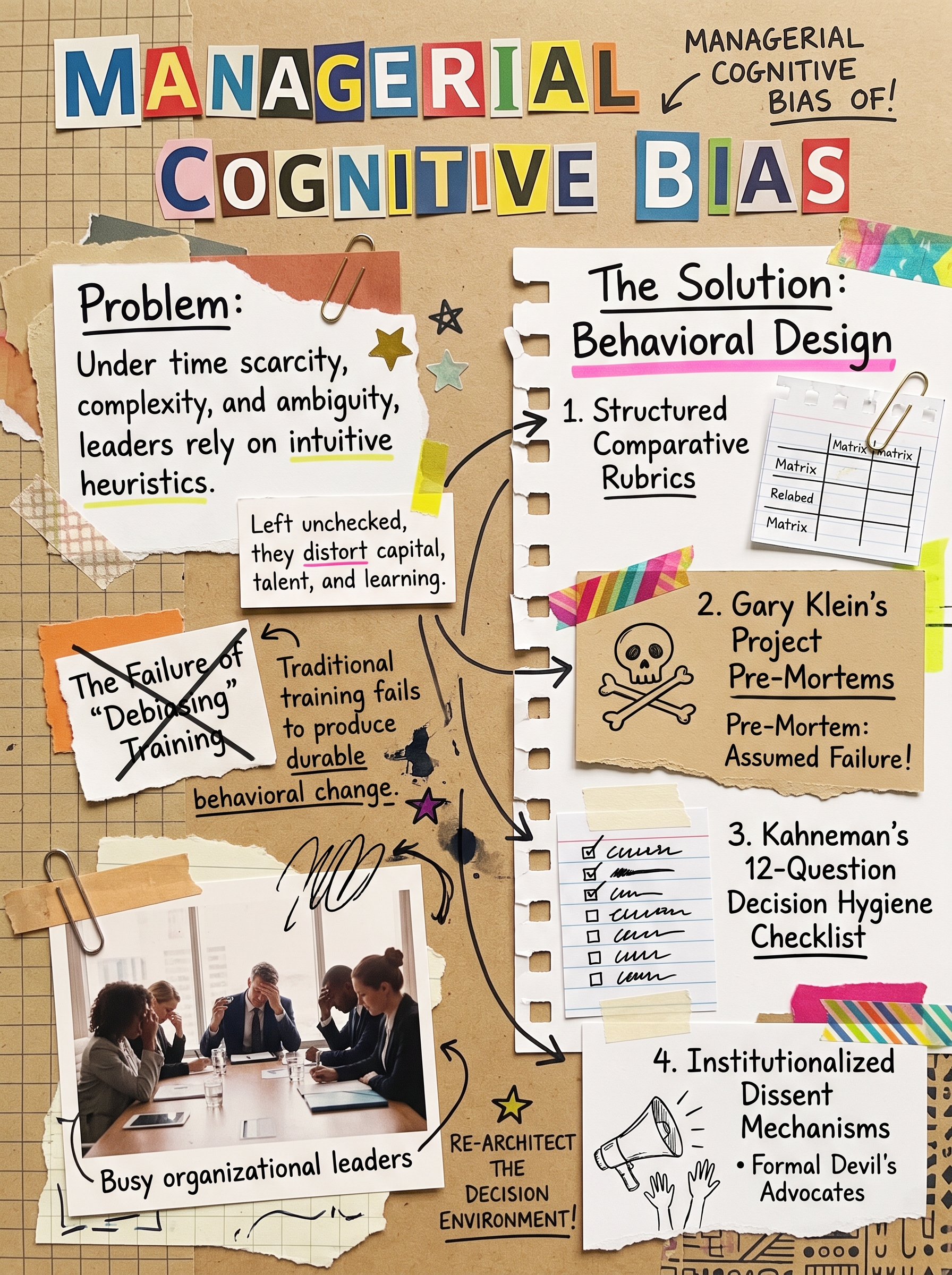
Managerial cognitive bias occurs when organizational leaders rely on rapid, intuitive heuristics under conditions of time scarcity, computational complexity, and strategic ambiguity.[1][2] Left unchecked, these systematic distortions compromise capital allocation, warp talent acquisition and performance appraisals, and stifle organizational learning.[2:1][3] Because decades of empirical research demonstrate that standalone unconscious bias training fails to produce durable behavioral modification, contemporary organizational science shifts from "debiasing minds" to behavioral design: re-architecting decision environments through structured comparative rubrics, Gary Klein's project pre-mortems, Daniel Kahneman's 12-question decision hygiene checklists, and institutionalized dissent mechanisms.[1:1][4][5]
1. Cognitive Foundations: Dual-Process Theory & Bounded Rationality
Classical neoclassical economics rested on the axiomatic assumption of the hyper-rational executive optimizer (Homo economicus)—a leader possessing complete information, infinite computational capacity, and stable, transitive utility preferences. In the mid-twentieth century, Nobel laureate Herbert Simon dismantled this premise by formulating the doctrine of bounded rationality, demonstrating that human beings operate under strict neurocognitive constraints, incomplete information, and finite temporal reserves.[6] In response to these operational limits, managers do not maximize; instead, they engage in satisficing, selecting options that clear a minimally acceptable threshold rather than conducting exhaustive combinatorial searches for the global optimum.[6:1]
Building on Simon's foundations, cognitive psychologists Daniel Kahneman and Amos Tversky articulated the Dual-Process Theory of human cognition, partitioning mental operations into two interactive cognitive modes:[1:2][4:1]
- System 1 (Heuristic / Autonomous): Operates automatically, fast, and associatively with minimal conscious effort or voluntary control. System 1 generates impressions, feelings, and intuitive inclinations by rapidly mapping incoming stimuli against stored experiential patterns.
- System 2 (Deliberative / Analytic): Operates slowly, sequentially, and effortfully, allocating metabolic attention to complex mental computations, counterfactual simulations, formal logic, and probabilistic modeling.
| Cognitive Dimension | System 1: Heuristic Intuition | System 2: Deliberative Computation | Strategic Executive Manifestation |
|---|---|---|---|
| Operational Velocity | Instantaneous, subconscious, and automatic | Deliberate, reflective, and metabolically expensive | Rapid triage of inbound emails vs. multi-year capital budget modeling |
| Information Processing | Associative pattern-matching; WYSIATI rule | Algorithmic deduction; probabilistic calculation | Gut feeling on candidate charisma vs. multi-criteria scorecard evaluation |
| Cognitive Resource Cost | Minimal metabolic expenditure; cognitive miser default | High glucose and working-memory consumption | Defaulting to industry orthodoxy when mentally fatigued |
| Sensory & Data Perimeter | Singular information; ignores distributional base rates | Distributional base rates; statistical variances | Fixating on a vivid pitch deck rather than historical project reference classes |
| Vulnerability to Distortion | High; vulnerable to framing, priming, and anchoring | Low when engaged; prone to rationalizing System 1 outputs | Rubber-stamping executive pet initiatives with post-hoc financial spreadsheets |
Under the relentless pace of executive leadership—characterized by fragmented attention, continuous meetings, and performance pressure—the human brain functions as an unrepentant cognitive miser.[1:3][2:2] Rather than mobilizing the metabolically expensive machinery of System 2, executive leaders naturally follow the path of least resistance, operating on autopilot while navigating strategic dilemmas.[2:3] Under System 1 dominance, the brain enacts the principle of WYSIATI (What You See Is What You Get): it constructs a coherent, emotionally compelling causal narrative solely from the facts immediately in view, while treating unobserved systemic variables as non-existent.[1:4][4:2] Consequently, strategic judgment drifts into acute cognitive blind spots that remain invisible to the leaders themselves.[1:5][3:1]
2. The Triad of Managerial Detriment
Cognitive bias in management is not a minor statistical nuisance; it represents an institutional vulnerability that damages organizational performance across three interconnected operational domains.[2:4][7]
1. Suboptimal Strategic & Capital Allocation
When strategic leaders evaluate mergers, capital expenditures, and product portfolios through uncalibrated intuition, resource allocation degrades.[1:6][3:2] Overconfidence and the planning fallacy lead executive committees to underestimate implementation timelines and capital costs while dramatically inflating revenue projections.[1:7][7:1] Preliminary budget numbers serve as powerful mental anchors; subsequent adjustments are conservative, leaving multi-million-dollar forecasts built on sand.[1:8][2:5]
Furthermore, when strategic initiatives encounter operational friction or deteriorating market fundamentals, executive egos fall prey to the sunk cost fallacy and the escalation of commitment.[2:6][3:3] Rather than cutting losses, leadership pours fresh capital into failing ventures to justify past commitments, treating financial models as smoke and mirrors to project an outward facade of strategic continuity.[2:7] Empirical field research by McKinsey & Company demonstrates that strategic proposals vetted through depersonalized, bias-mitigating debate deliver returns on invested capital up to 2.3 times higher than decisions driven by subjective executive intuition.[3:4]
2. Human Capital Distortion & Homogeneity
In recruitment, promotion, and compensation reviews, cognitive heuristics lead managers to confuse personal familiarity with professional competence.[8][9] Driven by affinity bias and the similarity-attraction effect, managers favor candidates who mirror their own educational pedigrees, communicative cadences, and socio-demographic profiles, hiring for nebulous "culture fit" rather than audited operational competencies.[8:1][9:1]
This dynamic fosters cognitive monocultures, depriving leadership teams of the diverse perspectives needed to identify emergent risks.[7:2][9:2] In performance reviews, evaluators fall victim to the halo/horns effect and recency bias, allowing a single presentation or the final six weeks of an annual cycle to determine career trajectories while systemic contributions over the prior ten months go unrewarded.[10] These subjective appraisals fail to level the playing field, driving away high-performing contributors whose work goes unacknowledged.[8:2][10:1]
3. Psychological Safety Erosion & The Silence Spiral
When managers exhibit unreflective confirmation bias and defensive leadership routines, open communication collapses.[3:5][11] Subordinates recognize that challenging an executive's preferred initiative or bringing disconfirming operational data to light carries social and professional penalties.[11:1] Fearing retaliation, team members choose not to rock the boat, remaining silent when flawed assumptions threaten project success.[3:6][12]
This collective silence deprives top executives of ground-level operational intelligence, allowing preventable errors to compound beneath an outward appearance of consensus until initiatives reach their breaking point.[3:7][12:1] When failure becomes undeniable, insecure leadership teams reflexively point the finger at market anomalies or throw subordinates to the wolves rather than examining their own flawed decision-making processes.[11:2]
3. Comprehensive Taxonomy of Managerial Cognitive Biases
Managerial biases cluster into three distinct operational domains: strategic capital biases (how leaders process macroeconomic and operational data), interpersonal evaluation biases (how leaders evaluate talent and allocate credit), and group-dynamic biases (how collective deliberative bodies suppress variance).[1:9][2:8][11:3]
| Category | Specific Cognitive Bias | Psychological Mechanism | Concrete Managerial Manifestation | Primary Institutional Vulnerability |
|---|---|---|---|---|
| Strategic | Confirmation Bias | Actively hunting for data that validates a prior thesis while dismissing or rationalizing contradictory evidence.[1:10][11:4] | Highlighting positive pilot focus-group feedback while ignoring poor retail conversion metrics.[11:5] | Capital committed to unviable products; failure to pivot when market signals shift. |
| Strategic | Sunk Cost Fallacy & Escalation | Allowing irrecoverable historical investments (time, capital, ego) to justify continued expenditure.[1:11][2:9] | Refusing to decommission a dysfunctional legacy ERP migration because $40M has been spent.[2:10] | Depletion of capital reserves; missed opportunity to pivot toward modern SaaS architectures. |
| Strategic | Anchoring & Adjustment | Over-indexing on the first piece of numerical information received when generating estimates.[1:12][2:11] | Letting an unvetted vendor estimate establish the benchmark for enterprise software procurement.[1:13] | Prolonged contract mispricing; budget models built on sand. |
| Strategic | Availability Heuristic | Gauging event probability by how easily vivid or emotionally salient examples come to memory.[2:12][7:3] | Halting an international expansion because a peer firm suffered a high-profile regulatory audit abroad.[2:13] | Risk misallocation; over-insuring against vivid risks while ignoring systemic hazards. |
| Strategic | Planning Fallacy & Overconfidence | Adopting the Inside View: constructing idealized step-by-step narratives while ignoring historical base rates.[1:14][7:4] | Projecting a complex cloud data migration in 9 months when historical industry peers average 24 months.[7:5] | Chronic schedule slippages, severe budget overruns, and reputational damage. |
| Interpersonal | Affinity Bias (In-Group Favoritism) | Instinctively gravitating toward candidates sharing similar social, educational, or cultural backgrounds.[8:3][9:3] | Selecting a candidate because they went to the same business school or share common hobbies.[9:4][11:6] | Structural monoculture; lack of cognitive diversity; discriminatory talent pipelines. |
| Interpersonal | Halo & Horns Effect | Allowing a single prominent positive or negative attribute to color the holistic evaluation of a person.[2:14] | Assuming an articulate, charismatic presenter possesses elite technical architecture skills.[2:15] | Mismatched talent placement; promoting incompetent communicators into complex technical roles. |
| Interpersonal | Recency Bias | Disproportionately weighting observations from the immediate past over cumulative longitudinal performance.[7:6][10:2] | Scoring an employee's annual review solely on a minor milestone delivery from the preceding month.[10:3] | Demotivated top performers; volatile retention; distorted performance management. |
| Interpersonal | Fundamental Attribution Error | Attributing external failures to moral or character deficits while attributing personal failures to environment.[11:7] | Blaming a missed product delivery date on a developer's laziness rather than upstream tooling outages.[11:8] | Breakdown of psychological safety; mutual distrust; executive blame shifting. |
| Group Dynamic | Groupthink (Janis) | Suppressing individual critical dissent to preserve superficial group consensus and social cohesion.[3:8][7:7] | Investment committees nodding along with a CEO's acquisition target despite dubious synergies.[3:9][5:1] | Flawed due diligence; catastrophic acquisitions; unvetted strategic risks. |
| Group Dynamic | Shared Information Bias | Discussing mutually known data while failing to unearth unshared, specialized domain intelligence.[3:10][5:2] | Cross-functional committees spending 90% of meeting time reviewing widely known high-level metrics.[3:11] | Specialized risk warnings from engineering or compliance remain unheard. |
| Group Dynamic | Outcome Bias ("Resulting") | Judging decision quality entirely by the final outcome rather than the analytical process at choice time.[2:16] | Praising a reckless, unhedged financial trade because an unforeseen macro event yielded high profits.[2:17] | Rewarding reckless gambles while penalizing rigorous risk-adjusted decision procedures. |
The Compounding Cycle of Managerial Bias
| Operational Arena | Primary Cognitive Drivers | Team & Communication Dynamics | Institutional Consequence |
|---|---|---|---|
| 1. Strategic & Capital Arena | Anchoring to initial forecast; confirmation bias in pilot metrics; sunk cost escalation on faltering initiatives. | Leaders present financial spreadsheets as smoke and mirrors; alternative market models ignored. | Capital committed to unviable initiatives; strategic forecasts built on sand. |
| 2. Interpersonal Arena | Affinity bias in talent acquisition; halo effect in leadership promotions; recency bias in annual appraisals. | Managers hire for vague "culture fit"; performance feedback focuses on subjective trait impressions. | Creation of homogenous monocultures; disengagement of overlooked high performers; attrition of talent. |
| 3. Group Dynamic Arena | Groupthink (Janis); authority cascades; shared information bias; defensive self-censorship. | Subordinates fear to rock the boat; unshared operational risks remain hidden from executive sight. | Information silos; critical frontline warnings suppressed; institutional blind spots expand. |
| 4. Structural Value Destruction | Collective escalation of commitment; outcome bias ("resulting"); executive blame shifting. | When failure becomes undeniable, leaders point the finger or throw subordinates to the wolves. | Acute destruction of shareholder value, employee psychological safety, and organizational agility. |
4. The De-Biasing Fallacy: Awareness Training vs. Behavioral Architecture
When organizations recognize the cost of managerial bias, their standard response is to roll out mandatory unconscious bias workshops, lectures, and e-learning modules.[8:4][13] The implicit assumption of this approach is that educating managers about cognitive biases will enable them to monitor their own thoughts and make objective decisions through deliberate self-control.[4:3][8:5]
Empirical research shows that this approach rarely works in practice.[8:6][14]
In an exhaustive study analyzing three decades of human resources data across more than 800 commercial enterprises, sociologists Frank Dobbin (Harvard University) and Alexandra Kalev (Tel Aviv University) demonstrated that mandatory unconscious bias training does not produce sustained behavioral change.[8:7][14:1]
Within days of training, cognitive awareness declines back to baseline levels.[8:8] More concerningly, compulsory compliance training often triggers psychological reactance: managers resent mandatory instruction, dig into existing habits, and exhibit increased bias in subsequent hiring and evaluation reviews.[8:9][13:1] Furthermore, awareness training can foster a false sense of moral licensing: managers assume that because they understand bias intellectually, their personal decisions must be objective.[4:4][14:2]
The fundamental failure of standalone training stems from the bias blind spot: individuals readily detect heuristics and prejudices in others while remaining convinced that their own judgments are impartial and grounded in empirical facts.[1:15][4:5] Because System 1 operates beneath conscious awareness, willpower alone cannot prevent biased impressions from surfacing.[1:16]
As Harvard behavioral economist Iris Bohnet demonstrates in What Works: Gender Equality by Design, sustainable organizational debiasing requires moving away from the futile attempt to "debias human minds." Instead, leaders must focus on debiasing organizational architecture.[4:6][5:3] Rather than asking imperfect humans to police their own thoughts under stress, behavioral design structures the environments, rubrics, and workflows within which decisions take place.[4:7][14:3]
| Organizational Dimension | Standalone Awareness Training (Mind-Centric) | Structural Behavioral Design (Architecture-Centric) |
|---|---|---|
| Underlying Hypothesis | Educating individual managers about cognitive biases will prompt them to self-correct during daily operations.[8:10] | Human cognitive architecture is constrained; environments must be designed to neutralize predictable cognitive failure points.[4:8] |
| Operational Locus | Internal: attempts to alter subconscious feelings, instincts, and personal attitudes.[4:9][8:11] | External: redesigns evaluation forms, meeting agendas, data displays, and governance approval gates.[4:10][5:4] |
| Managerial Effort Required | Continuous, high-friction System 2 vigilance and willpower during high-stress moments.[1:17] | Passive, default structural nudges embedded directly into everyday organizational workflows.[4:11] |
| Talent Acquisition Method | Unstructured conversations with instructions to "watch out for personal affinities."[8:12] | Standardized horizontal interview scorecards, anonymized work samples, and blind resume reviews.[4:12][9:5] |
| Capital Allocation Method | Unstructured committee discussions followed by a general call for critical feedback.[3:12] | Gary Klein's pre-mortems, Kahneman's 12-question checklists, and independent Red Teams.[1:18][12:2] |
| Long-Term Empirical Efficacy | Negligible to negative; triggers psychological reactance and complacency.[8:13][13:2] | Highly durable; produces measurable improvements in candidate quality, forecasting accuracy, and capital discipline.[3:13][4:13] |
5. Decision Hygiene and Behavioral Architecture Protocols
To protect organizational decision-making from cognitive distortions, executive leadership must institutionalize decision hygiene.[1:19][15] Just as clinical hygiene consists of systematic antiseptic procedures that protect patients without requiring surgeons to see individual microbes, institutional decision hygiene introduces structured protocols that neutralize cognitive biases without requiring managers to diagnose their own subconscious thoughts.[1:20][15:1]
The Three Tiers of Institutional Decision Hygiene
| Governance Tier | Phase & Operational Focus | Structural Protocols & Safeguards | Primary De-Biasing Mechanism |
|---|---|---|---|
| Tier 1: Upstream Data Sanitization | Input Design (Pre-Deliberation) | • Horizontal talent scorecards across isolated questions. • Anonymized resume screening & work-sample tests. • Behaviorally anchored rating scales (BARS). • Blinding demographic and non-essential variables. | Neutralizes the halo effect, affinity bias, and initial impression framing before evaluation begins. |
| Tier 2: Midstream Deliberative Architecture | Meeting & Discussion Engineering | • Gary Klein's Project Pre-Mortem (prospective hindsight). • Inverted speaking hierarchy (junior specialists first). • Independent silent ideation & brainwriting before open debate. • Institutionalized Red Teams & assigned Devil's Advocates. | Breaks collective groupthink, prevents premature consensus, and surfaces unshared private operational intelligence. |
| Tier 3: Downstream Governance Gates | Approval & Monitoring Protocols | • Pre-committed quantitative kill criteria (stop rules). • Decoupled shutdown authority (independent boards/CFO). • Kahneman, Lovallo & Sibony's 12-question quality checklist. • Process accountability over outcome bias ("resulting"). | Disarms the sunk cost fallacy, prevents emotional escalation of commitment, and rewards disciplined risk appraisal. |
1. Structural Debiasing in Talent Architecture
- Horizontal Comparative Evaluation: Traditional hiring evaluates candidates vertically—interviewing Candidate A across all five competencies, then Candidate B across all five competencies.[4:14] This approach allows the halo effect and affinity bias to distort the entire profile.[4:15] Behavioral design mandates horizontal evaluation: review all applicants' responses to Question 1 side-by-side before evaluating Question 2.[4:16] This practice neutralizes personal charm and highlights variance in technical competence.[4:17]
- Standardized Behavioral Rubrics: Replace vague, open-ended evaluations with explicit, behaviorally anchored rating scales (BARS).[2:18][4:18] Require interviewers to provide observable behavioral evidence for each score before submitting their review, preventing managers from falling back on subjective "gut feelings."[2:19]
- Continuous Performance Logging: To counteract recency bias and availability heuristics in annual performance reviews, managers should maintain longitudinal, timestamped performance logs throughout the year.[10:4] Evaluating contributors based on complete historical logs rather than unassisted memory ensures balanced, evidence-based performance assessments.[10:5]
- Reframing Feedback as Forward-Looking Advice: Research by Harvard Business School organizational behavioralist Ashley Whillans indicates that asking managers for backward-looking "feedback" generates vague praise or defensive trait-based criticism.[16] Conversely, prompting evaluators for forward-looking developmental advice directs cognitive attention toward actionable behavioral modifications and concrete skills development.[16:1]
2. Decision Hygiene in Strategic Capital Allocation
- Gary Klein's Project Pre-Mortem: Developed by cognitive psychologist Gary Klein, the pre-mortem disrupts overconfidence, confirmation bias, and collective groupthink before capital is committed.[2:20][12:3] Just prior to final project approval, the executive leader gathers the planning team and delivers a structured prompt:[12:4][17]
"Imagine we are looking into a crystal ball three years in the future, and our initiative has collapsed into a complete disaster. Over the next ten minutes, write down a comprehensive historical account detailing exactly how and why our project failed."[12:5]
By instructing the team to treat catastrophic failure as an established certainty, the pre-mortem leverages prospective hindsight.[12:6] It removes the social taboo surrounding pessimism, shields dissenters from accusations of disloyalty, and brings critical operational risks into focus before resources are spent.[12:7][17:1] - Pre-Committed Kill Criteria (Decoupled Stop Rules): To counter the sunk cost fallacy and the psychological need for self-justification, governance frameworks must define clear operational "kill criteria" before a project launches.[2:21] These quantitative milestones (e.g., maximum allowable burn rate, minimum beta adoption hurdles, or regulatory deadlines) automatically trigger project restructuring or termination.[2:22] Crucially, the authority to enforce stop rules must be held by an independent governance board or finance committee rather than the original project champion, turning an emotional retreat into a disciplined operational protocol.[2:23][3:14]
- Kahneman's 12-Question Decision Quality Control Checklist: Daniel Kahneman, Dan Lovallo, and Olivier Sibony propose a formal diagnostic checklist that executive boards must administer to major strategic investment proposals prior to sign-off.[1:21][15:2] The checklist screens for twelve specific distortions clustered into three functional checkpoints:[1:22]
- Screening the Proposing Team: Auditing whether the team's recommendations are influenced by self-interest, loss aversion, or the halo effect of past successes.[1:23]
- Challenging the Underlying Logic: Testing whether the proposal anchors on arbitrary precedent, exhibits confirmation bias by omitting counter-evidence, or relies on a single unvetted analogy.[1:24]
- Stress-Testing Projections: Verifying whether the team considered credible counterfactual alternatives, modeled competitor reactions, and accounted for systemic downside risks rather than planning solely for an idealized base case.[1:25][18]
3. Re-Engineering Deliberation & Meeting Architectures
- Silent, Independent Ideation: When groups deliberate openly, the first confident perspective voiced anchors the entire conversation, triggering an informational cascade that limits exploratory thinking.[2:24][3:15] Behavioral design counters this dynamic through brainwriting and silent polling: require committee members to write down their estimates, risk ratings, or recommendations independently before any discussion begins.[2:25][5:5] Revealing all perspectives simultaneously surfaces disagreement before social conformity can take hold.[2:26][3:16]
- Inverted Speaking Order: Because junior specialists are often hesitant to contradict senior executives, meeting leaders should reverse the traditional speaking hierarchy.[2:27][5:6] Junior analysts and frontline specialists share their assessments first, followed by mid-level managers, with the most senior executive speaking last.[2:28] This order prevents junior contributors from anchoring their perspectives to executive preferences, preserving their independent viewpoints.[5:7]
- Institutionalized Red Teams & Assigned Devil's Advocates: In high-stakes investments and major acquisitions, corporate boards should deploy dedicated Red Teams—independent units chartered with finding flaws in strategic assumptions, identifying unseen operational risks, and constructing the strongest possible case against the favored initiative.[2:29][3:17] Because the contrarian role is an explicit institutional duty rather than an individual critique, teams can explore challenging questions without damaging working relationships.[3:18]
- Process Accountability Over Outcome Bias: Organizations often evaluate decision quality based entirely on eventual outcomes—a fallacy professional poker player and decision strategist Annie Duke calls "resulting."[2:30] When executive committees reward reckless gambles that succeed by luck and punish well-reasoned risks that encounter unexpected external headwinds, they encourage political maneuvering and risk aversion.[2:31] To build a resilient organization, leadership must evaluate managers on the thoroughness of their decision-making process: did they solicit diverse inputs, consult historical base rates, evaluate alternative hypotheses, and utilize debiased checklists at the moment the decision was made?[2:32][3:19]
🎴 Interactive Web Practice (Comprehension Check)
Question 1 (Dual-Process Cognition & Heuristic Vulnerability): How does the interaction between System 1 heuristics, bounded rationality, and the principle of WYSIATI lead experienced executive leaders to make systematically flawed capital allocation decisions?
Answer: Experienced executive leaders operate in complex corporate environments characterized by time pressure, information overload, and strategic ambiguity. Under these conditions, the brain functions as a cognitive miser, relying on System 1 thinking (rapid, associative pattern recognition) rather than engaging the metabolically expensive, computationally slow System 2 thinking (deliberative, statistical analysis).
This default triggers Herbert Simon's bounded rationality: rather than optimizing across all possible strategic choices, executives fall back on satisficing, settling for options that appear intuitively acceptable based on past personal experience. This dynamic is reinforced by Daniel Kahneman's WYSIATI (What You See Is What You Get) rule. System 1 builds a coherent causal story solely from the selective, emotionally resonant information currently in view (e.g., a polished pitch deck, confident founder presentations, or vivid recent market successes), while treating unobserved systemic variables—such as base-rate industry failure rates, competitor counter-moves, and tail risks—as if they do not exist.
Consequently, leaders anchor on optimistic financial projections, hunt for data that validates their initial impressions (confirmation bias), and commit millions of dollars to initiatives with fragile operational foundations, mistaking intuitive pattern fluency for objective strategic rigor.
Question 2 (The Behavioral Design Paradigm vs. Awareness Training): Why does empirical research indicate that standalone unconscious bias training fails to modify managerial behavior, and how does Iris Bohnet's framework of behavioral design resolve this institutional failure?
Answer: Standalone unconscious bias training relies on a flawed foundational premise: the belief that educating managers about cognitive distortions will enable them to consciously monitor their thoughts and eliminate bias through willpower and self-policing. As sociologists Frank Dobbin and Alexandra Kalev demonstrated across three decades of data from over 800 enterprises, standalone awareness training fails because:
- The Bias Blind Spot: Individuals readily identify heuristic shortcuts in their colleagues while remaining convinced that their own internal judgments are impartial, treating their biased impressions as objective reality.
- Cognitive Decay & Moral Licensing: Intellectual awareness fades within days of a workshop, and completing mandatory compliance training often provides managers with "moral licensing"—the false belief that because they completed bias training, their subsequent evaluations must be free of prejudice.
- Psychological Reactance: Compulsory training that tells managers how to think often provokes defensiveness and resentment, entrenching existing biases.
Question 3 (Decision Hygiene Protocols & Institutional Governance): How do Gary Klein's Project Pre-Mortem, Daniel Kahneman's 12-question checklist, and decoupled stop rules interact to insulate executive committees from groupthink and the sunk cost fallacy?
Answer: These three decision hygiene protocols provide a multi-layered defense that neutralizes cognitive bias across the project lifecycle:
- Gary Klein's Project Pre-Mortem (Upstream Intervention): Before an initiative receives final funding, the planning group gathers and assumes the project has failed catastrophically years into the future. By using prospective hindsight, the exercise removes the social taboo against corporate skepticism, breaks through groupthink, and allows team members to voice critical operational concerns without fear of appearing unsupportive.
- Kahneman's 12-Question Decision Quality Checklist (Midstream Gate): Prior to board approval, an independent review committee evaluates the proposal using a 12-question diagnostic checklist. This screens the proposing team for self-interest, halo effects, and loss aversion; verifies whether credible alternative options were explored; audits initial numbers for arbitrary anchoring; and checks whether the proposal relies on flawed historical analogies.
- Decoupled Stop Rules / Kill Criteria (Downstream Execution): To disarm the sunk cost fallacy and prevent the escalation of commitment, quantitative kill criteria are defined before capital is committed. Critically, the authority to terminate or restructure the initiative based on these criteria is given to an independent governance committee rather than the original project sponsor. This decouples the shutdown decision from individual executive egos, turning a potentially painful political defeat into a disciplined operational protocol.
Resonant Notes
The following notes in the vault share direct thematic, sociological, and strategic connections with Managerial Cognitive Bias and Behavioral Design:
🔴 Cognitive Architecture, Heuristics & Decision Theory
- Confirmation Bias — Provides the neurobiological, evolutionary, and epistemological foundation for motivated reasoning, showing how selective information search protects pre-existing beliefs from contradictory empirical evidence.
- Satisficing (Herbert Simon) — Outlines Herbert Simon's foundational critique of classical economic maximization, showing how bounded rationality compels real-world managers to choose good-enough options under cognitive constraints.
- The Planning Fallacy and Reference Class Forecasting — Sister governance framework detailing how planners default to the Inside View and how Reference Class Forecasting uses historical base rates to de-bias capital budgets.
- The McNamara Fallacy — Warns against the executive cognitive bias that prioritizes easily quantifiable metrics while dismissing qualitative operational and human realities.
- Cognitive Dissonance — Analyzes the internal psychological distress experienced when strategic outcomes conflict with executive self-narratives, driving defensive rationalizations and the escalation of commitment.
- Goodhart's Law — Examines the systemic distortion that occurs when an operational metric becomes an executive target, incentivizing managers to optimize narrow indicators at the expense of holistic organizational health.
🟡 Strategic Governance, Project Risk & Enterprise Failure
- The Anatomy of a Project Disaster - RMS Titanic Case Study — Post-mortem investigation illustrating how unchecked executive overconfidence, commercial schedule pressures, and systemic confirmation bias can culminate in operational disaster.
- Lululemon Case Study & Incapable of Ever Taking the Blame — Business case study analyzing founder's syndrome and executive motivated reasoning, where leadership rationalized product failures by blaming customer biology rather than addressing manufacturing defects.
- From Toxic Blitzscaling to Corporate Governance - Investigating Uber's Systemic Reforms — Case study detailing the real-world operational fallout of unchecked autocratic management, hubris, and aggressive corporate culture, alongside the structural governance reforms required to restore enterprise integrity.
- The Triple Constraint (The Iron Triangle of Project Governance) — Core project governance framework illustrating how cognitive biases distort upfront Scope, Time, and Cost estimates before projects launch.
- PM - Assessing Risk — Practical risk management guide detailing threat identification, probability-impact matrices, and protocols for surfacing project vulnerabilities.
- Execution - The Discipline of Getting Things Done — Focuses on executive realism, operational accountability, and closing the gap between strategic goals and frontline execution reality.
🟢 Organizational Sociology, Leadership Dynamics & Culture
- IBM - Managerial Styles and Global Leadership — Compares classical managerial styles with participative facilitation and Jim Collins' Level 5 Leadership, examining the "Window and Mirror" attribution framework across international enterprises.
- Difference Between Leadership and Management — Establishes the core distinction between maintaining operational alignment through systems (management) and inspiring collective direction through purpose (leadership).
- Level 5 Leadership — Examines the leadership archetype that balances personal humility with institutional resolve, countering executive ego and the charismatic blind spots that distort decision-making.
- Douglas McGregor, The Human Side of Enterprise — Explores Theory X and Theory Y management assumptions, demonstrating how managerial preconceptions function as self-fulfilling behavioral prophecies.
- Lipman-Blumen - The Allure of Toxic Leaders — Explores the psychological and sociopolitical reasons why teams succumb to autocratic and narcissistic executives, illustrating how conformity pressures suppress organizational dissent.
- William H. Whyte's The Organization Man — Classic sociological study of mid-century corporate conformism, providing historical context for modern research on groupthink and committee compliance.
- Institutional Isomorphism — Explains why organizations imitate industry peers (mimetic isomorphism), adopting fashionable management practices that introduce shared systemic biases across entire market sectors.
- The Peter Principle — Diagnostic framework explaining the organizational dynamic where competent technical contributors are promoted into managerial leadership roles beyond their competence level.
References
Daniel Kahneman, Dan Lovallo, and Olivier Sibony / Before You Make That Big Decision... / Harvard Business Review ↩︎ ↩︎ ↩︎ ↩︎ ↩︎ ↩︎ ↩︎ ↩︎ ↩︎ ↩︎ ↩︎ ↩︎ ↩︎ ↩︎ ↩︎ ↩︎ ↩︎ ↩︎ ↩︎ ↩︎ ↩︎ ↩︎ ↩︎ ↩︎ ↩︎ ↩︎
SUE Behavioural Design / Cognitive Biases in Management Decisions: The Complete Guide / suebehaviouraldesign.com ↩︎ ↩︎ ↩︎ ↩︎ ↩︎ ↩︎ ↩︎ ↩︎ ↩︎ ↩︎ ↩︎ ↩︎ ↩︎ ↩︎ ↩︎ ↩︎ ↩︎ ↩︎ ↩︎ ↩︎ ↩︎ ↩︎ ↩︎ ↩︎ ↩︎ ↩︎ ↩︎ ↩︎ ↩︎ ↩︎ ↩︎ ↩︎ ↩︎
McKinsey & Company / Biases in Decision-Making: A Guide for CFOs / mckinsey.com ↩︎ ↩︎ ↩︎ ↩︎ ↩︎ ↩︎ ↩︎ ↩︎ ↩︎ ↩︎ ↩︎ ↩︎ ↩︎ ↩︎ ↩︎ ↩︎ ↩︎ ↩︎ ↩︎ ↩︎
Iris Bohnet / What Works: Gender Equality by Design / Harvard University Press ↩︎ ↩︎ ↩︎ ↩︎ ↩︎ ↩︎ ↩︎ ↩︎ ↩︎ ↩︎ ↩︎ ↩︎ ↩︎ ↩︎ ↩︎ ↩︎ ↩︎ ↩︎ ↩︎
SUE Behavioural Design / Inclusive Leadership: Why It Fails and How to Design It / suebehaviouraldesign.com ↩︎ ↩︎ ↩︎ ↩︎ ↩︎ ↩︎ ↩︎ ↩︎
Herbert A. Simon / Models of Man: Social and Rational / Wiley, 1957 ↩︎ ↩︎
K. Deshpande / Reducing Cognitive Biases in Strategic Business Decisions: A Framework for Enhanced Leadership and Organizational Success / Development and Learning in Organizations ↩︎ ↩︎ ↩︎ ↩︎ ↩︎ ↩︎ ↩︎ ↩︎
Frank Dobbin and Alexandra Kalev / Why Diversity Programs Fail / Harvard Business Review ↩︎ ↩︎ ↩︎ ↩︎ ↩︎ ↩︎ ↩︎ ↩︎ ↩︎ ↩︎ ↩︎ ↩︎ ↩︎ ↩︎
TechFunnel / The Impact of Diversity and Inclusion Initiatives in Workplaces / techfunnel.com ↩︎ ↩︎ ↩︎ ↩︎ ↩︎ ↩︎
Gergely Orosz / Common Performance Review Biases: How to Spot and Counter Them / The Pragmatic Engineer ↩︎ ↩︎ ↩︎ ↩︎ ↩︎ ↩︎
ResearchGate / The Impact of Cognitive Biases on Corporate Decision-Making: Analysis and Mitigation Strategies / researchgate.net ↩︎ ↩︎ ↩︎ ↩︎ ↩︎ ↩︎ ↩︎ ↩︎ ↩︎
Gary Klein / Performing a Project Premortem / Harvard Business Review ↩︎ ↩︎ ↩︎ ↩︎ ↩︎ ↩︎ ↩︎ ↩︎
AboveBoard / Here's Why Diversity Programs Fail / blog.aboveboard.com ↩︎ ↩︎ ↩︎
Frank Dobbin and Alexandra Kalev / Getting to Diversity: What Works and What Doesn't / Harvard University Press, 2022 ↩︎ ↩︎ ↩︎ ↩︎
Daniel Kahneman, Olivier Sibony, and Cass R. Sunstein / Noise: A Flaw in Human Judgment / Little, Brown and Company, 2021 ↩︎ ↩︎ ↩︎
Ana Elena Azpurua (featuring Ashley V. Whillans) / Want Better Performance Reviews? Change This One Word / Harvard Business School Working Knowledge ↩︎ ↩︎
Rework / Pre-Mortem: Gary Klein's Technique for Spotting Project Failure Early / resources.rework.com ↩︎ ↩︎
Dan Lovallo and Daniel Kahneman / Delusions of Success: How Optimism Undermines Executives' Decisions / Harvard Business Review ↩︎