Buddhist Themes in Lucky
🗂️ Interactive Notebook: Open Buddhist Themes in Lucky Study Companion (Video Summary, Flashcards, Mind Map) ↗

Lucky (2017) Directed by John Carroll Lynch • Written by Logan Sparks & Drago Sumonja • Starring Harry Dean Stanton, David Lynch, and Ed Begley Jr.
Lucky presents a profound cinematic contemplation of mortality, impermanence, and human existence. Far from a conventional drama, the film operates as an existential bridge between Eastern Buddhist ontology (Anicca, Anatta, Śūnyatā) and Western Heideggerian phenomenology (Sein-zum-Tode, Jemeinigkeit). By tracing an aged veteran's response to his sudden physical decline, the narrative demonstrates how confronting the inevitability of death strips away everyday trivialities, individualizes human consciousness, and transmutes existential dread into serene, compassionate acceptance.
Introduction: The Cinematic Hermeneutics of Mortality
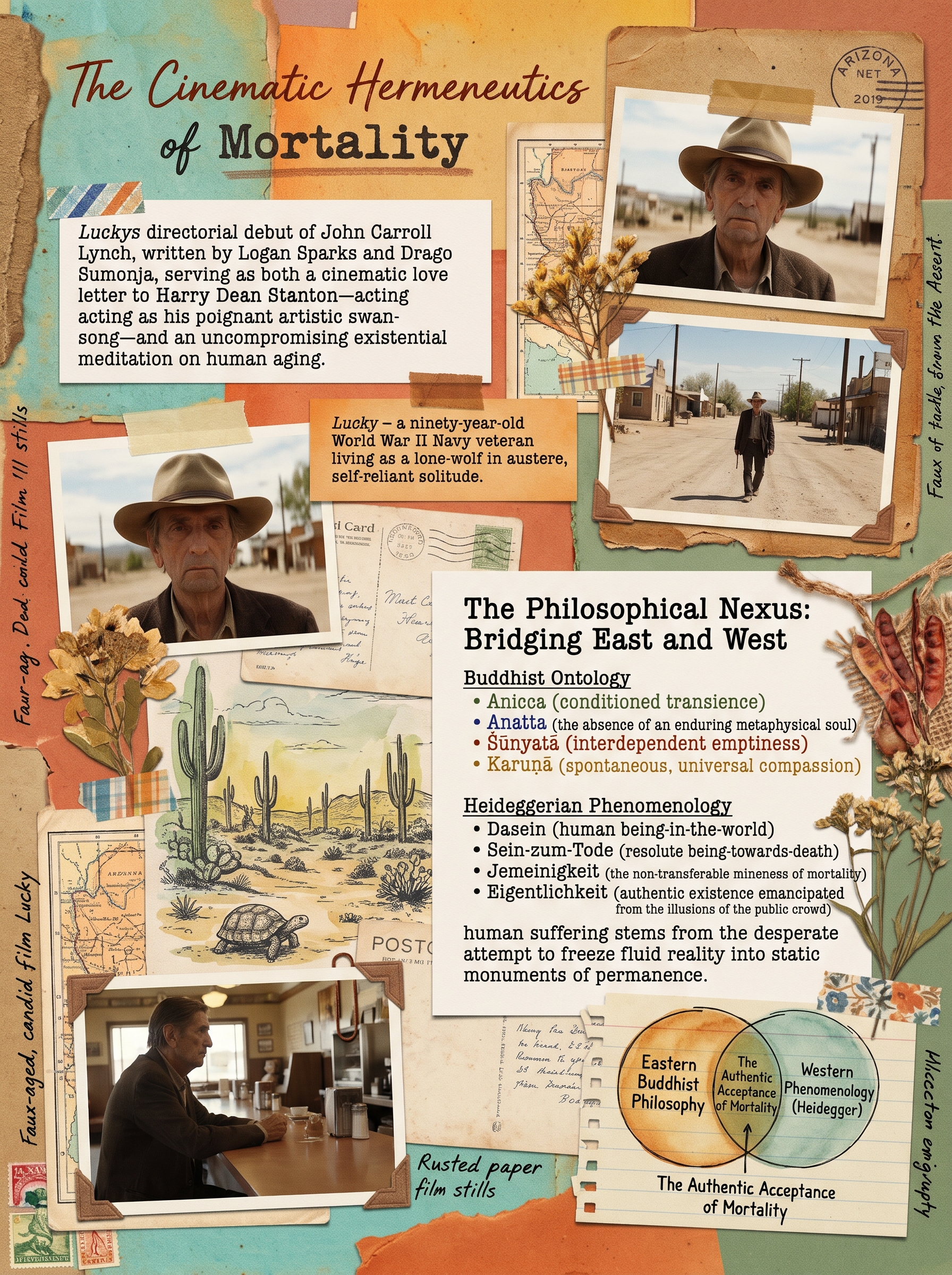
John Carroll Lynch's directorial debut Lucky (2017), written by Logan Sparks and Drago Sumonja, serves as both a cinematic love letter to Harry Dean Stanton—acting as his poignant artistic swan-song—and an uncompromising existential meditation on human aging. Set against the sun-scorched, dusty expanse of a small Arizona desert town, the narrative centers on Lucky, a ninety-year-old World War II Navy veteran living as a-lone-wolf in austere, self-reliant solitude.
While superficially framed around an old man's quiet eccentricities, the film functions as a rigorous philosophical exploration. It synthesizes core tenets of Buddhist philosophy—specifically impermanence, non-self, and luminous emptiness—with Martin Heidegger's phenomenological critique of human finitude. Rather than offering sentimental religious consolation or collapsing into cynical nihilism, Lucky constructs a secular theology of mortality: death is not an enemy to be conquered or denied, but the constitutive horizon that renders life authentic, urgent, and precious.
The Philosophical Nexus: Bridging East and West
The film orchestrates a continuous dialogue between two profound intellectual traditions:
- Buddhist Ontology: Articulated through the foundational principles of Anicca (conditioned transience), Anatta (the absence of an enduring metaphysical soul), Śūnyatā (interdependent emptiness), and Karuṇā (spontaneous, universal compassion).
- Heideggerian Phenomenology: Explored through the fundamental concepts of Dasein (human being-in-the-world), Sein-zum-Tode (resolute being-towards-death), Jemeinigkeit (the non-transferable mineness of mortality), and Eigentlichkeit (authentic existence emancipated from the illusions of the public crowd).
Rather than treating these frameworks as mutually exclusive doctrines, Lucky demonstrates their shared insight: human suffering stems from the desperate attempt to freeze fluid reality into static monuments of permanence.
Impermanence (Anicca) and the Dissolution of Daily Routine
Dasein and Everyday Inauthenticity
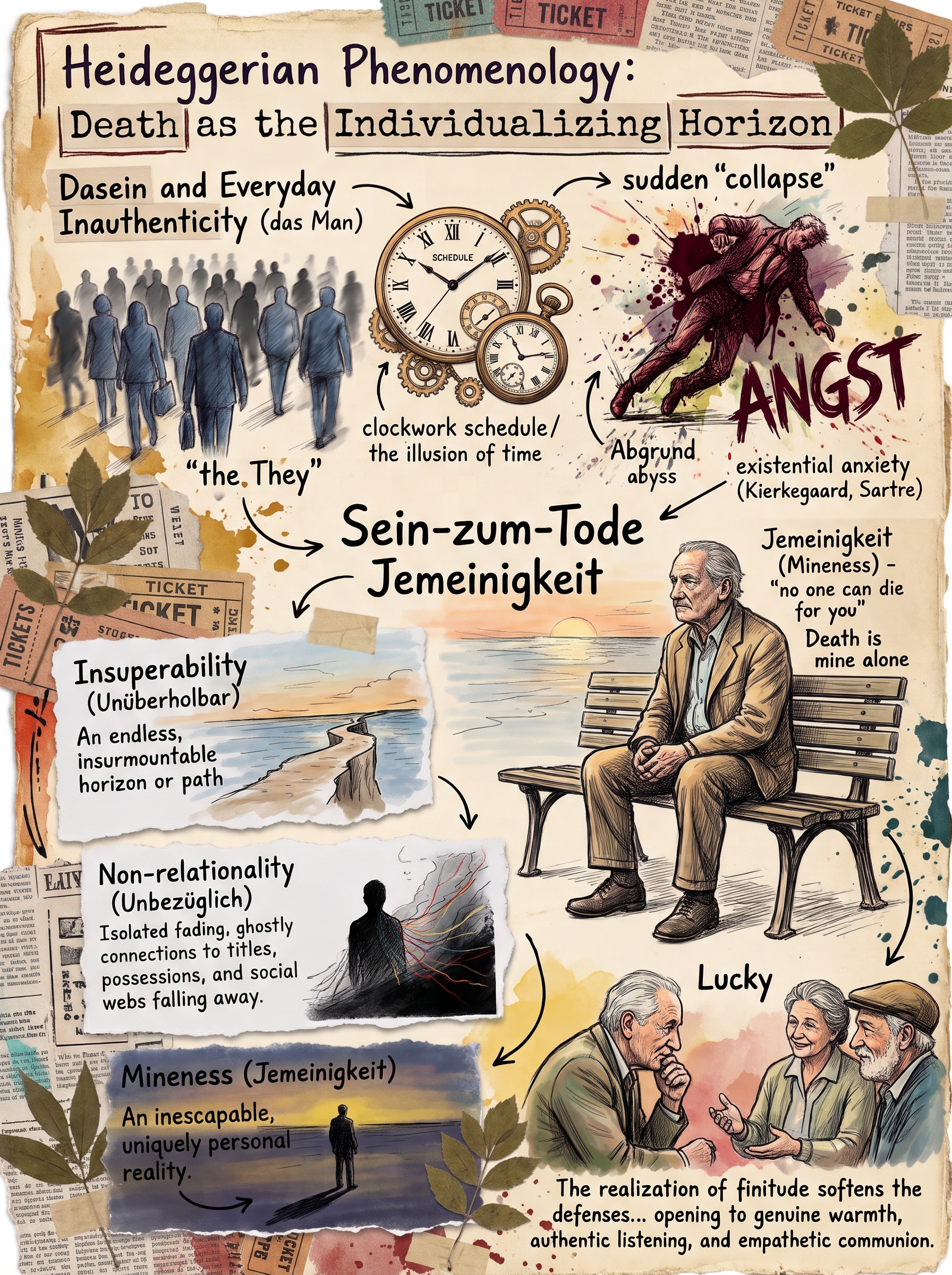
In Being and Time (1927), Martin Heidegger conducts an existential analytic of human existence, designated as Dasein ("being-there"). Heidegger observes that in the average routines of everyday life (Alltäglichkeit), human beings typically surrender their autonomy to the collective public mindset—what he terms "the They" (das Man).
Within this social consensus, death is treated as the-elephant-in-the-room: an awkward, distant reality that happens vaguely to other people at some undefined future date. By domesticating mortality into an abstract statistical fact, the individual evades the terrifying realization of personal finitude.
Prior to his fall, Lucky inhabited his own disciplined version of this everydayness. His clockwork schedule functioned as a psychological shield keeping death at an intellectual distance. The sudden collapse ruptures this insulation, unleashing authentic Heideggerian Angst (existential anxiety)—an ontological tremor analyzed also by Søren Kierkegaard and Jean-Paul Sartre. Unlike ordinary fear, which targets a specific environmental danger, Angst discloses the utter groundlessness (Abgrund) and radical contingency of existence.
Sein-zum-Tode and Jemeinigkeit
Heidegger establishes that death possesses three distinct phenomenological properties:
- Insuperability (Unüberholbar): Mortality is an unconditional horizon that consciousness cannot outrun or negotiate away.
- Non-relationality (Unbezüglich): When confronting death, all external social titles, family allegiances, and material possessions fall silent; the individual must face the abyss entirely alone.
- Mineness (Jemeinigkeit): No one can undergo another person's death on their behalf. Mortality belongs uniquely and inalienably to the singular subject.
Confronting death compels Lucky to face-the-music: he cannot delegate his dying to anyone else, nor can he indefinitely defer the reckoning. Recognizing that his remaining time is finite strips away his reflexive bitterness. Instead of isolating him, the realization of Jemeinigkeit softens his defenses, opening him to genuine warmth, authentic listening, and empathetic communion with his fellow townspeople.
The Philosophical Synthesis: Where Zen Meets Heidegger
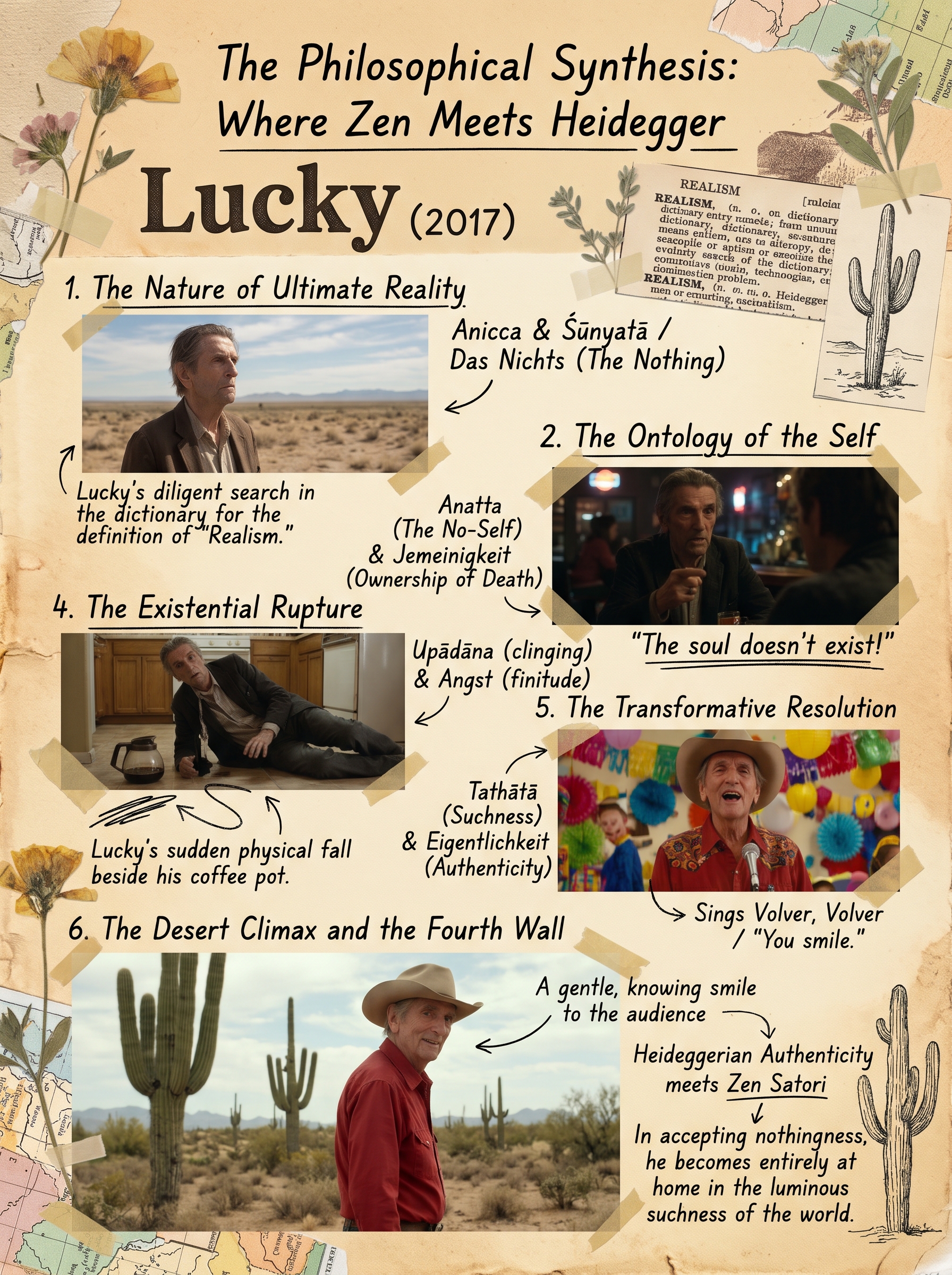
The narrative architecture of Lucky culminates in a profound convergence of Eastern Buddhist ontology
- The Nature of Ultimate Reality: Where Mahāyāna Buddhism identifies Anicca (universal transience) and Śūnyatā (empty interdependence), Heideggerian thought identifies human finitude and Das Nichts (the Nothing). In the film, this appears as the silent expanse of the desert and Lucky's diligent search in the dictionary for the definition of "Realism."
- The Ontology of the Self: Buddhism articulates Anatta (the self as an illusory aggregate of changing skandhas), while Heidegger articulates Jemeinigkeit (the singular self individualized through the ownership of death). In the film, this crystallizes in Lucky's bar confrontation: "The soul doesn't exist!"
- The Existential Rupture: Buddhism diagnoses Upādāna (possessive clinging producing existential anguish, dukkha), while phenomenology diagnoses Angst (the shattering of everyday complacency disclosing finitude). In the film, this rupture is dramatized by Lucky's sudden, unprovoked physical fall beside his coffee pot.
- The Transformative Resolution: Buddhism culminates in Tathātā (joyful acceptance of suchness) and Karuṇā (universal compassion), while existentialism culminates in Eigentlichkeit (authentic, resolute living). In the film, this finds expression when Lucky sings Volver, Volver at a child's birthday fiesta and offers his luminous answer: "You smile."
The Desert Climax and the Fourth Wall
In the closing sequence, Lucky walks back into the vast, open desert. He pauses beside towering saguaro cacti—silent botanical monuments that have endured harsh desert winds and scorching sun for centuries.
Lucky stops, turns toward the camera, and gazes directly into the lens. He offers a gentle, knowing smile to the audience before turning around and walking toward the distant horizon.
This final cinematic gesture unifies Heideggerian authenticity with Zen satori:
- Heideggerian Authenticity: Lucky no longer runs from his finitude. He assumes complete ownership of his mortal existence, walking resolutely toward the horizon without false consolations.
- Zen Liberation: His direct smile signals the enlightenment of non-attachment. Because there was never an isolated ego to protect from annihilation, death cannot conquer him. In accepting nothingness, he becomes entirely at home in the luminous suchness of the world.
🎴 Interactive Web Practice (Comprehension Check)
Question 1 (Impermanence, Routine & Ontological Rupture): How does Lucky's daily routine function as a psychological defense mechanism against Anicca (impermanence), and how does his unexpected physical collapse trigger a Heideggerian ontological crisis?
Answer: In Buddhist ontology, anicca denotes that all conditioned phenomena are transient, unstable, and in perpetual flux. To insulate himself from this reality, Lucky constructs a rigid, repetitive daily circuit (morning yoga stretches, cigarette smoking, diner crosswords, game shows, and evening bloody marys at Elaine's bar). These habitual rituals produce a comforting illusion of permanence (nicca), functioning within Heidegger's phenomenology as the inauthentic absorption of everyday life (Alltäglichkeit) and within Alfred Schütz's sociology as the unreflective "natural attitude." When Lucky collapses unexpectedly without organic medical pathology, this routine suddenly shatters. The collapse serves as an ontological shock that exposes the physical body as composite and decaying. This rupture strips away everyday distraction and thrusts Lucky into Heideggerian Angst—an existential dread that discloses human groundlessness and forces him to confront his impending mortality.
Question 2 (Non-Self, Nihilism & The Transmutation of Śūnyatā): Why does Lucky vehemently reject the existence of the "soul," and how does his climactic bar monologue transform what appears to be bleak nihilism into the liberating Buddhist realization of Śūnyatā (emptiness)?
Answer: Lucky's vehement declaration that "the soul doesn't exist" mirrors the foundational Buddhist doctrine of Anatta (Non-Self)—the teaching that human beings possess no permanent, immutable, or indivisible spiritual core, but are instead dynamic, impermanent configurations of physical and mental aggregates (skandhas). For Lucky, claiming an immortal soul is an evasive metaphysical fiction that denies mortal reality. In his climactic speech at Elaine's bar, he declares that everything—patrons, the bar, the self—is destined to vanish into nothingness. While this sounds superficially like bleak nihilism, the film transfigures it into the Madhyamaka Buddhist concept of Śūnyatā (emptiness) formulated by Nāgārjuna. Emptiness does not mean absolute non-existence, but the absence of isolated, independent existence (svabhāva). Because nothing exists independently, all entities are bound in mutual, interdependent arising. When Elaine asks what one does in the face of this void, Lucky smiles. This smile affirms Tathātā (suchness)—a joyful, unburdened acceptance of reality that dissolves fear once the illusion of an ego is surrendered.
Question 3 (Phenomenology of Mortality & Heideggerian Authenticity): How does Lucky's personal transformation embody Martin Heidegger's concept of Sein-zum-Tode (Being-towards-Death), specifically through the phenomenological criterion of Jemeinigkeit (Mineness)?
Answer: In Martin Heidegger's Being and Time, ordinary everyday existence is dominated by "the They" (das Man), where mortality is sanitized into an abstract, impersonal event that happens vaguely to others. Heidegger argues that authenticity (Eigentlichkeit) is achieved only when Dasein confronts death as its ownmost, insuperable, and non-relational possibility—an orientation termed Sein-zum-Tode (Being-towards-Death). The central criterion of this awakening is Jemeinigkeit (mineness): the realization that no one else can die in my place, making death strictly non-transferable. When Lucky collapses, he realizes that neither his rigid habits nor his eccentric defenses can exempt him from this non-relational horizon. Instead of producing paralyzing despair, owning his finitude dismantles his emotional armor. He stops hiding behind abrasive cynicism, performs Volver, Volver with heartfelt vulnerability at a child's birthday fiesta, and connects authentically with his community, embodying Heideggerian resolve united with Buddhist compassion.
Question 4 (Lexical Priming & Applied Idioms): In what ways do the idiomatic expressions "built on sand," "the elephant in the room," "face the music," and "vanish into thin air" characterize Lucky's psychological arc and his philosophical synthesis of Buddhist ontology and Heideggerian phenomenology?
Answer: These idiomatic expressions capture the dynamic movement of Lucky's psychological and philosophical awakening. Initially, Lucky's rigid habits represent an existence built on sand—an imposing yet fundamentally fragile structure designed to insulate his consciousness from the shifting ground of universal impermanence (anicca). Throughout polite society and his own casual routines, mortality is treated as the elephant in the room: an omnipresent, undeniable reality that everyone recognizes but actively evades discussing. Following his sudden physical collapse, Lucky is compelled to face the music—directly confronting the non-transferable mineness (Jemeinigkeit) of his own biological decline. Finally, in his climactic bar monologue, Lucky articulates the universal destiny of all conditioned phenomena: recognizing that while worldly identities eventually vanish into thin air, their transience is not cause for nihilistic panic, but the very condition for luminous emptiness (Śūnyatā) and liberated equanimity.
Resonant Notes
The following notes in the vault share direct thematic, ontological, and existential connections with Lucky and its philosophical synthesis of Buddhist ontology and existential phenomenology:
🔴 Buddhist Ontology, Emptiness & Non-Self
- Nāgārjuna — Formulated the foundational Madhyamaka philosophy of Śūnyatā (emptiness), demonstrating that emptiness is not nihilistic nothingness, but the absence of independent, separate self-existence (svabhāva). This directly underpins Lucky's realization that vanishing into the void is a reason not for despair, but for smiling equanimity.
- Stephen Batchelor — Batchelor's framework of secular Buddhism—articulated in Buddhism Without Beliefs—mirrors Lucky's refusal of supernatural dogmas, reincarnation, or an eternal soul, championing instead an agnostic, grounded embrace of mortal finitude and immediate presence.
- The Dhammapada — The classic Theravāda verses on impermanence (anicca), the non-substantiality of the self (anatta), and vigilance toward death parallel Lucky's awakening from the passive slumber of mechanical routine into authentic, mindful awareness.
- Tibetan Wheel of Life — The traditional depiction of the Lord of Death (Yama) holding the entire cycle of saṃsāra visually encapsulates the film's core thesis: all worldly routines, attachments, and organic forms exist within the enclosing horizon of impermanence and mortality.
- Constructs of the Mind-Unmasking Consciousness in East and West — Deconstructs the Western Cartesian ego into fluid, impermanent psychological aggregates, echoing Lucky's passionate repudiation of the soul during his argument with Paulie at Elaine's bar.
- Epistemology of Preference-Avijjā, Māna, and the Emptiness of Aesthetic Taste in Buddhist Philosophy — Analyzes how ego-attachment (māna) and ignorance (avijjā) construct personal defenses against groundlessness, matching Lucky's initial reliance on rigid rituals before his collapse.
🟡 Heideggerian Phenomenology & Existential Finitude
- Martin Heidegger — Lucky's physical collapse and subsequent existential awakening directly track the analytic of Dasein in Being and Time. The fall shatters the complacency of everyday inauthenticity (das Man), plunging Lucky into Angst and forcing him into an authentic orientation of Sein-zum-Tode (Being-towards-Death).
- Søren Kierkegaard — Kierkegaard's exploration of existential anxiety (Angst) as the dizziness of freedom when confronting the abyss parallels Lucky's initial ontological disorientation after his bodily collapse, before his dread matures into resolute acceptance.
- Jean-Paul Sartre — Lucky's refusal to seek refuge in comforting theological illusions or bad faith (mauvaise foi) reflects Sartre's existential principle that human consciousness must bravely confront its own nothingness (le néant) and live without metaphysical guarantees.
- Schopenhauerian Pessimism — Arthur Schopenhauer's synthesis of Eastern metaphysics and Western philosophy—specifically the recognition of existence as suffering (dukkha) driven by craving—parallels Howard's grief over his escaped tortoise, President Roosevelt, as an allegory of attachment and loss.
- Time as Change — Explores the metaphysical reality of temporal flux, affirming that time is not an abstract linear container but the irreversible, physical transformation of matter and organic bodies, experienced somatically by Lucky in his ninetieth year.
🟢 The Absurd, Everyday Routine & The Life-World
- Albert Camus — Lucky serves as an elderly, desert-dwelling incarnation of Camus's Absurd Hero. In responding to the ultimate vanishing of all things with a serene smile, Lucky enacts the conclusion of The Myth of Sisyphus—revolting against nihilism not through despair or religious hope, but through joyful, lucid defiance of the void.
- Alfred Schütz (1899–1959) — Schütz's phenomenological sociology of the everyday life-world (Lebenswelt) illuminates how Lucky's rigid daily routines (diner crosswords, television game shows, bar chatter) function as typified habits shielding consciousness from the fundamental anxiety of mortality.
- Henri Bergson — Bergson's distinction between homogeneous, spatialized clock time and authentic lived duration (la durée) mirrors Lucky's temporal evolution—transitioning from the mechanical scheduling of daily tasks to the rich, qualitative stillness of the desert sunset.
🟣 Core Lexical Syllabus & Applied Metaphoric Expressions
- swan-song — Serves as the poignant real-world and cinematic swan song for veteran actor Harry Dean Stanton, whose final leading performance functions as an authentic artistic testament to mortality, non-self (Anatta), and secular equanimity before his death in 2017.
- a-lone-wolf — Characterizes Lucky's austere, self-reliant existence in the high desert of Arizona, living as a lone wolf whose disciplined solitude and refusal of conventional social dependencies mirror the solitary renunciation praised in Theravāda Buddhist texts like The Dhammapada.
- shoot-the-breeze — Captures the evening rituals at Elaine's bar where Lucky gathers with local eccentrics to shoot the breeze, demonstrating how everyday casual banter (Alltäglichkeit) operates in Alfred Schütz's phenomenology as a typified social ritual shielding the mind from existential groundlessness.
- a-facade — Illustrates how Lucky's rigid daily circuit (morning yoga, diner crossword puzzles, game shows) functions as a facade of domestic order designed to conceal somatic decline and defend consciousness against the destabilizing flux of universal impermanence (Anicca).
- built-on-sand — Embodies the central Buddhist insight that any illusion of permanent stability (nicca) or independent ego (res cogitans) is fundamentally built on sand, destined to crumble the moment biological aging or an unexpected physical collapse shatters the unreflective natural attitude.
- take-for-granted — Demonstrates how ordinary consciousness tends to take physical health for granted until an unexpected somatic fall acts as an ontological shock, forcing the individual out of passive habituation into Heideggerian Angst and authentic existential evaluation.
- crossroads — Represents the critical existential crossroads Lucky reaches following his sudden kitchen collapse, where he must choose between clinging to panicked denial or leaning into the Heideggerian resolve of Sein-zum-Tode (Being-towards-Death) and Buddhist detachment.
- vanish-into-thin-air — Reframes the inevitable dissolution of worldly phenomena: Lucky realizes that while human lives, friendships, and physical spaces eventually vanish into thin air, this void is not cause for nihilistic despair, but the luminous realization of interdependent emptiness (Śūnyatā).
- the-elephant-in-the-room — Diagnoses the collective denial of mortality in polite society ("the They" / das Man), where terminal aging and death remain the elephant in the room—an undeniable universal reality that everyday public discourse actively sanitizes and avoids confronting.
- face-the-music — Symbolizes the Heideggerian demand of Jemeinigkeit (mineness): Lucky must face the music regarding his non-transferable mortality, transforming dread into serene presence by performing Volver, Volver and smiling directly into the horizon of the unknown.