Woody Allen
🗂️ Interactive Notebook: Open Study Companion (Video Summary, Flashcards, Mind Map) ↗
Woody Allen's cinematic canon serves as an incisive tragicomic diagnosis of the modern intellectual's existential predicament. Through neurotic, hyper-articulate urban protagonists, Allen maps the psychology of the "Square"—a thinker acutely aware of cosmic meaninglessness, mortality, and moral ambiguity who retreats into bourgeois convention, compulsive psychoanalysis, and aesthetic escapism to evade the terrifying burden of radical freedom.
1. The Terror of Freedom and the Intellectual Abyss
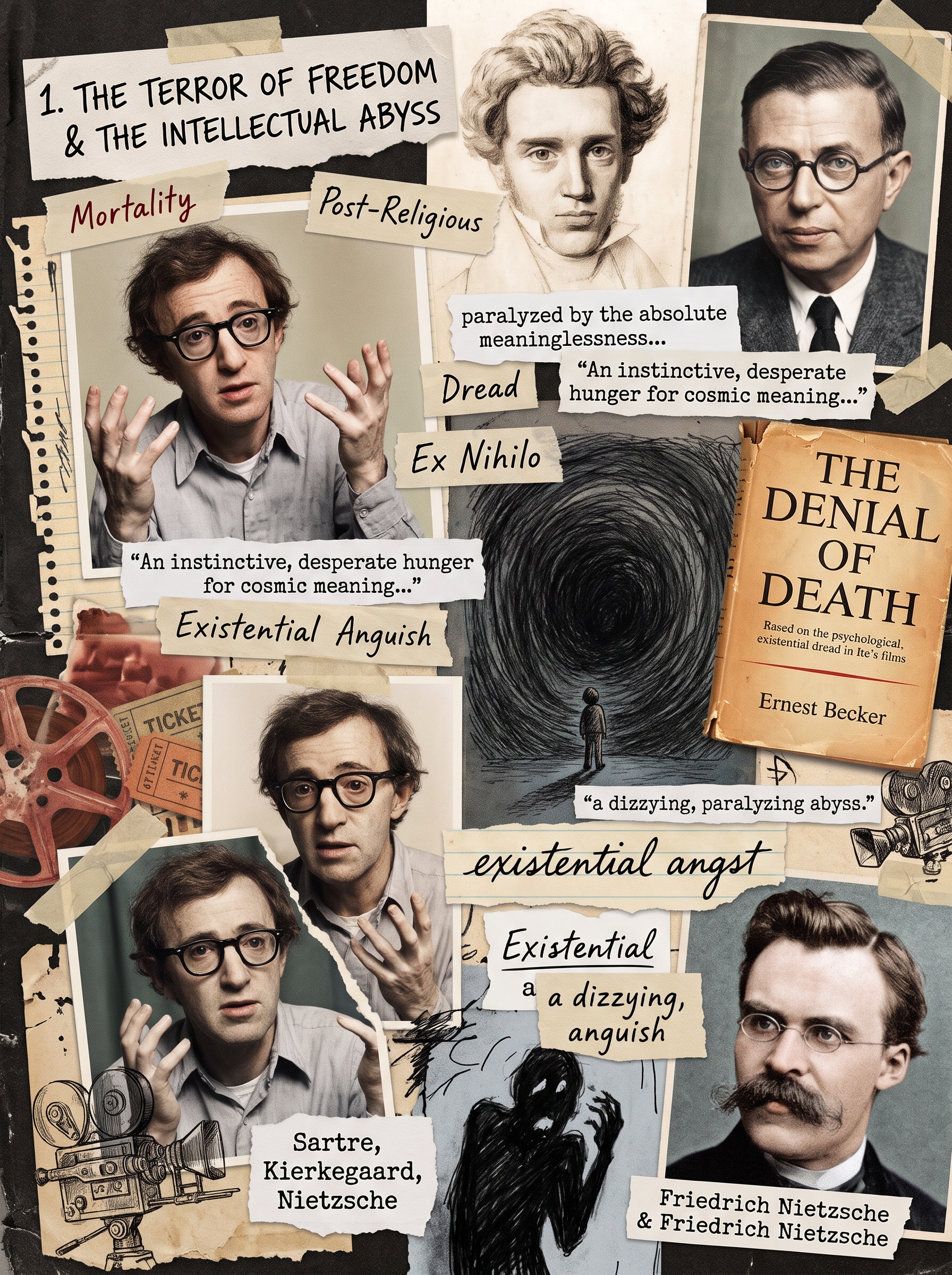
Throughout Woody Allen's filmography, the modern urban intellectual is paralyzed by an acute awareness of mortality and the absolute meaninglessness of a post-religious, post-metaphysical universe.[1] His central characters—professors, television writers, comedy performers, and physicians—are steeped in European existentialism, citing Kierkegaard, Sartre, Nietzsche, and Ernest Becker (The Denial of Death). Yet far from conferring liberation or spiritual autonomy, this high-level intellectual sophistication acts as a source of unrelenting dread.[2]
The Allen protagonist is caught in a fundamental existential contradiction: an instinctive, desperate hunger for cosmic meaning and moral order pitted against the crushing certainty of an indifferent universe. Having recognized that neither transcendent providence nor absolute moral imperatives exist, the intellectual is left wholly responsible for inventing their own purpose ex nihilo. Rather than welcoming this radical freedom as an invitation to authentic self-actualization, Allen's characters experience it as a dizzying, paralyzing abyss—a state of perpetual existential anguish (angst) that stalls action and poisons romantic fulfillment.
2. The "Square" Condition: Bourgeois Convention as Fortress
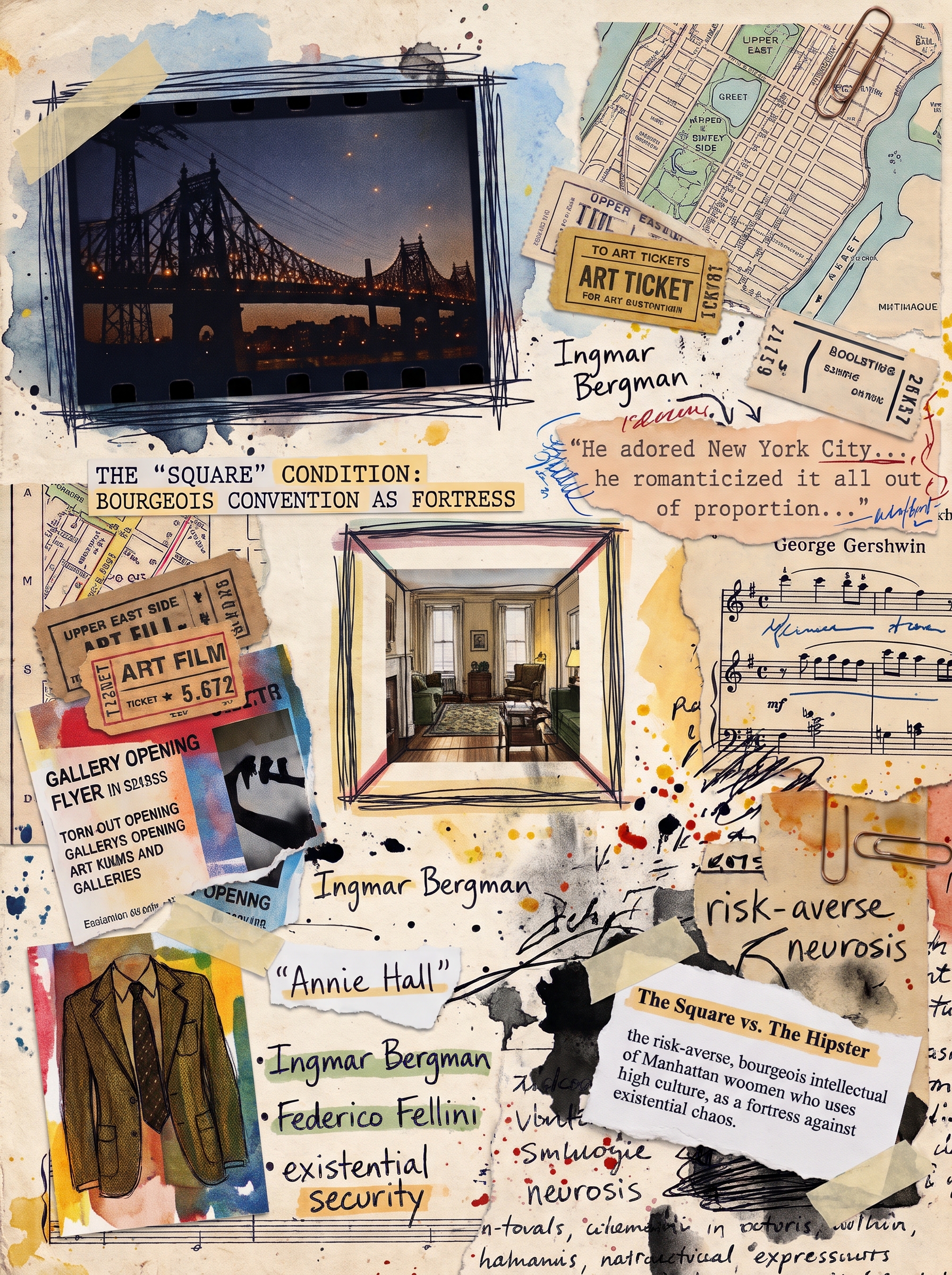
To survive this cosmic vertigo, Allen's protagonists systematically adopt the archetype of the intellectual "Square"—the risk-averse conformist directly opposed to the rebellious outsider articulated in Norman Mailer's American existentialism. Mailer's "Hipster" seeks authenticity by leaping into the perilous, violent, and instinctual unknown; Allen's "Square" chooses the protective enclosure of suburban or Upper East Side bourgeois domesticity, cultural prestige, and institutional ritual.
"He adored New York City. He idolized it all out of proportion. Uh, no, make that: he romanticized it all out of proportion. To him, no matter what the season was, this was still a town that existed in black and white and pulsed to the great tunes of George Gershwin." — Manhattan (1979)
In masterworks like Annie Hall and Manhattan, characters employ high culture not as an instrument of subversion, but as an elaborate shield against the void.[3] They attend gallery openings, argue the nuances of Ingmar Bergman and Federico Fellini, obsess over academic reputations, and debate political theory in fashionable delis. This cultural snobbery constructs an insular, predictable universe that keeps cosmic chaos at bay. The Square trades existential authenticity for bourgeois security, actively choosing a state of quiet, civilized neurosis over the terrifying danger of true psychic liberation.
3. Neurosis, Hypochondria, and Psychoanalysis as Defense Mechanisms
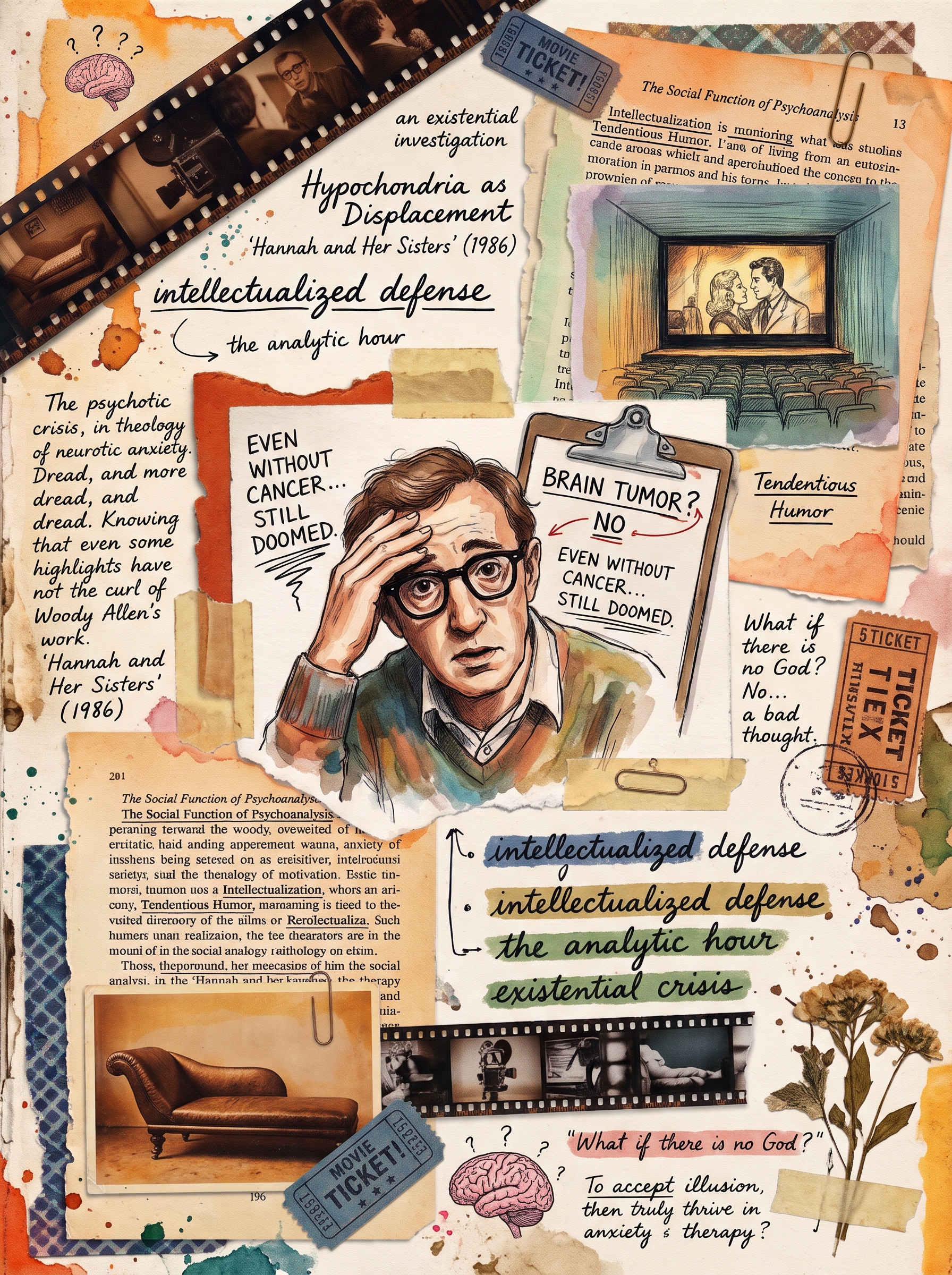
The comic signature of Allen's work is generated directly from this friction between philosophical awareness and moral cowardice. The neurotic, hyper-verbal persona is not an accidental quirk, but a sophisticated psychological defense matrix designed to protect the fragile ego from confronting annihilation.
In Allen's cinematic landscape, decades of psychoanalysis never achieve clinical resolution or cure. Instead, the analytic hour functions as a high-status bourgeois sacrament—a ritualized theater where existential dread is comfortably domesticated into harmless self-absorption.
By keeping consciousness hyper-focused on petty grievances, romantic anxieties, and imagined physical ailments, the protagonist successfully evades cosmic dread:
- Hypochondria as Displacement: In Hannah and Her Sisters (1986), Mickey Sachs panics over an imaginary brain tumor. While undergoing medical tests, he is consumed by terror; upon receiving a clean bill of health, he is suddenly confronted by the far worse realization that even without cancer, he is still doomed to die in an indifferent universe. The physical symptom operates as a manageable substitute for unmanageable metaphysical dread.
- Intellectualization: Emotional vulnerability and moral guilt are converted into rapid-fire verbal debate, deflecting authentic feeling through intellectual citations and irony.
- Tendentious Humor: As explored in Freud's Jokes and Their Relation to the Unconscious, jokes serve as psychic release valves. For Allen, self-deprecating comedy discharges unbearable existential anxiety without demanding actual lifestyle change.
4. Flagship Case Study: The Existential Paradox of Annie Hall's Opening Monologue
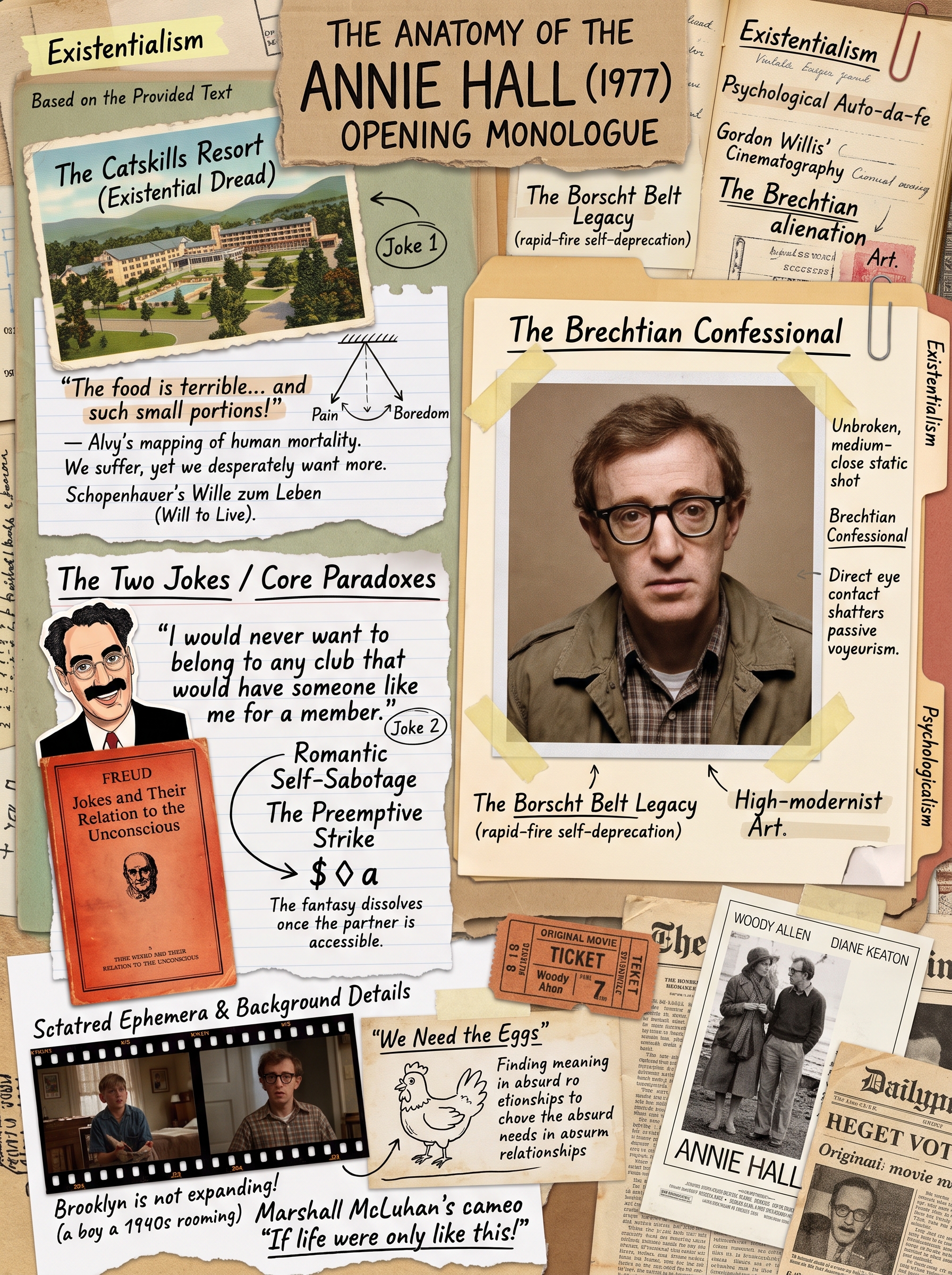
The opening monologue of Annie Hall (1977) represents Woody Allen's definitive cinematic and philosophical overture. By staging an unmediated fourth-wall address that synthesizes Borscht Belt stand-up comedy with European existentialism and psychoanalytic theory, the sequence introduces the neurotic persona of Alvy Singer and interrogates two core paradoxes of modern consciousness: the Schopenhauerian absurdity of clinging to an agonizing existence and the narcissistic self-sabotage that dooms contemporary romantic intimacy.
Cinematic Staging and Formal Mechanics: The Brechtian Confessional
The prologue of Annie Hall deviates sharply from classical Hollywood romantic comedy conventions. Photographed by cinematographer Gordon Willis, the sequence consists of an unbroken, medium-close static shot lasting nearly two minutes.
| Formal Dimension | Cinematic Staging | Psychological & Theoretical Function |
|---|---|---|
| Spatial Backdrop | Neutral, sterile beige-brown wall devoid of architectural markers | Detaches Alvy from geographic space, isolating pure subjective consciousness |
| Actor Demeanor | Crumpled earth-tone sweater, thick glasses, nervous gesticulations, conversational hedges | Disguises a rigorously structured philosophical thesis as spontaneous neurotic fretting |
| Camera Relation | Direct, unbroken eye contact with the camera lens | Shatters passive voyeurism through Brechtian alienation (Verfremdungseffekt) |
| Spectator Positioning | Unmediated address directly to the theater audience | Transposes the viewer into the dual role of psychoanalyst, confidant, and commiserator |
Rather than orienting the viewer through establishing shots, character interactions, or romantic musical cues, the film begins in an austere non-place. By breaking the fourth wall, Alvy forces the spectator out of passive escapism into active intellectual collaboration, establishing the entire film as a retrospective memory play and psychoanalytic autopsy unfolding within his mind.
The Monologue: Text and Structural Anatomy
The monologue hinges on two complementary parables that diagnose the human condition at cosmic and interpersonal levels:
Joke 1: The Catskills Resort (Existential Dread and the Absurd)
"There's an old joke: Uh, two elderly women are at a Catskill Mountain resort, and one of 'em says, 'Boy, the food at this place is really terrible.' The other one says, 'Yeah, I know; and such small portions.' Well, that's essentially how I feel about life—full of misery, loneliness, misery, and suffering—and it's all over much too quickly."
Joke 2: The Groucho Marx Paradox (Romantic Self-Loathing and the Split Ego)
"The other joke is the one that's usually attributed to Groucho Marx, but I think it appears originally in Freud's Jokes and Their Relation to the Unconscious. Inside, it relates to the Groucho Marx joke, which is: 'I would never want to belong to any club that would have someone like me for a member.' That's the key joke of my adult life in terms of my relationships with women."
Philosophical Breakdown: The Catskills Paradox & Schopenhauerian Pessimism
The humor of the Catskills joke stems from a fundamental logical contradiction: if an experience is characterized by unmitigated wretchedness ("terrible food"), its abbreviation ("such small portions") represents a positive relief, not an injustice. By mapping this culinary complaint onto human mortality, Singer crystallizes the core dilemma of existential philosophy:
- The Clashing Imperatives of Suffering and Survival: Human life is objectively saturated with physical deterioration, emotional disappointment, and psychological isolation. Rational calculus would dictate welcoming its conclusion. However, conscious beings are governed by an irrational biological impulse to endure. This contradiction exposes human reason as subservient to primal instincts that mock intellectual sovereignty.
- The Schopenhauerian Parallel: This dynamic corresponds directly to Schopenhauerian Pessimism. In The World as Will and Representation (1818), Arthur Schopenhauer posits that individual existence is an illusion generated by the blind, striving metaphysical force known as the Will to Live (Wille zum Leben). The Will compels individuals to survive at all costs regardless of misery, keeping life oscillating like a pendulum between the pain of unmet longing and the boredom of attainment.[4] Alvy's intellect perceives the wretchedness of the "food," but his biological "Will" desperately demands larger portions.
- Camus and the Absurd: The Catskills joke further illustrates Albert Camus's concept of the Absurd—the irreconcilable friction between the human desire for inherent meaning and the unreasonable silence of an indifferent universe.[5] Alvy does not respond with heroic Camusian revolt; instead, he adopts the posture of the comedic victim, weaponizing laughter to survive the void.
Psychoanalytic Framework: Freud, Lacan, and Romantic Self-Sabotage
The second half of the monologue shifts the inquiry from cosmic existentialism to relational psychoanalysis. By tracing Groucho Marx's quip to Sigmund Freud's 1905 treatise Jokes and Their Relation to the Unconscious, Alvy frames his romantic failures not as accidental misfortune, but as structural psychic neurosis:
- The Tendentious Joke as Ego Defense: In Jokes and Their Relation to the Unconscious, Freud argues that wit functions as an economy of psychic expenditure.[6] Tendentious jokes bypass internal censorship, allowing the speaker to discharge repressed aggression and self-contempt without conscious guilt. Alvy uses the Groucho Marx joke as intellectual armor: by publicly professing his unworthiness, he shields his fragile ego from the genuine vulnerability required by intimate communion.
- The Dynamics of Relational Devaluation: The paradox deconstructs the psychological mechanism that guarantees the collapse of Alvy's romances:
- Projection of Value: Alvy desires a partner who embodies grace, emotional equilibrium, and cultural sophistication—qualities he feels he lacks.
- Contamination of Reciprocity: If the desired partner reciprocates his affection and accepts him into her "club," her value instantly evaporates. Her acceptance serves as conclusive proof of her flawed judgment.
- The Preemptive Strike: To avoid confronting internal inadequacy, Alvy finds pretexts to critique, patronize, or alienate the partner, sabotaging the bond before she can discover his flaws and abandon him.
- Lacanian Lack and the Impossibility of Desire: This structural impasse aligns with Jacques Lacan's formula for desire ($ ◊ a$). Lacan demonstrates that human desire is not directed toward a concrete empirical object, but is structured around a fundamental, irreparable lack (manque-à-être):
- The object of desire (objet petit a) maintains its seductive allure only so long as it remains out of reach.[7]
- The moment the partner yields and becomes accessible, the fantasy of completion dissolves.
- Alvy Singer is trapped in this Lacanian deadlock: he cannot love what he possesses, and he cannot respect what accepts him.
Cultural Pedigree: The Borscht Belt Legacy
The opening monologue achieves its distinctive power by transposing traditional Jewish-American folk humor into high-modernist cinematic art:
- The Borscht Belt Heritage: The Borscht Belt refers to the Jewish summer resort colonies throughout the Catskill Mountains of upstate New York, which flourished from the 1920s through the late 1960s.[8] These resorts served as an incubator for American comedy, producing entertainers such as Henny Youngman, Sid Caesar, Milton Berle, and Mel Brooks. Traditional routines relied on rapid-fire self-deprecation, domestic combat (kvetching), and complaints about physical decline, bad food, and money.
- The Modernist Synthesis: In Annie Hall, this regional vernacular is elevated into an epistemological inquiry, fusing Catskills comic timing with European art cinema (Godard, Bergman) and existential philosophy.
| Analytical Dimension | Traditional Borscht Belt Stand-Up | Alvy Singer in Annie Hall | European Art Cinema (Bergman / Godard) |
|---|---|---|---|
| Primary Medium | Live resort showroom stage; vaudeville sketch | Reflexive, fourth-wall breaking cinematic address | Dialectical cinema; alienating, detached performance |
| Thematic Focus | In-laws, bad food, stinginess, domestic squabbles | Metaphysical dread, mortality, romantic self-loathing | Spiritual crisis, silence of God, bourgeois ennui |
| Psychological Engine | Communal commiseration; outer survival mechanism | Freudian neurosis, intellectualization, ego defense | Existential despair, alienation, ontological guilt |
| Philosophical Pretext | Pragmatic folk survivalism | Schopenhauerian Pessimism & Freudian analysis | Kierkegaardian dread, Sartrean bad faith |
| Resolution / Catharsis | Punchline delivers instant relief through laughter | Irony defers dread without resolving the crisis | Melancholy, psychological collapse, open ambiguity |
Narrative Architecture: The Monologue as Structural Blueprint
The opening monologue does not stand as an isolated routine; it functions as the architectural blueprint and interpretive key for the narrative that follows:
- The Expanding Universe: In a childhood flashback, young Alvy refuses to do homework because Dr. Flicker told him the universe is expanding and will eventually break apart. Alvy's mother protests, "What has the universe got to do with it? You're in Brooklyn! Brooklyn is not expanding!" The scene dramatizes the Catskills paradox: cosmic despair paralyzing immediate lived reality.
- The McLuhan Fantasy Intervention: When an obnoxious academic in a movie theater line pontificates loudly on television and cinema, Alvy pulls Marshall McLuhan himself from behind a lobby billboard to rebuke the man ("You know nothing of my work!"). Alvy addresses the camera directly: "Boy, if life were only like this!" The moment dramatizes the clash between Alvy's desire for aesthetic control and the uncontrollable messiness of empirical reality.
- The Split-Screen Psychoanalysis: The film divides the frame between Alvy and Annie in their respective therapists' offices. Asked how often they have sex, Alvy laments, "Hardly ever. Maybe three times a week." Annie sighs, "Constantly. I'd say three times a week." Perceptions of reality are shown to be radically discordant, reinforcing the impossibility of harmonious union.
- The Closing Bookend ("We Need the Eggs"): The film concludes with an exact structural mirror of the opening address. After reflecting on his final, platonic encounter with Annie in New York, Alvy delivers a closing voiceover centered on another classic joke:
"I thought of that old joke, you know, the, this guy goes to a psychiatrist and says, 'Doc, uh, my brother's crazy! He thinks he's a chicken.' And, uh, the doctor says, 'Well, why don't you turn him in?' The guy says, 'I would, but I need the eggs.' Well, I guess that's pretty much now how I feel about relationships; you know, they're totally irrational, and crazy, and absurd, and... but, uh, I guess we keep goin' through it because, uh, most of us... need the eggs."
This concluding joke provides the dialectical resolution to the opening monologue. While the Catskills and Groucho Marx jokes emphasize despair and self-destruction, the "chicken" joke accepts human frailty. Relationships are recognized as delusional, irrational, and doomed to friction, but the emotional sustenance they provide—the metaphorical "eggs"—makes the absurdity endurable.
5. The Dostoevskian Crisis: Guilt, Moral Luck, and Cosmic Silence
While Allen's early work approaches existential dread through romantic comedy and parody, his mature dramatic cinema—most notably Crimes and Misdemeanors (1989) and Match Point (2005)—directly transposes Fyodor Dostoevsky's Crime and Punishment into a secular, late-20th-century moral vacuum.[9]
In Crimes and Misdemeanors, prominent ophthalmologist Judah Rosenthal arranges the contract murder of his mistress to safeguard his wealthy marriage, social reputation, and financial security. Allen explicitly interrogates whether a cultured individual can commit murder without facing divine retribution or psychological disintegration:
- The Blind Eyes of God: Judah is haunted by memories of his orthodox religious father, who taught that the eyes of God see all human action. Yet Rosenthal's profession—restoring physical eyesight—contrasts with his metaphysical blindness. The blind Rabbi Ben represents pure, uncorrupted faith, but his physical sightlessness underscores that in the empirical universe, the heavens are silent and unseeing.
- The Evaporation of Guilt: Dostoevsky's Raskolnikov finds redemption through confession, suffering, and spiritual rebirth in Siberia. Rosenthal, by contrast, endures temporary panic and moral anguish, only to discover that with time, guilt simply evaporates. He returns to his champagne galas and social prestige unscathed.
- The Primacy of Moral Luck: In Match Point, Allen removes even the pretense of psychological crisis. The opening image of a tennis ball striking the top of the net—hovering between falling forward or bouncing back—establishes that human survival and moral outcome are dictated by arbitrary chance rather than moral desert. Chris Wilton murders his lover, escapes detection through a bizarre stroke of luck involving a discarded wedding ring, and flourishes in aristocratic society.
6. Illusion, Escapism, and the Consolation of Art
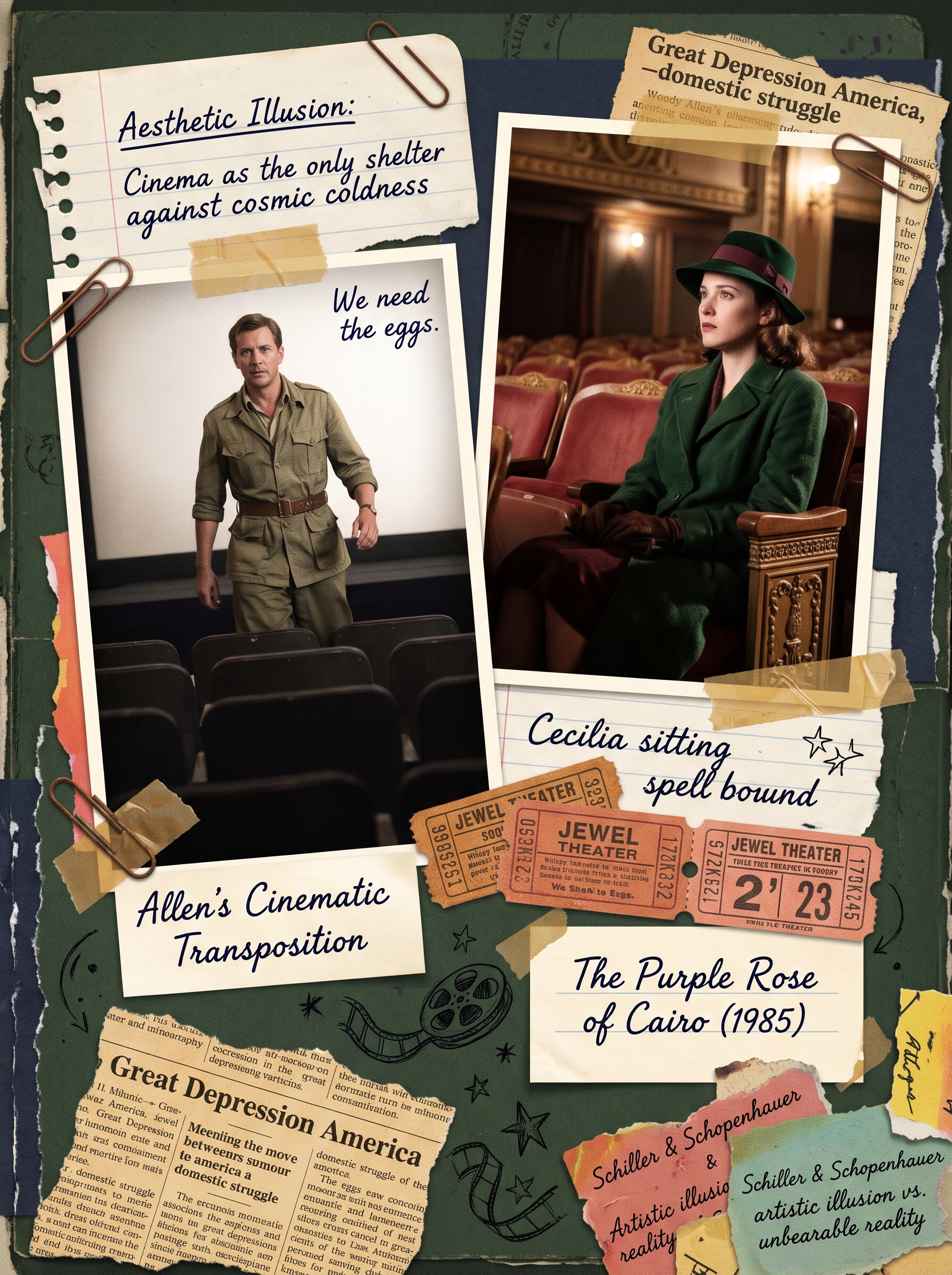
Confronted by the unbearable reality of mortality, physical decline, and moral indifference, Allen's cinema positions artistic illusion not as superficial deceit, but as a vital psychological necessity.
| Thematic Dimension | Classical / Philosophical Precursor | Allen's Cinematic Transposition | Representative Work / Manifestation |
|---|---|---|---|
| Existential Freedom | Sartre (L'être et le néant) & Kierkegaard (The Concept of Anxiety) | Radical freedom experienced not as agency, but as paralyzing dread; retreat into bourgeois convention ("The Square"). | Manhattan (1979); Annie Hall (1977) |
| Transgression & Justice | Dostoevsky (Crime and Punishment) | Murder committed without cosmic consequence; guilt as an impermanent psychological discomfort; reign of moral luck. | Crimes and Misdemeanors (1989); Match Point (2005) |
| Ego Defenses & Death | Freud (The Ego and the Id) & Ernest Becker (The Denial of Death) | Psychoanalysis as ritual performance; hypochondria as manageable proxy for mortal annihilation. | Hannah and Her Sisters (1986); Deconstructing Harry (1997) |
| Aesthetic Illusion | Friedrich Schiller & Schopenhauer (Aesthetic Contemplation) | Cinema and magical fantasy serving as temporary reprieves from harsh empirical suffering; "we need the eggs." | The Purple Rose of Cairo (1985); Midnight in Paris (2011) |
| Identity & Conformity | Mailer (The Hipster vs. Square) & Lacan (The Imaginary Ego) | Extreme chameleonic transformation to evade social ostracization; total liquidation of the authentic self. | Zelig (1983) |
In The Purple Rose of Cairo (1985), Cecilia escapes the domestic violence and poverty of Great Depression America inside the movie theater, culminating in the fictional character Tom Baxter stepping off the screen to romance her. While Baxter discovers the harshness of real life and Cecilia is abandoned when the Hollywood actor chooses ambition over love, Allen affirms that the cinematic daydream, however fragile, is the only shelter humanity possesses against cosmic coldness.
🎴 Interactive Web Practice (Comprehension Check)
Question 1 (Existential Dread & The "Square"): How does Woody Allen's portrayal of the urban intellectual redefine Norman Mailer's archetype of the "Square," and why does hyper-intellectualism fail to produce Sartrean authenticity?
Answer: In Norman Mailer's existential framework, the "Square" is the conformist who submits to bureaucratic routine and suburban security to avoid the dangerous friction of life, contrasted with the "Hipster" who embraces instinct, risk, and marginality. Allen adapts this dynamic to the high-culture urban intelligentsia. His protagonists read Sartre, Kierkegaard, and Becker, understanding conceptually that God is absent and human beings are radically free. However, rather than translating this recognition into authentic self-creation (which Sartre demands), Allen's intellectuals are paralyzed by the burden of absolute responsibility. They use their formidable intellects defensively—retreating into Upper East Side brownstones, dinner party debates, and cultural snobbery. Intellectualization and aesthetic consumption become an impenetrable fortress against the abyss, turning high philosophy into an instrument of Sartrean bad faith (mauvaise foi).
Question 2 (Morality, Guilt & Cosmic Silence): How do Crimes and Misdemeanors and Match Point secularize Dostoevsky's Crime and Punishment, particularly regarding the role of conscience and moral luck?
Answer: Dostoevsky's Crime and Punishment is structured around a metaphysical moral order: Raskolnikov's transgression disintegrates his psyche because human conscience is divinely attuned to moral truth, ensuring that confession, suffering, and spiritual redemption are inescapable. In contrast, Allen's films secularize the narrative into a godless universe characterized by cosmic silence. In Crimes and Misdemeanors, Dr. Judah Rosenthal arranges his mistress's murder and discovers that guilt is merely a biological and social conditioning reflex that gradually fades with time; once past the initial panic, he resumes his affluent lifestyle with zero cosmic retribution. In Match Point, Allen underscores the supremacy of "moral luck": Chris Wilton's evasion of justice hinges entirely on a tennis ball-like bounce of an incriminating ring off a railing. By showing that the wicked prosper while the righteous (such as the blind Rabbi Ben) are marginalized, Allen rejects providential justice in favor of existential absurdity.
Question 3 (Psychoanalysis, Humor & Defense Mechanisms): How do Freudian psychoanalysis, hypochondria, and Borscht Belt comedy operate as ego defense mechanisms rather than therapeutic cures in Allen's work?
Answer: In traditional clinical psychology, psychoanalysis aims to bring repressed unconscious material into conscious awareness to achieve integration and cure. In Allen's cinematic universe, however, decades of analysis serve as a chronic, institutionalized defense mechanism. Engaging in perpetual self-interrogation allows the neurotic protagonist to simulate self-improvement without ever risking behavioral change. Similarly, hypochondria operates as psychological displacement: worrying obsessively about a phantom brain tumor or heart condition provides an acute, manageable problem that temporarily diverts consciousness from the unmanageable metaphysical terror of universal mortality (as diagnosed in Ernest Becker's terror management framework). Finally, drawing on Freud's Jokes and Their Relation to the Unconscious and Catskills vaudeville, tendentious humor acts as a psychic safety valve—diffusing unbearable existential dread through irony and self-deprecation, allowing the ego to acknowledge cosmic futility while preserving daily bourgeois functioning ("needing the eggs").
Question 4 (The Catskills Paradox & Metaphysical Pessimism): How does the Catskills resort joke articulate the central contradiction of Arthur Schopenhauer's metaphysical pessimism, and why is this contradiction fundamentally absurd?
Answer: The Catskills joke contains a sharp logical contradiction: the speaker simultaneously decries the quality of the food ("terrible") and laments the brevity of the portions ("such small portions"). In the philosophical framework of Arthur Schopenhauer's The World as Will and Representation, this mirrors the conflict between human cognitive awareness and the primal "Will to Live" (Wille zum Leben). Reason recognizes that empirical life is dominated by suffering, physical decline, and loneliness; logically, consciousness should welcome the end of this torment. However, humanity is subjugated by an irrational, blind biological drive that demands survival at all costs, mourning the swiftness with which life passes. The contradiction is absurd because it exposes human intellect as completely impotent against blind metaphysical craving.
Question 5 (The Groucho Marx Paradox & Psychoanalytic Self-Sabotage): How does Alvy Singer's invocation of the Groucho Marx / Freudian joke illustrate the psychological mechanics of romantic devaluation and the Lacanian concept of lack?
Answer: Drawing from Sigmund Freud's Jokes and Their Relation to the Unconscious, the Groucho Marx joke—"I would never want to belong to any club that would have someone like me for a member"—acts as an intellectualized ego defense concealing a profound narcissistic wound. When applied to romantic relationships, it triggers automatic devaluation: Alvy projects ideal qualities onto a partner, but the moment she reciprocates his affection and accepts him, her approval serves as definitive proof that her standards are low and her judgment defective. In Jacques Lacan's psychoanalytic model, this illustrates the dynamic of desire ($ ◊ a$), which can only sustain itself through an elusive, unattainable lack. Once the romantic object yields, the fantasy of fulfillment collapses, compelling the neurotic subject to sabotage the relationship to restore the safety of unfulfilled longing.
Question 6 (Formal Innovation & Narrative Symmetry): In what ways does the monologue's Brechtian fourth-wall rupture prefigure the non-linear architecture of Annie Hall, and how does the film's closing "eggs" joke resolve the opening philosophical crisis?
Answer: By shooting the monologue as a single, static take where Alvy directly addresses the camera in front of an empty beige wall, the film breaks classical Hollywood continuity and employs Brechtian alienation (Verfremdungseffekt). This establishes that the entire film is an internal memory play and psychoanalytic post-mortem taking place within Alvy's subjective consciousness, justifying the subsequent use of non-linear flashbacks, subtitles translating inner thoughts, cartoon animation, and the fourth-wall cameo of Marshall McLuhan. The film resolves this architectural trajectory through its final bookend: the joke about the man whose brother thinks he is a chicken. While the opening monologue posits life and relationships as painful, neurotic, and unlivable, the closing parable reconciles Alvy to the Absurd. Even though romance is irrational and grounded in delusion, human beings endure the torment because they "need the eggs"—affirming emotional connection as an indispensable psychological necessity.
Resonant Notes
The following notes in the vault share direct thematic, sociological, and literary connections with Woody Allen:
🔴 Philosophical & Existential Roots
- Jean-Paul Sartre — Allen's neurotic urbanites are definitive character studies in Sartrean bad faith (mauvaise foi); terrified of radical freedom and the responsibility of constructing an authentic essence, they flee into rigid social roles and bourgeois intellectual routines.
- Søren Kierkegaard — Allen's protagonists inhabit Kierkegaard's Aesthetic Sphere, seeking temporary novelty, ironic distance, and romantic distraction to stave off ethical commitment and existential anxiety (angst).
- Schopenhauerian Pessimism — Serves as the metaphysical engine of Allen's worldview; life swings like a relentless pendulum between suffering and boredom, with compulsive artistic output, humor, and romantic delusion providing temporary reprieves from the blind Will.
- Albert Camus — Allen dramatizes the Absurd—the irreconcilable clash between human longing for meaning and the silence of an indifferent universe. Where Camus commands lucid revolt and heroic defiance, Allen's comic antiheroes settle for neurotic retreat and self-mocking compromise.
- Continental Philosophy — Allen translates abstract Continental philosophy (phenomenology, existential dread, the critique of the autonomous subject) into an accessible, tragicomic cinematic idiom of contemporary urban life.
🟡 Literary & Psychological Parallels
- Norman Mailer — Mailer's seminal distinction between the risk-taking Hipster and the conformist Square provides the precise sociological diagnosis of Allen's characters: intellectuals who retreat from authentic existential peril into the comfort of convention.
- Fyodor Dostoevsky (1821-1881) — Allen's major moral works (Crimes and Misdemeanors, Match Point, Irrational Man) directly interrogate Crime and Punishment, testing the viability of human conscience, murder, and moral luck in a universe devoid of divine surveillance.
- Sigmund Freud & Jokes and Their Relation to the Unconscious — Freudian psychoanalysis, Oedipal guilt, transference, and ego defense mechanisms (displacement, intellectualization, reaction formation) form the psychological substructure of Allen's entire filmography.
- Jacques Lacan — Alvy Singer's romantic self-sabotage demonstrates the Lacanian split subject ($) and the tragedy of desire, which thrives exclusively on lack (manque) and disintegrates upon attainment.
- Freud's The Uncanny (Das Unheimliche) — The unsettling sensation when the familiar becomes frighteningly estranged; mirrors the moment the neurotic protagonist realizes his own unconscious mind is the hostile force undermining contentment.
- Defensive communication tactics — Allen's trademark verbal wit, intellectual name-dropping, and rapid-fire kvetching operate as clinical communication defenses designed to evade authentic vulnerability and emotional exposure.
- John Updike's Main Literary Themes — Both Updike and Allen portray the post-war crisis of American male identity, marital dissatisfaction, and death-anxiety, demonstrating how intellectual and spiritual ideals are continually shipwrecked by erotic impulses.
- Viktor Frankl — Frankl's "existential vacuum" and the Tragic Triad (pain, guilt, death) stand as the philosophical foil to Allen: where Frankl argues that meaning must be discovered through heroic attitude in the face of suffering, Allen's protagonists remain paralyzed within cynical rationalization.
- Franz Kafka (1883-1924) — Kafka's claustrophobic alienation, bureaucratic guilt, and surreal anxiety find direct expression in Allen's parodic writings and films like Shadows and Fog and Stardust Memories.
🟢 Cultural, Aesthetic & Narrative Frameworks
- Travis Bickle — Travis Bickle and Allen's neurotic antiheroes represent the two opposite poles of 1970s urban alienation in New York: while Travis weaponizes loneliness into violent vigilantism, the Allen protagonist weaponizes it into compulsive verbal irony and domestic retreat.
- Marshall McLuhan (1911-1980) & McLuhan's The Medium is the Message — McLuhan's literal fourth-wall cameo in the Annie Hall theater queue operationalizes the film's meta-cinematic style, demonstrating how the medium of cinema can intervene in and critique intellectual pretension.
- Don DeLillo Major Themes Analysis — Both DeLillo (in White Noise) and Allen recognize that contemporary consumerism, academic posturing, and media saturation serve as elaborate psychological defense systems against mortal terror.
- Ralph Waldo Emerson — Allen's protagonists dramatize the comic collapse of Emersonian self-reliance, perpetually unable to trust inner intuition and remaining dependent on the very institutional orthodoxies they mock.
- The Dehumanization of Art — Ortega y Gasset's analysis of artistic irony and the separation of high aesthetic contemplation from middle-class sentimentalism parallels Allen's reflexivity, fourth-wall breaks, and meta-cinematic staging.
- Northrop Frye's - Anatomy of Criticism — Allen's protagonists embody the Low Mimetic and Ironic modes within Frye's Winter mythos, chronicling the frustration, bondage, and comic paralysis of individuals trapped in an absurd society.
References
Philip Pecorino / Philosophy As Defined in Woody Allen's Films / scribd.com ↩︎
Woody Allen Films / Woody Allen's Influences: How European Cinema and Literature Shaped His Work / medium.com ↩︎
Peter J. Bailey / The Reluctant Film Art of Woody Allen / University Press of Kentucky, 2001. University Press of Kentucky ↩︎
Arthur Schopenhauer / The World as Will and Representation (Volume 1) / Translated by E. F. J. Payne / Dover Publications, 1969. ↩︎
Albert Camus / The Myth of Sisyphus and Other Essays / Translated by Justin O'Brien / Vintage Books, 1991. ↩︎
Sigmund Freud / Jokes and Their Relation to the Unconscious / Translated by James Strachey / W. W. Norton & Company, 1960. ↩︎
Jacques Lacan / Écrits: A Selection / Translated by Bruce Fink / W. W. Norton & Company, 2006. ↩︎
Phil Brown / Catskill Culture: A Mountain Rat's Memories of the Borscht Belt / Temple University Press, 2002. ↩︎
Miao Miao / The Philosophy of “Crime and Punishment” and “Existentialism” in Woody Allen's Film / atlantis-press.com ↩︎