Habit Energy (Vāsanā) and the Entropic Brain
🗂️ Interactive Notebook: Open Study Companion (Video Summary, Flashcards, Mind Map) ↗
Modern computational neuroscience describes severe mental rigidity—manifesting as obsessive-compulsive disorder, depressive rumination, addiction, and catatonia—as a sub-critical, low-entropy brain state characterized by deep canalization and hyper-weighted top-down predictions.[1] Over fifteen centuries earlier, Buddhist psychology—particularly the Yogācāra school—articulated an astonishingly parallel model through the concept of vāsanā (habit energy): latent karmic imprints stored in the foundational consciousness that "perfume" present perception and compel repetitive mental and behavioral loops.[2] Viewing Buddhist vāsanā through the lens of the Entropic Brain Hypothesis and predictive processing reveals how worn neural attractors trap consciousness in predictable scripts, and how contemplative practices restore neural flexibility by de-weighting rigid priors and flattening the mind's attractor landscape.[3]
1. The Entropic Brain and Sub-Critical Rigidity

In cognitive neuroscience, cortical entropy measures the informational richness, uncertainty, and dynamical repertoire of spontaneous brain activity.[1:1] Under the Entropic Brain Hypothesis proposed by Robin Carhart-Harris, human waking consciousness operates near an evolutionary sweet spot just below a mathematical phase transition known as criticality—the delicate boundary between rigid, crystalline order and chaotic randomness (a balance central to self-organizing systems, cf. Entropy and the Bayesian Brain Hypothesis):[1:2]
- High-Entropy States (Critical / Super-Critical): Characterized by broadened associative capacity, flexible network transitions, dynamic cross-modal communication, and the softening of habitual egoic constraints (observed acutely during classical psychedelic states and deep contemplative absorption).[1:3][3:1]
- Low-Entropy States (Sub-Critical): Characterized by hyper-constrained neural dynamics, narrowed functional repertoires, hyper-stable network configurations, and relentless recursive looping inside predictable scripts.[1:4][4]
Sub-Criticality and Over-Constrained Dynamics
While moderate entropy suppression allows the adult human brain to maintain executive focus, filter extraneous sensory noise, and sustain a coherent autobiographical narrative via the Default Mode Network (DMN), pathological drops in entropy push the brain into a deeply sub-critical regime.[1:5][5] In this low-entropy trap, neural dynamics lose metastability and become locked inside narrow, repetitive feedback loops:
| Clinical Manifestation | Predominant High-Precision Prior | Dynamical Attractor Profile | Cognitive & Behavioral Expression |
|---|---|---|---|
| Depressive Rumination | Unshakeable self-deprecating prior ("I am fundamentally deficient and hopeless").[5:1] | Deep, inescapable midline attractor basin; hyper-coupled anterior Default Mode Network (DMN).[5:2] | Involuntary perseveration over past failures and perceived inadequacies; inability to assimilate positive real-world evidence.[5:3] |
| Obsessive-Compulsive Disorder (OCD) | Hyper-weighted catastrophic threat prediction ("Contamination / catastrophe is imminent unless neutralized").[4:1] | Hyper-stable, rigid loop between the orbitofrontal cortex and ventral striatum.[4:2] | Compulsive behavioral and mental rituals deployed to artificially force predictive uncertainty down to zero.[4:3] |
| Substance & Behavioral Addiction | Hijacked incentive salience prior ("Relief and survival demand immediate cue consumption").[6] | Narrowed motivational attractor basin dominating mesolimbic dopamine circuits.[6:1] | Compulsive reward-seeking routines operating on autopilot despite conscious recognition of catastrophic harm.[6:2] |
| Catatonia & Psychomotor Freezing | Extreme top-down inhibitory prior gating motor and volitional initiation.[4:4] | Pathological hyper-stability freezing cortical-striatal motor transitions.[4:5] | Complete arrest of voluntary movement, posture, and speech under overwhelming top-down constraint.[4:6] |
Predictive Processing and Canalization (CANAL)
Building upon Karl Friston's Free-Energy Principle and the REBUS (RElaxed Beliefs Under pSychedelics) framework, Carhart-Harris and colleagues formalized this low-entropy trap as canalization (the CANAL model of psychopathology).[3:2][4:7] Borrowed from evolutionary biologist Conrad Hal Waddington's epigenetic landscape, canalization visualizes mental states as a ball rolling down a hillside carved with valleys, or chreods:[4:8]
- High-Precision Priors: In hierarchical predictive processing (detailed in the Bayesian Brain Hypothesis), the brain constantly generates top-down expectations (priors) to minimize bottom-up sensory surprise (prediction error).[3:3] When high-level priors acquire excessive statistical weight (hyper-precision), they systematically override and discard contradictory sensory evidence as noise.[3:4]
- Deep Attractor Basins: Every time a ruminative thought, anxious prediction, or compulsive action executes, Hebbian neuroplasticity deepens that specific valley in the brain's dynamical landscape.[4:9] Eventually, the attractor basin becomes so steep that even neutral, benign stimuli pull the mind straight back into the rut, insulating the false belief from revision.[4:10]
- Default Mode Network (DMN) Hyper-Coupling: Neurobiologically, these deep ruts correlate with hyperactivity and rigid functional connectivity within core midline hubs of the Default Mode Network (DMN)—specifically the medial prefrontal cortex (mPFC) and the posterior cingulate cortex (PCC), which govern self-referential narrative generation and egoic contraction.[5:4][7]
Canalization as Pathological Error Minimization
Pathological canalization is an adaptive survival strategy gone awry. Under the Free Energy Principle, the brain's ultimate computational directive is to minimize variational free energy (informational uncertainty and sensory surprise). By locking into a grim, hyper-stable script, the brain successfully eliminates uncertainty, trading psychological freedom, cognitive flexibility, and sensory openness for absolute predictability.[4:11]
2. The Buddhist Architecture of Habit Energy (Vāsanā)

Long before the development of non-linear dynamical systems theory and computational psychiatry, Buddhist phenomenology mapped the exact mechanics by which transient intentional actions solidify into inescapable mental grooves. Across early Nikāya literature, Abhidharma psychology, and Mahāyāna Yogācāra philosophy (detailed in Vasubandhu's-Triṃśikā-vijñaptimātratā and Internal Time-Consciousness and Buddhist Psychology), this kinetic momentum is captured by two closely linked Sanskrit concepts: saṃskāra (volitional conditioning formations) and vāsanā (habit energy or subliminal karmic impressions).[2:1]
Etymology and the Metaphor of "Perfuming"
The Sanskrit noun vāsanā (Tibetan: bag chags; Chinese: xíqì 習氣) derives from the verbal root vas ("to dwell, abide, or perfume").[2:2] In classical Indian aesthetics and foundational Yogācāra treatises such as the Cheng Weishi Lun, vāsanā is illustrated through the physical metaphor of a cloth exposed to incense or sesame flowers: even after the physical incense is removed, the fabric retains its lingering fragrance.[8]
Modern Zen master Thích Nhất Hạnh popularized the English translation habit energy to emphasize vāsanā's kinetic, autonomous push in everyday life.[9] Rather than an inert memory archive, habit energy acts as an unseen current that propels individuals to repeat destructive speech, anxious rushing, or emotional reactivity—even when they intellectually recognize the resulting suffering and vow to stop.[9:1]
"Intellectually we know that saying or doing a certain thing will cause a lot of suffering, and yet we say or do it... Though you say this with sincerity, the next time the situation presents itself, you say and do the same thing. This is the power of habit energy." — Thích Nhất Hạnh[9:2]
Seeds (Bīja) and Storehouse Consciousness (Ālayavijñāna)
To explain how psychological continuity and habit momentum persist across intervals when a person is not actively ruminating, angry, or craving, the 4th-century Yogācāra founders Asaṅga and Vasubandhu articulated a dynamic feedback loop centered on the eighth consciousness, the ālayavijñāna (storehouse consciousness):[10]
| Stage of Conditioning | Yogācāra Operational Term | Cognitive & Neurodynamic Equivalent | Functional Mechanics |
|---|---|---|---|
| 1. Manifest Activity | Samudācāra (Active Operation) | Volitional cognitive, affective, or motor behavior. | An intentional thought, verbalization, or action executes through active consciousness (pravṛttivijñāna).[10:1] |
| 2. Karmic Perfuming | Abhiniveśa / Vāsanā (Imprinting) | Hebbian synaptic plasticity & predictive error-weighting. | The executed act immediately "perfumes" the foundational substrate, depositing or deepening a latent seed (bīja).[8:1] |
| 3. Latent Storage | Ālayavijñāna (Storehouse Substrate) | Generative hierarchical model / subcortical attractor reservoir. | Latent impressions are preserved as potential energy, conditioning the baseline architecture of perception without conscious awareness.[2:3][10:2] |
| 4. Ripening & Re-activation | Vipāka (Karmic Maturation) | Prior-driven perceptual inference & policy selection. | When contextual cues (pratyaya) match the latent seed, it ripens into an automatic mental or motor impulse, re-initiating the loop.[2:4] |
As detailed in The Dividual and the Triṃśikā, the ālayavijñāna is not a static soul or immutable substrate; it is an ongoing, turbulent stream in constant flux—perpetually receiving new perfuming traces (vāsanā) while simultaneously projecting outward the perceptual conditions of the present moment.[10:3]
The Three Tiers of Conditioning
Yogācāra treatises categorize vāsanā into three primary strata that mirror the hierarchical tiers of cortical predictive coding:[2:5]
| Tier of Vāsanā | Sanskrit Formulation | Cognitive Architecture Locus | Manifest Phenomenological Effect |
|---|---|---|---|
| Linguistic & Conceptual | Abhilāpa-vāsanā | Semantic networks & categorical predictive filters | Carves raw sensory flux into discrete, pre-labeled mental objects and conceptual scripts (papañca).[2:6] |
| Self-Grasping / Egoic | Ātmagrāha-vāsanā | Afflicted mentation (kliṣṭamanas) & midline Default Mode Network (DMN) | Continuously polarizes experience into dualistic categories of "self" (ātman) versus "other," driving defensive clinging (upādāna).[10:4] |
| Existential / Life-Stream | Bhavāṅga-vāsanā | Subcortical, affective, and autonomic baselines | Establishes fundamental temperamental inclinations, affective reactivity thresholds, and the overarching trajectory of saṃsāric existence.[2:7] |
3. Structural Synthesis: Low-Entropy Grooves as Vāsanā
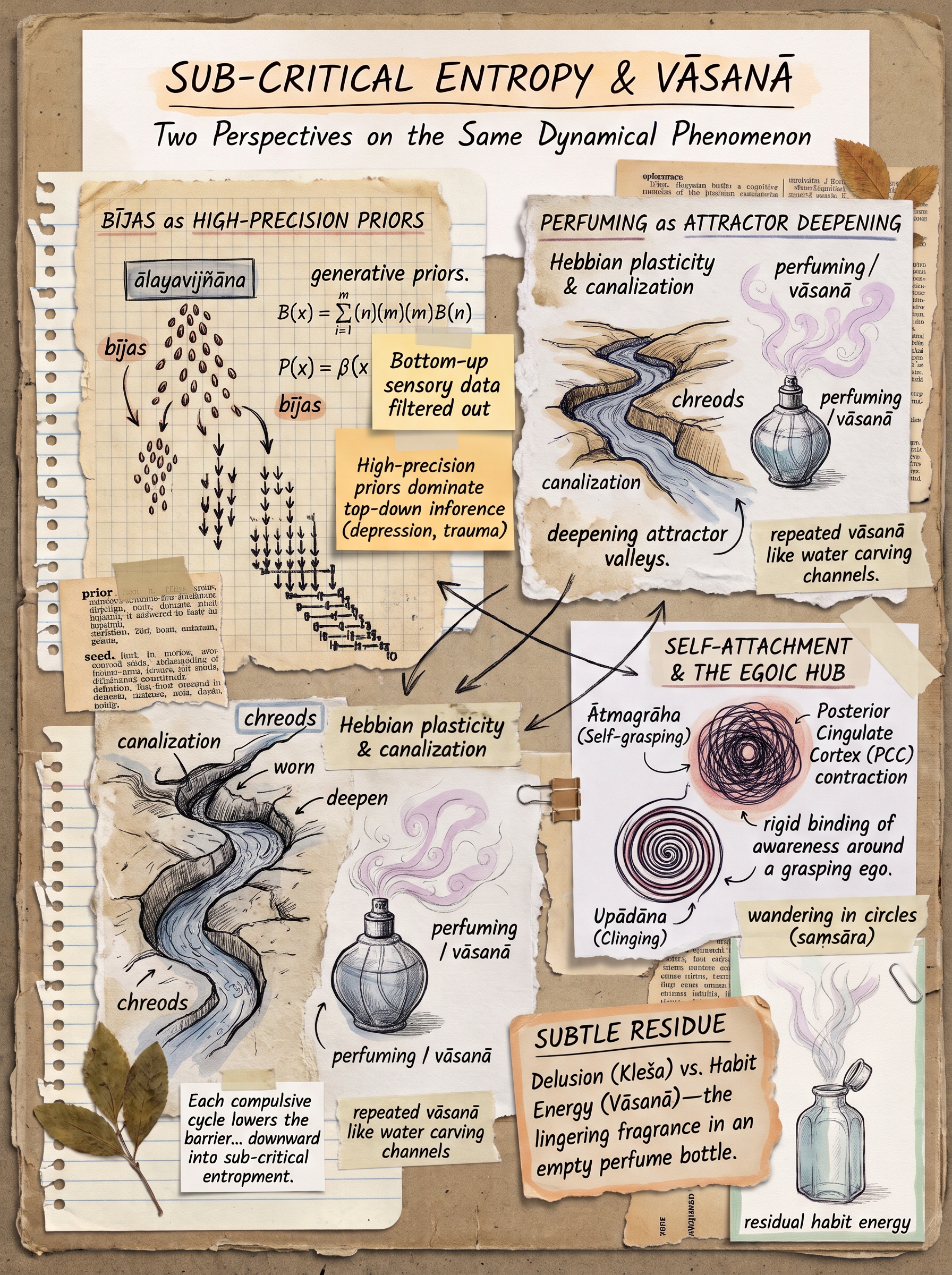
When juxtaposed, the sub-critical entropic brain and the Yogācāra mechanics of vāsanā describe the exact same dynamical phenomenon from third-person computational and first-person phenomenological perspectives:
| Dimension | Neurocomputational Model (EBH / CANAL) | Buddhist Phenomenology (Yogācāra / Zen) |
|---|---|---|
| Core Mechanism | Hyper-weighted top-down priors suppressing sensory prediction error.[3:5] | Bījas (seeds) in the ālayavijñāna projecting habitual conceptual overlays.[2:8] |
| Feedback Loop | Hebbian plasticity & canalization deepening attractor valleys (chreods).[4:12] | Vāsanā ("perfuming"): manifest acts (karma) reinforcing latent seeds.[10:5] |
| Egoic Hub | Rigid Default Mode Network (DMN) (mPFC / PCC) hyper-coupling.[5:5] | Kliṣṭamanas (afflicted mentation) perpetuating ātmagrāha (self-grasping).[10:6] |
| Phenomenology | Sub-critical rigidity; inability to exit internal scripts (OCD, depression).[1:6] | Saṃsāra ("wandering in circles"); involuntary propulsion by habit energy.[9:3] |
| Systemic Goal | Minimizing variational free energy (avoiding uncertainty at all costs).[4:13] | Clinging (upādāna) to permanence and illusory security amidst impermanence.[7:1] |
1. Bījas as High-Precision Priors
In Bayesian brain terms, a bīja stored in the ālayavijñāna functions identically to an entrenched generative prior. When an individual suffering from severe depression, trauma, or compulsive anxiety encounters an ambiguous social cue, vāsanā ensures they do not perceive raw, unmediated sensory data; instead, the high-precision prior ("I am in danger" or "I am fundamentally unworthy") dominates top-down inference.[3:6] Bottom-up sensory evidence that contradicts the negative script is filtered out as noise, starving the neural hierarchy of the prediction errors required to update its internal generative model (a dynamic directly examined in Cognitive Dissonance and Confirmation Bias):[4:14]
2. Perfuming as Attractor Deepening
Classical Indian texts explicitly compare repeated vāsanā to water carving deep channels into stone until the stream cannot flow anywhere else.[2:9] This directly prefigures Waddington's and Carhart-Harris's canalization metaphor down to the physical imagery.[4:15] Each cycle of compulsive checking, substance craving, or self-critical rumination acts as a neuroplastic "perfuming" event: it lowers the energetic barrier required to enter that specific neural state while raising the barrier required to transition into alternative states, driving cortical entropy downward into sub-critical entrapment.[4:16]
3. PCC Contraction and Self-Attachment (Ātmagrāha)
Neuroimaging trials on contemplative practitioners conducted by Judson Brewer and colleagues demonstrate that posterior cingulate cortex (PCC) activation spikes not merely when people engage in self-referential thought, but specifically when they get caught up in experience—enduring a visceral sense of "contraction" during craving, worry, and rumination.[7:2] In Buddhist terms, this PCC lock-in represents the neural signature of upādāna (clinging) and ātmagrāha-vāsanā: the rigid binding of awareness around an endangered, grasping ego at the center of the loop (cf. Deconstruction of the Central Controller and Constructs of the Mind-Unmasking Consciousness in East and West):[2:10]
Subtle Residue: Delusion (Kleśa) vs. Habit Energy (Vāsanā)
Buddhism draws a vital distinction between coarse manifest defilements (kleśa—active greed, hatred, delusion) and residual habit energy (vāsanā). Even after an advanced practitioner eliminates acute delusions, subtle behavioral quirks—like the lingering fragrance in an empty perfume bottle—can persist until structural reorganization completes.[10:7] Clinically, this parallels the post-acute recovery phase following depressive or substance remission: even after symptoms abate, residual sub-critical attractor vulnerability leaves the patient susceptible to relapse under acute stress.[4:17]
4. Escaping the Ruts: De-Canalization and Transforming Vāsanā

If psychopathology and dukkha (suffering) stem from sub-critical, over-canalized habit grooves, liberation requires mechanisms that inject controlled flexibility—raising cortical entropy back toward criticality so the landscape of priors can flatten, soften, and reorganize.[1:7] Contemporary cognitive science demonstrates that Buddhist contemplative practices accomplish endogenously what psychedelic therapies catalyze pharmacologically:
| Intervention Modality | Primary Neurodynamic Action | Effect on Predictive Priors | Contemplative / Yogācāra Correlate |
|---|---|---|---|
| Focused Attention (Śamatha) | Upregulates sensory/attentional networks; stabilizes cortical oscillatory drift.[11] | Clamps attention to present sensory data, starving automatic cognitive ruts of attentional fuel.[9:4] | Stopping (śamatha); interrupting the translation of latent bīja into impulsive manifest action (samudācāra).[9:5] |
| Open Monitoring (Vipassanā) | Downregulates midline DMN nodes (mPFC/PCC); decouples narrative self from interoceptive insula.[7:3] | De-weights high-level priors (ātmagrāha), treating thoughts as transient mental events rather than absolute facts.[11:1] | Insight into non-self (anattā) and impermanence (anicca); dismantling habitual self-grasping (ātmagrāha-vāsanā).[10:8] |
| Non-Dual Awareness & Deconstruction | Induces global functional decoupling; promotes simulated annealing across cortical hierarchies.[11:2] | Flattens the top-down attractor landscape, allowing locked, rigid models to melt and dissolve.[3:7][11:3] | Turning about at the basis (āśraya-parāvṛtti); transmuting defiled storehouse consciousness into luminous wisdom (jñāna).[10:9] |
| Psychedelic-Assisted Therapy (REBUS) | Potent | Acute collapse of hyper-weighted priors; surges cortical entropy, opening a critical window of neuroplasticity.[3:9][4:18] | Pharmacological dissolution of egoic grasping, providing a temporary experiential glimpse of non-canalized awareness.[3:10] |
Mindfulness as Precision De-Weighting
When Thích Nhất Hạnh instructs practitioners not to violently combat habit energy—which merely injects adversarial tension and deepens egoic contraction—but simply to recognize it ("Hello there, my habit energy") and return to embodied breathing, he describes a precise computational intervention:[9:6]
- Amplifying Bottom-Up Sensory Precision: Shifting attention from abstract narrative loops (top-down priors) to raw interoceptive sensations of the breath and body increases the precision-weighting of present-moment sensory data, weakening the dominance of entrenched predictions (as operationalized in Jon Kabat-Zinn-Full Catastrophe Living).[11:4]
- Suspending Policy Selection (Stopping / Śamatha): By observing an urge or obsessive thought without enacting the habitual motor or cognitive response, the practitioner breaks the closed loop between manifest action (samudācāra) and fresh perfuming (vāsanā).[9:7] Deprived of behavioral reinforcement, the attractor basin gradually shallows through extinction learning.[6:3]
Curiosity, Disenchantment, and PCC Quieting
Brewer's clinical trials on smoking cessation, emotional eating, and generalized anxiety show that replacing contracted craving with open, non-judgmental curiosity immediately deactivates the posterior cingulate cortex.[7:4] In predictive processing terms, curiosity shifts the brain out of defensive exploitation of known scripts and into epistemic exploration, raising state entropy and dissolving the rigid momentum of the habit loop.[7:5]
Deconstructive Meditation and Flattening the Landscape
Advanced insight (vipassanā) and non-dual contemplations (such as Dzogchen and Zen, explored in The Core Instruction - Turning the Gaze Inward) directly target the highest-level priors in the cortical hierarchy—conceptual reification and the illusion of an enduring, solid self (anattā / śūnyatā).[11:5] Cognitive scientists Ruben Laukkonen and Shamil Chandaria propose that progressive meditative absorption systematically relaxes top-down precision across the predictive hierarchy, analogous to simulated annealing in physics and machine learning:[11:6]
Just as heating a metal allows locked crystalline defects to melt and resettle into a lower-energy, more harmonious configuration, raising neural entropy—whether acutely via serotonergic psychedelics (REBUS) or sustainably via meditative deconstruction—temporarily flattens the deeply rutted Waddington landscape.[3:11][11:7] In Yogācāra terminology, this profound structural reorganization is known as āśraya-parāvṛtti (turning about at the basis): the transformation of the ālayavijñāna from a storehouse of compulsive, canalized habit energy into flexible, mirror-like responsiveness (ādarśa-jñāna).[10:10]
🎴 Interactive Web Practice (Comprehension Check)
Question 1 (The Entropic Brain, Sub-Criticality & Canalization): Why does computational neuroscience characterize psychiatric disorders like OCD, depression, and addiction as "sub-critical, low-entropy" brain states, and how does Conrad Waddington's canalization metaphor explain their stubborn persistence?
Answer: Under Robin Carhart-Harris's Entropic Brain Hypothesis, healthy waking consciousness operates near "criticality"—a phase transition balancing order and flexibility. When cortical entropy drops pathologically, the brain enters a "sub-critical" regime where neural dynamics become excessively constrained and predictable. In conditions like depression, OCD, and addiction, high-level top-down expectations (priors) become hyper-weighted ("hyper-precise"), suppressing bottom-up sensory prediction errors that could otherwise correct false assumptions. Conrad Waddington's epigenetic landscape metaphor (canalization) visualizes this as a ball rolling down a hillside carved with deep valleys (chreods). Each time a compulsive ritual or self-critical narrative executes, Hebbian plasticity deepens the valley, turning it into a steep dynamical attractor basin. Even neutral environmental stimuli inevitably pull brain activity into the rut, locking consciousness into repetitive scripts and trading behavioral freedom for the absolute minimization of uncertainty (free energy).
Question 2 (Yogācāra Phenomenology & The Dynamics of Vāsanā): How does the classical Yogācāra feedback loop of samudācāra (manifest action), vāsanā (perfuming), and bīja (seeds) parallel modern predictive processing, and why is habit energy distinct from active delusion (kleśa)?
Answer: Yogācāra Buddhism models mental continuity without a permanent soul through a four-stage circular causal loop centered on the storehouse consciousness (ālayavijñāna). When an intentional thought, word, or deed occurs (samudācāra), it immediately "perfumes" (vāsanā) the storehouse, depositing or reinforcing a latent karmic seed (bīja). When triggered by contextual conditions, that seed matures (vipāka) into a new manifest impulse. This directly anticipates predictive processing and Hebbian plasticity: manifest thoughts act as predictive outputs, perfuming represents synaptic weight updating, and stored seeds operate as latent generative priors that structure future perceptual inference. Furthermore, Buddhism distinguishes between active, conscious defilements (kleśa—such as acute anger or craving) and residual habit energy (vāsanā). Even after an individual intellectually dismantles a delusion, subtle behavioral momentum—like the lingering scent in an empty perfume bottle—persists until deep neuroplastic attractor reorganization completes, explaining clinical vulnerability to relapse after acute symptom remission.
Question 3 (Contemplative De-Canalization & Āśraya-parāvṛtti): How do mindfulness practices and "simulated annealing" reverse pathological canalization, and what is the neurocomputational significance of Yogācāra's "turning about at the basis" (āśraya-parāvṛtti)?
Answer: Reversing pathological canalization requires elevating cortical entropy toward criticality to flatten steep attractor basins. In contemplative practice, focused attention (śamatha) stabilizes the sensorium while open monitoring (vipassanā) downregulates the Default Mode Network's core midline nodes (mPFC and PCC), de-weighting the hyper-precise prior of self-grasping (ātmagrāha). By replacing avoidance or compulsive reactivity with non-judgmental curiosity, awareness shifts from top-down narrative loops to raw bottom-up sensory data, starving the habitual attractor of behavioral reinforcement. In computational terms, advanced contemplative deconstruction acts like "simulated annealing" in metallurgy and machine learning: temporarily raising system temperature (entropy) allows rigid crystalline traps to dissolve so the system can settle into a more flexible, globally optimal state. Yogācāra terms this profound reorganization āśraya-parāvṛtti ("turning about at the basis"): the fundamental transformation of the storehouse consciousness from a canalized repository of compulsive habit energy into flexible, open, mirror-like awareness.
Resonant Notes
The following notes in the vault share direct thematic, cognitive, and contemplative connections with Habit Energy (Vāsanā) and the Entropic Brain:
🔴 Cognitive Architecture, Predictive Processing & Neurodynamics
- Default Mode Network (DMN) — The neuroanatomical apex sustaining the narrative self, autobiographical continuity, and top-down predictive priors; its midline hyper-connectivity serves as the physical substrate for pathological canalization.
- Bayesian Brain Hypothesis & Glitches in The Bayesian Brain — Detail how the brain functions as an active inference engine, demonstrating how hyper-precise priors override sensory prediction errors to construct rigid internal scripts.
- Entropy — Explores thermodynamic and informational entropy, providing the mathematical foundation for Robin Carhart-Harris's Entropic Brain Hypothesis and Karl Friston's Free Energy Principle.
- Bergson’s Eliminative Model of Perception and Memory — Formulates the classic thesis that the brain operates as an eliminative filter (solliciteur d'action), winnowing reality down to utilitarian survival habits.
- Aldous Huxley's The Doors of Perception (1954) — Synthesizes Bergsonian philosophy with psychopharmacology, illustrating how inhibiting the brain's "reducing valve" increases conscious bandwidth and dissolves habitual constraints.
- The Interface Theory of Perception (ITP) — Donald Hoffman’s evolutionary proof that perception evolved for fitness payoffs rather than veridical truth, explaining why consciousness readily settles into canalized, user-interface shortcuts.
🟡 Yogācāra Phenomenology, Buddhist Psychology & Temporal Consciousness
- Vasubandhu's-Triṃśikā-vijñaptimātratā — Vasubandhu’s definitive thirty verses detailing the eight consciousnesses, the mechanics of bīja and vāsanā, and the culmination of practice in āśraya-parāvṛtti.
- Internal Time-Consciousness and Buddhist Psychology — Directly compares Husserl's temporal phenomenology (Retention, Primal Impression, Protention) with Yogācāra's ālayavijñāna and vāsanā, modeling continuity without an enduring soul.
- The Dividual and the Triṃśikā — Bridges Deleuzian control theory with Yogācāra psychology, demonstrating how digital platform algorithms externalize and exploit subterranean vāsanā loops.
- Constructs of the Mind-Unmasking Consciousness in East and West — Investigates how the illusion of a solid ego is constructed and dismantled across Eastern contemplative traditions and Western cognitive science.
- Tibetan Wheel of Life — Maps the twelve links of Dependent Origination (paṭiccasamuppāda), illustrating how subconscious volitional formations (saṃskāras) drive the cyclical momentum of saṃsāra.
- Epistemology of Preference-Avijjā, Māna, and the Emptiness of Aesthetic Taste in Buddhist Philosophy — Analyzes how fundamental ignorance (avijjā) and ego conceit (māna) solidify into rigid cognitive biases and behavioral habit grooves.
🟢 Contemplative Deconstruction, Psychopathology & Therapeutic Liberation
- The Core Instruction - Turning the Gaze Inward — Outlines the reflexive contemplative methodology for observing spontaneous thought without egoic identification, interrupting the manifest-to-seed karmic loop.
- Jon Kabat-Zinn-Full Catastrophe Living & Jon Kabat-Zinn — Translates Buddhist mindfulness into clinical behavioral medicine, detailing how non-reactive present-moment awareness breaks the grip of "automatic pilot."
- Terror Management Theory, Existential Neuroscience, and Buddhist Contemplation — Direct companion essay examining how mindfulness and death contemplation (maraṇasati) decouple defensive midline neural circuits and eliminate ideological rigidity.
- Louis Sass - Phenomenological Psychopathology and the Self — Analyzes ipseity disturbance and hyperreflexivity, examining what occurs when the delicate predictive balance between focal awareness and tacit background breaks down.
- The Flow State — Explores transient hypofrontality and selective DMN suppression, demonstrating how peak performance requires quieting the rigid autobiographical critic.
- Confirmation Bias & Cognitive Dissonance — Examine the cognitive defenses deployed by the brain to protect hyper-precise priors against disconfirming evidence, preserving the established attractor landscape.
References
Robin L. Carhart-Harris et al. / The Entropic Brain: A Theory of Conscious States Informed by Neuroimaging Research with Psychedelic Drugs / Frontiers in Human Neuroscience ↩︎ ↩︎ ↩︎ ↩︎ ↩︎ ↩︎ ↩︎ ↩︎
Dan Lusthaus / Vāsanā & Yogācāra / Routledge Encyclopedia of Philosophy ↩︎ ↩︎ ↩︎ ↩︎ ↩︎ ↩︎ ↩︎ ↩︎ ↩︎ ↩︎ ↩︎
Robin L. Carhart-Harris & Karl J. Friston / REBUS and the Anarchic Brain: Toward a Unified Model of the Brain Action of Psychedelics / PubMed - Pharmacological Reviews ↩︎ ↩︎ ↩︎ ↩︎ ↩︎ ↩︎ ↩︎ ↩︎ ↩︎ ↩︎ ↩︎ ↩︎
Robin L. Carhart-Harris, Shamil Chandaria, Karl J. Friston et al. / Canalization and Plasticity in Psychopathology / Neuropharmacology ↩︎ ↩︎ ↩︎ ↩︎ ↩︎ ↩︎ ↩︎ ↩︎ ↩︎ ↩︎ ↩︎ ↩︎ ↩︎ ↩︎ ↩︎ ↩︎ ↩︎ ↩︎ ↩︎
J. Paul Hamilton et al. / Default-Mode and Task-Positive Network Activity in Major Depressive Disorder: Implications for Adaptive and Maladaptive Rumination / Biological Psychiatry ↩︎ ↩︎ ↩︎ ↩︎ ↩︎ ↩︎
Judson A. Brewer, Hani M. Elwafi, & Jake H. Davis / Craving to Quit: Psychological Models and Neurobiological Mechanisms of Mindfulness Training as Treatment for Addictions / PubMed Central ↩︎ ↩︎ ↩︎ ↩︎
Judson A. Brewer et al. / Meditation Experience is Associated with Differences in Default Mode Network Activity and Connectivity / PNAS ↩︎ ↩︎ ↩︎ ↩︎ ↩︎ ↩︎
Dan Lusthaus / Buddhist Phenomenology: A Philosophical Investigation of Yogācāra Buddhism and the Ch'eng Wei-shih Lun / RoutledgeCurzon ↩︎ ↩︎
Thích Nhất Hạnh / Transforming Negative Habit Energies & Be Free Where You Are / Parallax Press - The Mindfulness Bell ↩︎ ↩︎ ↩︎ ↩︎ ↩︎ ↩︎ ↩︎ ↩︎
William S. Waldron / The Buddhist Unconscious: The Ālaya-vijñāna in the Context of Indian Buddhist Thought / RoutledgeCurzon ↩︎ ↩︎ ↩︎ ↩︎ ↩︎ ↩︎ ↩︎ ↩︎ ↩︎ ↩︎ ↩︎
Ruben Laukkonen, Karl Friston, & Shamil Chandaria / A Beautiful Loop: An Active Inference Theory of Consciousness and Meditative Deconstruction / Asterisk Magazine ↩︎ ↩︎ ↩︎ ↩︎ ↩︎ ↩︎ ↩︎ ↩︎