Ayn Rand's The Fountainhead - An Explanation
🗂️ Interactive Notebook: Open Ayn Rand's The Fountainhead Study Companion (Video Summary, Flashcards, Mind Map) ↗
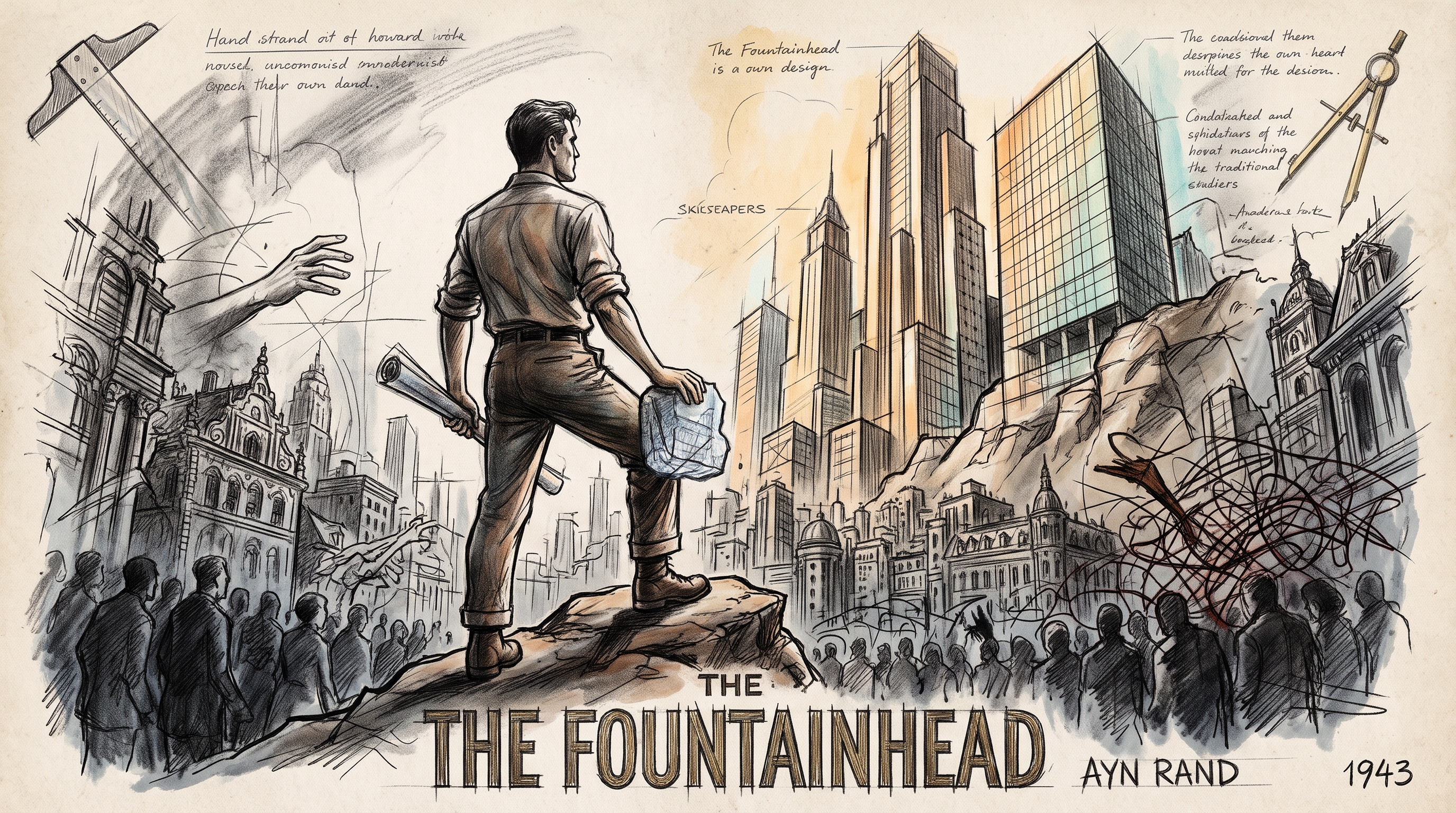
Published in 1943, The Fountainhead is Ayn Rand's breakthrough novel and the primary literary crucible through which she dramatized the foundational tenets of Objectivism—her philosophy of rational egoism, uncompromising individualism, and objective reality.[1] Centered on the tribulations of Howard Roark, an uncompromising modernist architect modeled conceptually on Frank Lloyd Wright and Louis Sullivan, the narrative stages a titanic conflict between the creative sovereign individual (the "prime mover") and the forces of societal collectivism, psychological mimicry, and altruistic conformism.[1:1][2] Through architecture as an overarching metaphor for metaphysical and moral integrity, Rand argues that all human progress emerges exclusively from the uncompromised intellect of the individual mind, and that the surrender of creative sovereignty to collective consensus constitutes humanity's supreme spiritual catastrophe.[1:2][3]
1. Historical & Philosophical Genesis: From Soviet Collectivism to the American Skyline
Ayn Rand (born Alisa Rosenbaum in Saint Petersburg in 1905) lived through both the Russian Revolution and the ensuing Bolshevik consolidation of totalitarian power.[4] Having witnessed the systematic expropriation of private property, the suppression of intellectual freedom, and the forced subordination of individual life to the Soviet state, Rand arrived in the United States in 1926 with an implacable hostility toward all forms of collectivism, socialism, and philosophical altruism.[4:1]
| Dimension | Soviet Petrograd (1917–1926) | American Manhattan (1930s–1940s) |
|---|---|---|
| Socio-Political Reality | Forced collectivization, chronic deprivation, and totalitarian state surveillance | Soaring skyscrapers, dynamic commercial markets, and technological vitality |
| Status of the Individual | Absolute subordination of individual life and property to the Soviet state | Creative capitalism, economic agency, and individual mastery over nature |
| Dominant Moral Dogma | Enforced self-abnegation and altruistic sacrifice for the collective mass | Monumental physical expression of rational self-interest and sovereign will |
| Architectural Embodiment | Drab, monolithic state housing and utilitarian suppression of beauty | The skyscraper: physical embodiment of the uncompromised, rational human mind |
In the towering commercial skyscrapers of New York City, Rand discerned the physical antithesis of Soviet drabness and spiritual degradation.[4:2] Architecture offered the ideal artistic arena for her philosophical thesis: a building is an incontrovertibly physical, mathematical, and functional artifact that cannot be wished into existence by committee vote or sentimental compassion. It requires rigorous structural logic, unyielding adherence to physical laws, and a singular coordinating creative intelligence.[2:1][5]
Rand conducted extensive architectural research while drafting the novel, working without pay as an unpaid typist and researcher in the office of renowned modernist architect Ely Jacques Kahn in New York City.[4:3] While Howard Roark was not a biographical portrait of Frank Lloyd Wright, Rand explicitly acknowledged Wright as the preeminent architectural inspiration for Roark's uncompromising commitment to organic, functionalist modernism and his relentless warfare against academic revivalism.[2:2][5:1]
2. Dramatis Personae: The Five Archetypes of Human Consciousness
The Fountainhead is structured around five central characters who function not merely as naturalistic figures, but as precise philosophical archetypes representing distinct psychological postures toward creative independence, social power, and personal integrity.[1:3][3:1]
| Archetype / Figure | Psychological Stance | Stance Toward Creative Independence | Core Narrative Function |
|---|---|---|---|
| Howard Roark (The Sovereign Creator) | Self-contained, intrinsically driven, oriented directly to objective reality. | Absolute: refuses compromise; demands truth to materials and functional logic. | The "Prime Mover" whose creative genius propels civilization forward despite social opposition. |
| Peter Keating (The Second-Hander) | Other-directed, vain, dependent upon external applause and maternal approval. | Nil: mimics traditional styles; plagiarizes Roark's work to maintain an illusion of competence. | Illustrates the spiritual bankruptcy and parasitical hollow core of social conformity. |
| Ellsworth M. Toohey (The Collectivist Inquisitor) | Power-seeking intellectual sociopath who weaponizes moral guilt and altruism. | Hostile: seeks to systematically destroy greatness and elevate mediocrity to rule minds. | The ideological demagogue who engineers collective leveling to conquer the individual soul. |
| Gail Wynand (The Tragic Compromiser) | Cynical realist who believes every human being has a price and can be bought. | Flawed: recognizes and loves true genius, yet panders to the base mob for commercial power. | The tragic cautionary tale of the man who discovers that catering to the collective makes him its slave. |
| Dominique Francon (The Radical Cynic & Purist) | Traumatized aesthetic idealist who despairs of the world's pervasive mediocrity. | Protective: attempts to destroy what she loves to shield it from vulgar defilement. | The journey from despairing aesthetic nihilism to moral liberation through Roark's victory. |
Howard Roark: The Uncompromising Creator (The "Prime Mover")
Roark is the archetype of the sovereign individual.[1:4] Expelled from the Stanton Institute of Technology for refusing to produce neoclassical, Beaux-Arts pastiche, Roark seeks neither approval, fame, nor social status. He creates buildings derived entirely from their function, their site, and the physical reality of modern industrial materials (concrete, steel, and glass). When clients demand historicist columns or pediments, Roark refuses the commission, preferring manual labor in a Connecticut granite quarry over corrupting his creative standards. Roark embodies the "prime mover"—the self-sufficient individual who lives from within, generating value through unassisted intellectual effort.[1:5][3:2]
Peter Keating: The Consummate "Second-Hander"
Keating is Roark’s classmate and opposite foil. Handsome, charming, and ambitious, Keating pursues architecture not out of an authentic passion for building, but because his mother desired social prestige and material success.[1:6] Keating achieves meteoric early success at the prestigious architectural firm of Francon & Heyer by flattering clients, conforming to popular taste, and playing office politics. However, because he lacks intrinsic creative ability, Keating secretly relies on Roark to solve his design problems and ghostwrite his landmark commissions. Keating is the quintessential "second-hander": an individual whose self-worth, identity, and values exist entirely in the eyes and praise of other people.[1:7][3:3]
Ellsworth M. Toohey: The Demagogue of Altruism
Toohey, the architecture critic for the sensationalist tabloid The New York Banner, is the ideological villain of the novel.[1:8] Possessing no creative talent of his own, Toohey lusts for absolute power over the human soul. He recognizes that overt tyrannical force cannot conquer a free nation; instead, power must be attained through psychological and moral subversion. Toohey methodically preaches humility, self-abnegation, and collective brotherhood to convince individuals that personal pride, ambition, and exceptional ability are sinful. By championing mediocre artists and vilifying authentic genius, Toohey systematically levels cultural standards, engineering a dependent herd mentality vulnerable to spiritual subjugation.[1:9][3:4]
Gail Wynand: The Tragic Sovereign of the Mob
Wynand, the self-made billionaire owner of The New York Banner, rose from the squalor of Hell's Kitchen to become the most influential media mogul in America.[1:10] Believing that humanity is inherently corrupt and depraved, Wynand built an empire by pandering to the vulgar instincts and sensationalist appetites of the masses, mistakenly believing that controlling what the public reads equates to true personal power. When he meets Roark, Wynand recognizes the incorruptible soul he once possessed and sought in vain. Wynand’s tragedy unfolds when he attempts to defend Roark during the Cortlandt trial: the public boycotts his paper, and Wynand is forced to realize that by pandering to the collective, he became their helpless slave rather than their master.[1:11][6]
Dominique Francon: Radical Aesthetic Nihilism
Dominique, the brilliant and beautiful daughter of conventional architect Guy Francon, begins the novel in a state of traumatized philosophical despair.[1:12] She perceives the profound beauty of human genius, but believes that the world is inherently dominated by vulgarity, cowardice, and spite, rendering genuine greatness doomed to inevitable desecration. To spare Roark the slow agony of being crucified by the mediocre public, she actively attempts to destroy his architectural career, and subjects herself to punitive marriages with Keating and Wynand. Only when Roark successfully defends his integrity and survives the trial does Dominique recognize that the creative spirit can withstand and triumph over societal hostility.[1:13][3:5]
3. The Architecture of Objectivism: Philosophical Tenets in Embryo
Although Ayn Rand would formulate Objectivism as a formal, systematic philosophy in her later non-fiction treatises (The Virtue of Selfishness, Capitalism: The Unknown Ideal), The Fountainhead provides its narrative and ethical foundation.[3:6][7]
| Philosophical Dimension | The Morality of the Prime Mover (Individualism) | The Morality of the Collective (Altruism / Parasitism) |
|---|---|---|
| Epistemology | Independent reason; direct, unborrowed perception of reality | Social consensus, second-hand authority, and inherited tradition |
| Primary Virtue | Productive work, creative competence, and self-esteem | Self-sacrifice, humility, and subordination to the group |
| Relational Logic | Trade, voluntary contractual exchange, and mutual independence | Parasitism, expropriation, moral guilt, and coercion |
| Psychological Engine | Intrinsic mastery of physical nature and problems | External social status, vanity, envy, and power over other minds |
| Ultimate Goal | Personal flourishing, authentic happiness, and structural integrity | Conformity, leveling of excellence, and spiritual self-abnegation |
1. The Primacy of the Sovereign Intellect
Rand insists that human survival and achievement are strictly cognitive: humanity survives not through fangs, claws, or instincts, but through the rational faculty of the individual mind.[1:14][3:7] Reasoning is an exclusively individual process. A committee cannot think; a collective cannot formulate a thought. It is always the solitary individual who discovers fire, invents the wheel, calculates structural loads, or conceives a symphony. Consequently, the individual owes no unchosen moral or material debts to society:
- The Creator vs. The Parasite: The creator produces new wealth, ideas, and structures through direct confrontation with physical nature. The parasite produces nothing, attempting instead to survive by redistributing, appropriating, or consuming the creations of others.[1:15]
2. Rational Egoism vs. Exploitative Parasitism
One of the most persistent misunderstandings of Rand's concept of "selfishness" is conflating it with predatory exploitation or narcissistic hedonism.[7:1] In The Fountainhead, Rand explicitly rejects the idea that a robber baron, a con artist, or an office climber like Peter Keating is "selfish."
- The True Egoist: Roark is genuinely selfish because his primary concern is his relationship with reality, his work, and his own moral standards. He does not sacrifice his mind to others, nor does he demand that others sacrifice their minds to him.[7:2]
- The False Egoist: Keating exploits people, flatters superiors, and steals Roark's work, but he is completely unselfish in Rand's technical sense: his desires are entirely mediated through other minds. He does not desire an architectural building for its own sake; he desires the envy and applause of the public.
3. Altruism as Spiritual Enslavement
Rand launches a ferocious assault against the ethical doctrine of altruism—the moral code asserting that an action is good only insofar as it involves self-sacrifice for the benefit of others.[1:16][7:3] Rand argues that altruism is fundamentally evil because it erects suffering and sacrifice as the highest moral goods, while branding productive achievement and personal happiness as morally suspect.
- In the hands of ideologues like Ellsworth Toohey, altruism becomes an instrument of totalitarian subjugation. If self-sacrifice is the supreme moral duty, then the individual has no right to exist except by permission of the collective. Altruism weaponizes guilt, paralyzing the competent and elevating the incompetent to moral arbiters.[1:17]
4. The Anatomy of the Second-Hander and Sartrean Bad Faith
Rand's psychological diagnosis of the "second-hander" shares profound theoretical parallels with Jean-Paul Sartre's existentialist concept of bad faith (mauvaise foi).[8]
- The second-hander lives second-hand: they do not look at reality directly, but look at what other people think of reality.[1:18] Keating chooses architecture because others respect it; he marries Dominique because others desire her; he adopts opinions because they are fashionable.
- In Sartrean terms, Keating flees the vertigo of genuine existential freedom, constructing an inauthentic, socially scripted identity that reduces him to an empty cipher. When his social acclaim evaporates, Keating collapses because he has never developed an autonomous self.[8:1]
4. Architecture as Ideology: Modernist Functionalism vs. Historicist Pastiche
In The Fountainhead, architectural design is never merely a matter of decorative preference; it is an epistemological and moral statement.[1:19][2:3] The architectural battles between Roark and the establishment reflect the historical clash between the emerging International Style and nineteenth-century academic eclecticism.
| Design Philosophy | Epistemological Basis | Structural Tectonic Logic | Aesthetic & Ethical Outcome |
|---|---|---|---|
| Classical & Beaux-Arts Eclecticism | Dead tradition, institutional inertia, and social prestige | Concealment: Greek columns pasted on commercial banks, Renaissance cornices masking structural steel frames | Architectural deception and pastiche; subordination of modern technology to ancient forms |
| Modernist Functional Integrity | Direct rational analysis: form follows function | Truth to materials: exposed structural steel, reinforced concrete slabs, open glass cantilevers, site integration | Authentic creative sovereignty; harmonious unity between internal purpose and physical manifestation |
Truth to Materials (Materialgerechtigkeit) and Functional Logic
Roark's architectural philosophy mirrors the core tenets of the Chicago School (Louis Sullivan) and European modernism (see The Bauhaus School):[2:4][5:2]
- Form Follows Function: A building's external form must be dictated by its internal purpose, its mechanical requirements, and the human activities it shelters. To impose a static classical facade onto a modern railway station or department store is an architectural lie.[5:3]
- Truth to Materials: Roark insists that modern materials must be utilized according to their own mechanical laws. Steel has tensile strength, allowing for vast glass cantilevers and soaring, slender spans; concrete can be poured into fluid, monolithic structural slabs. Disguising structural steel behind faux-marble classical pilasters or concealing concrete with ornamental plaster is condemned by Roark as intellectual and aesthetic cowardice.[1:20][5:4]
The Stoddard Temple of the Human Spirit
The ideological clash reaches an aesthetic peak in Roark's commission to design the Stoddard Temple of the Human Spirit.[1:21] Commissioned by Hopton Stoddard—a wealthy, neurotic client manipulated by Ellsworth Toohey—the temple is intended as a non-denominational sanctuary for spiritual contemplation.
- Roark designs an open, sunlit pavilion of granite and glass that rejects mystical gloom, kneeling benches, and stained glass. Instead of dwarfing human beings to inspire self-abnegation and religious guilt, Roark builds a temple scaled to the dignity and heroic stature of humanity, centering it around a nude statue of Dominique Francon sculpted by Steven Mallory.[1:22]
- Toohey immediately orchestrates a public scandal, branding the structure an insult to religion and human suffering. Stoddard sues Roark for breach of contract, and the architectural establishment rallies against him in court, successfully altering the temple into a home for subnormal children adorned with grotesque neoclassical columns and plaster statuary. The episode dramatizes how the collective punishes any attempt to exalt individual human dignity.[1:23]
5. Cortlandt Homes Climax: Dynamiting the Collective and the Courtroom Manifesto
The narrative and philosophical climax of The Fountainhead occurs over the construction and subsequent demolition of Cortlandt Homes, a massive public housing development in the Bronx designed for low-income tenants.[1:24]
| Stage of the Crisis | Dramatic & Operational Event | Philosophical & Ethical Meaning |
|---|---|---|
| 1. The Predicament | Peter Keating wins the massive Cortlandt Homes public housing commission but is utterly incapable of designing a dignified, low-cost project within budget constraints. | Demonstrates the fundamental impotence of the second-hander, who secures public commissions through influence but lacks creative capability. |
| 2. The Agreement | Roark agrees to ghostwrite the entire architectural design for zero financial remuneration, under one inviolable contractual condition: it must be built exactly as designed, with zero alterations. | Highlights the creator's pure devotion to the integrity of the work itself, treating intellectual creation as an uncompromised sovereignty. |
| 3. The Betrayal | Bureaucratic committees, municipal boards, and rival architects mutilate Roark's design, adding ornamental balconies, classical pastiche, and ruining its cost-saving structural logic. | Illustrates the collective's parasitical impulse: appropriating the fruits of independent thought while disfiguring and corrupting the creation. |
| 4. The Demolition | Roark dynamites the unfinished structure at night—taking careful precautions to ensure no human life is endangered—asserting that compromised intellectual property has no right to exist. | Establishes the radical Objectivist thesis that creative sovereignty supersedes stolen physical property, forcing a public courtroom reckoning on the rights of the mind. |
The Intellectual Property Crisis
Roark’s decision to blow up Cortlandt Homes represents the ultimate ethical test of Objectivism.[1:25][3:8] Roark did not dynamite the building out of malicious vandalism or financial greed; he destroyed it because the contractual integrity of his intellectual creation was violated. Cortlandt Homes was viable only because Roark solved the engineering problem of providing dignified, low-cost housing through revolutionary structural efficiencies. When the government housing board and second-rate architects grafted balconies and ornaments onto the framework, they appropriated Roark's mind while defacing his work.[1:26]
The Courtroom Speech: The Manifesto of the Sovereign Mind
Standing trial for criminal property destruction, Roark refuses legal counsel and delivers a historic courtroom address that serves as Rand’s purest philosophical manifesto.[1:27] Key arguments of Roark's defense include:
-
The Origin of Civilization: Civilization is not a communal product; it is the history of the individual creator confronting the resistance of tradition:
"Throughout the centuries there were men who took first steps down new roads armed with nothing but their own vision. Their goals differed, but they all had this in common: that the step was first, the road new, the vision unborrowed, and the response they received—hatred."[1:28]
-
The Creator vs. The Parasite: The creator lives for his work, producing value from nature through his own labor. The parasite survives second-hand by feeding on the creator:
"The creator's concern is the conquest of nature. The parasite's concern is the conquest of men. The creator produces. The parasite loots. The creator's interest is the search for truth. The parasite's interest is the manipulation of men."[1:29]
-
The Defense of Rational Self-Interest: The moral justification of an individual's life is their own happiness and self-directed creation:
"I came here to say that I do not recognize anyone's right to one minute of my life. Nor to any part of my energy. Nor to any achievement of mine. No matter who makes the claim, how large their number or how great their need."[1:30]
-
The Verdict: Roark concludes by explaining that Cortlandt Homes belonged to him in spirit, and that by dynamiting it, he refused to permit his stolen creative labor to validate a corrupt, collective system. The jury deliberates and returns a verdict of not guilty, validating the supreme moral sovereignty of the creator.[1:31]
6. Power, Demagoguery, and Rhetorical Subversion: The Strategy of Ellsworth Toohey
Ellsworth Toohey is arguably Rand's most chilling literary creation, anticipating modern sociological analyses of ideological manipulation, institutional gaslighting, and the totalitarian weaponization of language (see Defensive communication tactics and George Orwell (1903-1950)).[1:32][9]
| Tactical Lever | Method of Psychological Subversion | Ultimate Totalitarian Objective |
|---|---|---|
| Eradication of Individual Self-Esteem | Preach that personal pride, ambition, and exceptional ability are sins; demand continuous guilt and self-sacrifice for others. | Paralyzes the independent mind; convinces individuals of their unworthiness and strips them of moral confidence. |
| Exaltation of Systemic Mediocrity | Promote talentless hacks as artistic geniuses; denigrate authentic excellence; enforce uniform cultural standards. | Eradicates objective benchmarks of quality; ensures that superior ability cannot threaten or judge the mediocre mass. |
| Institutional Enclosure | Channel guilt-ridden, disoriented individuals into state committees, councils, and collective associations controlled by Toohey. | Achieves psychological slavery: creates a compliant, self-policing populace incapable of independent rebellion, begging for collective rule. |
In a pivotal monologue delivered to a broken Peter Keating in Part IV, Toohey reveals his actual operating philosophy with breathtaking cynicism:[1:33]
- Kill the Ego to Rule the Soul: Physical force can capture bodies, but true tyranny requires conquering the human soul. To rule a man, one must destroy his self-esteem, his capacity for independent judgment, and his belief in his own moral rightness.[1:34]
- The Weaponization of Ridicule and Guilt: Toohey teaches people to laugh at greatness and revere humility. By convincing humanity that exceptional ability is an arrogant offense against the less fortunate, Toohey installs an internal policeman of guilt within every capable individual.[1:35]
- The Cult of the Collective: Once individual judgment has been shattered, people flock to collectives—associations, unions, committees, councils—where they feel safe within the anonymous herd. Toohey rules the committees, meaning Toohey rules the society.[1:36][9:1]
7. Comparative Synthesis Matrix: The Archetypal Spectrum of Character & Ideology
The following matrix synthesizes the five primary characters of The Fountainhead, their underlying psychological engines, their stance toward reality, and their philosophical fates:
| Character | Archetype / Social Role | Epistemological Posture | Core Motivation & Drive | Stance on Architectural Integrity | Ultimate Narrative & Moral Fate |
|---|---|---|---|---|---|
| Howard Roark | The Sovereign Creator (Prime Mover) | Objective reality; independent reason; direct perception. | Creation for its own sake; unyielding pursuit of functional truth. | Pure modernism; structural integrity; truth to materials (Materialgerechtigkeit). | Acquitted at trial; ascends the steel framework of the Wynand Building as triumphant individual. |
| Peter Keating | The Consummate "Second-Hander" | Social mimicry; public consensus; external validation. | External acclaim, vanity, maternal approval, social status. | Eclectic pastiche; Beaux-Arts historicism; plagiarizes Roark's work. | Discarded by society; artistic bankruptcy exposed; painting pathetic watercolors in obscurity. |
| Ellsworth M. Toohey | The Collectivist Demagogue | Relativism; weaponized altruism; linguistic deception. | Absolute spiritual power over human minds; destruction of greatness. | Champions mediocrity; weaponizes criticism to suppress exceptional design. | Fired from the Banner; continues organizing committees and infiltrating other cultural institutions. |
| Gail Wynand | The Tragic Compromiser | Cynical realism; believes all men have a price. | Imperial power and financial control achieved by pandering to the mob. | Recognizes and loves Roark's genius, but publishes tabloids for masses. | Betrayed by his own mob; forced to close the Banner; commissions Roark's final monument before severing all contact. |
| Dominique Francon | The Traumatized Cynic / Purist | Acute aesthetic idealism paired with worldly despair. | Protecting true beauty from vulgar collective degradation. | Rejects historicist pastiche; smashes her own statue to prevent public defilement. | Liberated through Roark's triumph; openly marries Roark and embraces public life on her own terms. |
8. Critical Reception, Contemporary Resonance, and Intellectual Critiques
The Fountainhead achieved extraordinary commercial success via word-of-mouth, becoming an enduring bestseller and a founding cornerstone of modern American libertarian and conservative thought.[4:4][10] However, the novel has also generated intense philosophical, literary, and sociological debate.
| The Libertarian & Individualist Ideal | The Sociological & Systemic Critique |
|---|---|
| Heroic Entrepreneurship: Celebrates radical risk-taking, sovereign creative vision, and market-defying innovation against traditional inertia. | The Atomistic Fallacy: Overlooks the extensive social infrastructure, shared scientific knowledge, and public institutions that make individual achievement possible. |
| Inviolability of Intellectual Sovereignty: Champions the creator's absolute right to control, protect, and dispose of the products of their own mind. | Erasure of Collaborative Labor: Obscures the indispensable, skilled contributions of structural engineers, tradespeople, craftspeople, and civic coordinators. |
| Rejection of Bureaucratic Paralysis: Validates the moral courage required to resist stifling committee consensus, rent-seeking regulators, and academic dogma. | Founder's Syndrome & Hubris: Can metastasize into corporate narcissism, toxic blame avoidance, and pathological hostility toward necessary organizational governance. |
The Entrepreneurial Mythos and "Founder's Syndrome"
Roark's archetype of the uncompromising visionary has become a secular gospel among venture capitalists, software architects, and tech founders in Silicon Valley.[10:1] While this ethos champions heroic innovation and risk-taking, contemporary organizational theorists note that the uncritical worship of the Roark archetype frequently metastasizes into Founder's Syndrome, corporate narcissism, and acute blindness to team dynamics.[11]
- As examined in Incapable of Ever Taking the Blame and Analyzing the Lululemon Brand Controversy, executive leaders who view themselves as infallible, Roark-like visionaries often develop defensive communication routines, externalize all operational failures onto incompetent subordinates, and treat corporate accountability as a personal affront to their sovereign genius.[11:1][12]
Sociological and Communitarian Critiques: The Myth of the Isolated Genius
Sociologists, architectural historians, and communitarian philosophers have challenged Rand's extreme individualist ontology on several fronts:
- The Collaborative Nature of Construction: In reality, a skyscraper is never the product of a single, solitary mind. Architecture is an inherently collaborative, social endeavor requiring the coordinated labor of structural engineers, masons, electricians, plumbers, and civic planners. By reducing thousands of skilled workers to mere inert muscle executing Roark's divine blueprint, Rand obscures the social and collective dimensions of production analyzed by Karl Marx - Economic and Philosophic Manuscripts of 1844.
- The Collapse of Civic Urbanism: As diagnosed by From Walls of Wood to Walls of Glass - Northrop Frye’s Geography of Isolation and Anthony Vidler-The Architectural Uncanny, the dogmatic modernist insistence on radical functionalism and architectural autonomy often produced hostile, atomized urban environments. Roark's disdain for the public street and civic tradition mirrors the alienating spatial grids of the mid-century corporate city.
- William H. Whyte and the Institutional Realities: In The Organization Man, William H. Whyte analyzed the exact mid-century corporate pressures dramatized in The Fountainhead.[13] Whyte demonstrated that while conformity and committee consensus indeed stifle individual brilliance, the complete rejection of institutional belonging often leaves the individual isolated and politically impotent within modern managerial capitalism.[13:1]
🎴 Interactive Web Practice (Comprehension Check)
Question 1 (The Courtroom Manifesto & The Ethics of Creation): Why does Howard Roark consider dynamiting the Cortlandt Homes housing project a morally justified act, and how does his courtroom defense articulate the core Objectivist distinction between the creator and the parasite?
Answer: Howard Roark agreed to design the Cortlandt Homes public housing project for Peter Keating under strict contractual terms: he would receive zero financial compensation and no public architectural credit, on the sole condition that the structure be erected exactly according to his blueprints without a single alteration. Cortlandt Homes was structurally viable only because Roark had solved the engineering and spatial challenges of low-cost housing through radical structural innovations and functional efficiencies.
When the government housing board, bureaucratic committees, and rival architects defaced his design by adding classical pastiche and altering functional layouts, they violated the core condition of his labor. In Rand's philosophy, an individual's intellectual creation is an extension of their mind. By taking Roark's engineering solutions while mutilating his aesthetic vision, the collective appropriated his mind as uncompensated slave labor. Roark dynamited Cortlandt to dramatize the principle that intellectual property belongs solely to its creator, and that a mutilated creation has no right to exist.
In his courtroom speech, Roark distinguishes between two human types:
- The Creator (The Prime Mover): The self-sufficient individual who confronts physical reality directly, generating new wealth, ideas, and values through independent rational thought. The creator lives for his work and requires no human sacrificial victims.
- The Parasite (The Second-Hander): The individual who produces nothing of his own, surviving by consuming, redistributing, or appropriating the work of others. The parasite's goal is not mastery of reality, but the subjugation and manipulation of men.
Question 2 (Psychological Foil: The Second-Hander & Bad Faith): What defines the psychology of the "second-hander" in Ayn Rand's philosophy, how does Peter Keating embody this condition, and how does it parallel Jean-Paul Sartre's concept of bad faith (mauvaise foi)?
Answer: In Ayn Rand's philosophical framework, a second-hander is someone whose values, desires, and sense of personal identity are derived entirely from the opinions, expectations, and praise of other people, rather than from an independent, rational relationship with objective reality.
Peter Keating serves as the novel's primary archetype of the second-hander:
- Keating does not choose architecture out of a genuine, intrinsic passion for building; he chooses it because his mother and society regard it as prestigious and lucrative.
- In his professional career, he excels at social networking, sycophancy, and corporate politics, climbing to partnership at Francon & Heyer by flattering clients and mimicking historicist architectural trends.
- Crucially, Keating has no authentic creative core: when confronted with complex architectural design challenges, he is paralyzed and must secretly beg Roark to ghostwrite his work.
- Keating's desires are entirely mimetic: he marries Dominique Francon not because he understands her soul, but because she is desired by others, making her an ultimate trophy of social envy.
Question 3 (Ideological Subversion & Ellsworth Toohey's Rhetoric): What is Ellsworth M. Toohey's underlying strategy for attaining total power, and why does his campaign rely upon the promotion of mediocrity and the weaponization of altruism?
Answer: Ellsworth M. Toohey is an intellectual totalitarian who recognizes that physical violence and military force are crude, unstable mechanisms for ruling humanity; absolute, permanent power can be achieved only by conquering the human soul. His ultimate ambition is to engineer a completely collectivized, subservient society in which he acts as the unchallenged spiritual master.
Toohey's psychological strategy operates through three interconnected levers:
- The Destruction of Standards via the Elevation of Mediocrity: Toohey uses his architectural criticism, newspaper columns, and cultural influence to praise untalented writers, terrible architects, and mediocre thinkers, while relentlessly ignoring or mocking authentic geniuses like Howard Roark. By promoting mediocrity as greatness, Toohey destroys humanity's objective capacity to discern quality, beauty, and truth. When standards are eradicated, genuine achievement cannot be recognized, and excellence ceases to threaten the herd.
- The Weaponization of Altruism and Guilt: Toohey relentlessly preaches self-sacrifice, humility, and the moral duty of living for others. If self-abnegation is accepted as the highest virtue, then personal ambition, pride, and creative independence are automatically branded as sinful. By convincing people that they are morally guilty simply for existing as individuals, Toohey instills an internal psychological paralysis. A guilt-ridden person who believes they are unworthy will readily surrender their critical autonomy.
- The Absorption into the Collective: Once an individual's self-esteem has been crushed and their standards liquidated, they cannot stand alone. Desperate for safety, they submerge their identity into committees, councils, and collective organizations. Toohey controls these committees, positioning himself as the benevolent spokesman of the collective will. Through altruism, Toohey transforms free individuals into an obedient, self-policing herd.
Resonant Notes
The following notes in the vault share direct thematic, sociological, and literary connections with Ayn Rand's The Fountainhead:
🔴 Individual Sovereignty, Bad Faith & Philosophical Ancestry
- Friedrich Nietzsche — Rand’s archetype of the heroic creator ("prime mover") and her fierce assault on altruistic pity and slave morality deeply mirror Nietzsche’s concept of the Übermensch and his critique of herd conformity, although Rand anchors her ethics in objective reason and rights rather than the will to power.
- Ralph Waldo Emerson — Emerson’s radical doctrine of "Self-Reliance" and his insistence that institutional conformity is the primary killer of the human soul represent the 19th-century American intellectual taproot of Roark's sovereign individualism.
- Jean-Paul Sartre — Rand’s anatomy of the "second-hander" directly parallels Sartre’s phenomenological concept of bad faith (mauvaise foi): the psychological self-deception of surrendering existential freedom to inhabit a hollow, socially validated persona.
- Metaphysics of Henry David Thoreau — Thoreau’s radical civil disobedience, voluntary poverty at Walden Pond, and refusal to surrender his moral conscience to the state closely prefigure Roark's willingness to work in a granite quarry rather than compromise his architectural vision.
- Søren Kierkegaard — Kierkegaard’s critique of "the Crowd" as untruth and his insistence on the solitary individual standing before the absolute resonate with Roark's refusal to submit his architectural designs to democratic vote or public consensus.
- Albert Camus — Like Camus’s heroic rebel in The Myth of Sisyphus, Roark confronts an absurd, hostile world without cynicism or despair, finding intrinsic purpose and lucid joy in the manual and intellectual exertion of creation itself.
🟡 Architectural Modernism, Spatial Ideology & Aesthetic Purism
- The Bauhaus School — Roark’s radical crusade embodies the foundational tenets of Bauhaus modernism—functionalism, "truth to materials" (Materialgerechtigkeit), structural clarity, and the total rejection of historicist pastiche—over nineteenth-century academic Beaux-Arts ornament.
- Anthony Vidler-The Architectural Uncanny — Vidler's spatial and psychoanalytic critique of modern housing developments, urban estrangement, and the alienation of the built environment provides the theoretical counterpart to Roark’s destruction of the Cortlandt Homes project.
- The Dehumanization of Art — José Ortega y Gasset’s analysis of the avant-garde’s rejection of sentimental, 19th-century bourgeois romanticism in favor of pure conceptual form illuminates the hostile public reaction to Roark's Stoddard Temple.
- From Walls of Wood to Walls of Glass - Northrop Frye’s Geography of Isolation — Frye’s critique of modern urban architecture and the "condominium mentality" provides a sociological corrective to Roark's architectural utopia, illustrating how transparent high-rises can enforce atomized loneliness rather than heroic liberation.
- Canada's Housing Crisis - Designing Better Buildings — An empirical examination of residential architecture and value-engineering; demonstrates how contemporary real estate developers corrupted modernist functionalism into cheap, substandard construction, echoing the bureaucratic defacement of Cortlandt Homes.
- The Renaissance — Roark's ideal of the sovereign architect-creator revives the Renaissance humanist archetype of the universal master (such as Brunelleschi or Alberti), who integrated structural geometry, mathematics, and tectonic mastery into a singular vision.
🟢 Conformity, Organizational Sociopathy & Rhetorical Manipulation
- William H. Whyte's Social Ethics & William H. Whyte's The Organization Man — Whyte’s mid-century sociological critique of the "Social Ethic"—which subordinated individual brilliance to committee consensus and belongingness—describes the exact corporate dynamics that elevate Peter Keating and persecute Howard Roark.
- Defensive communication tactics — Analyzes the rhetoric of psychological deflection, projection, and ideological gaslighting, personified in The Fountainhead by Ellsworth Toohey’s calculated subversion of public discourse.
- Incapable of Ever Taking the Blame & Analyzing the Lululemon Brand Controversy — Dissects the real-world weaponization of Objectivist individualism and the "infallible founder" archetype in executive management, demonstrating how Roarkian self-assertion can mutate into executive hubris, Blame Avoidance, and organizational toxicity.
- George Orwell (1903-1950) — Ellsworth Toohey’s linguistic subversion of language—redefining selfishness as crime and self-effacement as virtue—acts as an ideological twin to Orwell’s Newspeak in Nineteen Eighty-Four, where linguistic engineering suppresses heretical thought.
- Michel Foucault — Toohey’s strategy of controlling society not through sovereign state violence, but through discursive networks, cultural criticism, and institutional committees illustrates Foucault’s thesis on modern disciplinary power and pastoral surveillance.
- Max Weber (1864-1920) — Weber’s diagnosis of the "iron cage" of rational-legal bureaucracy illuminates the institutional hurdles Roark faces: modern corporate capitalism tends toward bureaucratic standardization and committee safety rather than heroic individual innovation.
- Karl Marx - Economic and Philosophic Manuscripts of 1844 — Marx’s theory of alienated labor (Entfremdung) provides the primary ideological foil to Rand: where Marx insists that private intellectual property alienates the collective worker, Rand insists that collective expropriation alienates the sovereign mind.
- Don DeLillo Major Themes Analysis — DeLillo’s critique of late-capitalist media conglomerates and the manufactured spectacles of Gail Wynand’s tabloid empire reveals how mass communications manipulate public desires, confirming Wynand’s eventual recognition that he was owned by the mob he sought to rule.
References
Ayn Rand / The Fountainhead / Bobbs-Merrill ↩︎ ↩︎ ↩︎ ↩︎ ↩︎ ↩︎ ↩︎ ↩︎ ↩︎ ↩︎ ↩︎ ↩︎ ↩︎ ↩︎ ↩︎ ↩︎ ↩︎ ↩︎ ↩︎ ↩︎ ↩︎ ↩︎ ↩︎ ↩︎ ↩︎ ↩︎ ↩︎ ↩︎ ↩︎ ↩︎ ↩︎ ↩︎ ↩︎ ↩︎ ↩︎ ↩︎ ↩︎
Robert Twombly / Frank Lloyd Wright: His Life and His Architecture / John Wiley & Sons ↩︎ ↩︎ ↩︎ ↩︎ ↩︎
Leonard Peikoff / Objectivism: The Philosophy of Ayn Rand / Dutton / Penguin Books ↩︎ ↩︎ ↩︎ ↩︎ ↩︎ ↩︎ ↩︎ ↩︎ ↩︎
Anne C. Heller / Ayn Rand and the World She Made / Nan A. Talese / Doubleday ↩︎ ↩︎ ↩︎ ↩︎ ↩︎
Louis H. Sullivan / Kindergarten Chats and Other Writings / Wittenborn, Schultz ↩︎ ↩︎ ↩︎ ↩︎ ↩︎
Douglas J. Den Uyl and Douglas B. Rasmussen (Eds.) / The Philosophic Thought of Ayn Rand / University of Illinois Press ↩︎
Ayn Rand / The Virtue of Selfishness: A New Concept of Egoism / Signet / New American Library ↩︎ ↩︎ ↩︎ ↩︎
Jean-Paul Sartre / Being and Nothingness: An Essay on Phenomenological Ontology / Translated by Hazel E. Barnes / Philosophical Library / Washington Square Press ↩︎ ↩︎
Robert Mayhew (Ed.) / Essays on Ayn Rand's The Fountainhead / Lexington Books / Rowman & Littlefield ↩︎ ↩︎
Jennifer Burns / Goddess of the Market: Ayn Rand and the American Right / Oxford University Press ↩︎ ↩︎
Manfred F. R. Kets de Vries / The Leader on the Couch: A Clinical Approach to Psychodynamics in Leadership / John Wiley & Sons ↩︎ ↩︎
Chip Wilson / Little Black Stretchy Pants / Self-published ↩︎
William H. Whyte / The Organization Man / Simon & Schuster ↩︎ ↩︎