Northrop Frye
🗂️ Interactive Notebook: Open Study Companion (Video Summary, Flashcards, Mind Map) ↗
Herman Northrop Frye (1912–1991) stands as one of the most formidable literary theorists, cultural philosophers, and mythologists of the twentieth century. Frye executed a double revolution in humanistic thought: first, in his structural masterpiece Anatomy of Criticism (1957), he established literary studies as an autonomous, inductive science, demonstrating that literature is not a passive mirror of empirical history or subjective psychology, but a self-contained verbal universe organized by cyclical narrative archetypes (mythoi), historical fictional modes, and biblical typologies. Second, in his cultural and geographic writings (The Bush Garden, 1971), Frye formulated the garrison mentality, diagnosing how early Canadian literature was shaped by the psychological trauma of an immense, indifferent northern wilderness that enforced rigid moral conformity and institutional defense. In his late urban philosophy, Frye traced the dialectical mutation of this spatial neurosis from the wooden stockades of early settlers ("social but not creative") into the vertical glass curtain walls of modern high-rise condominiums ("neither social nor creative"), diagnosing an urban pathology of hyper-density paired with radical social atomization.
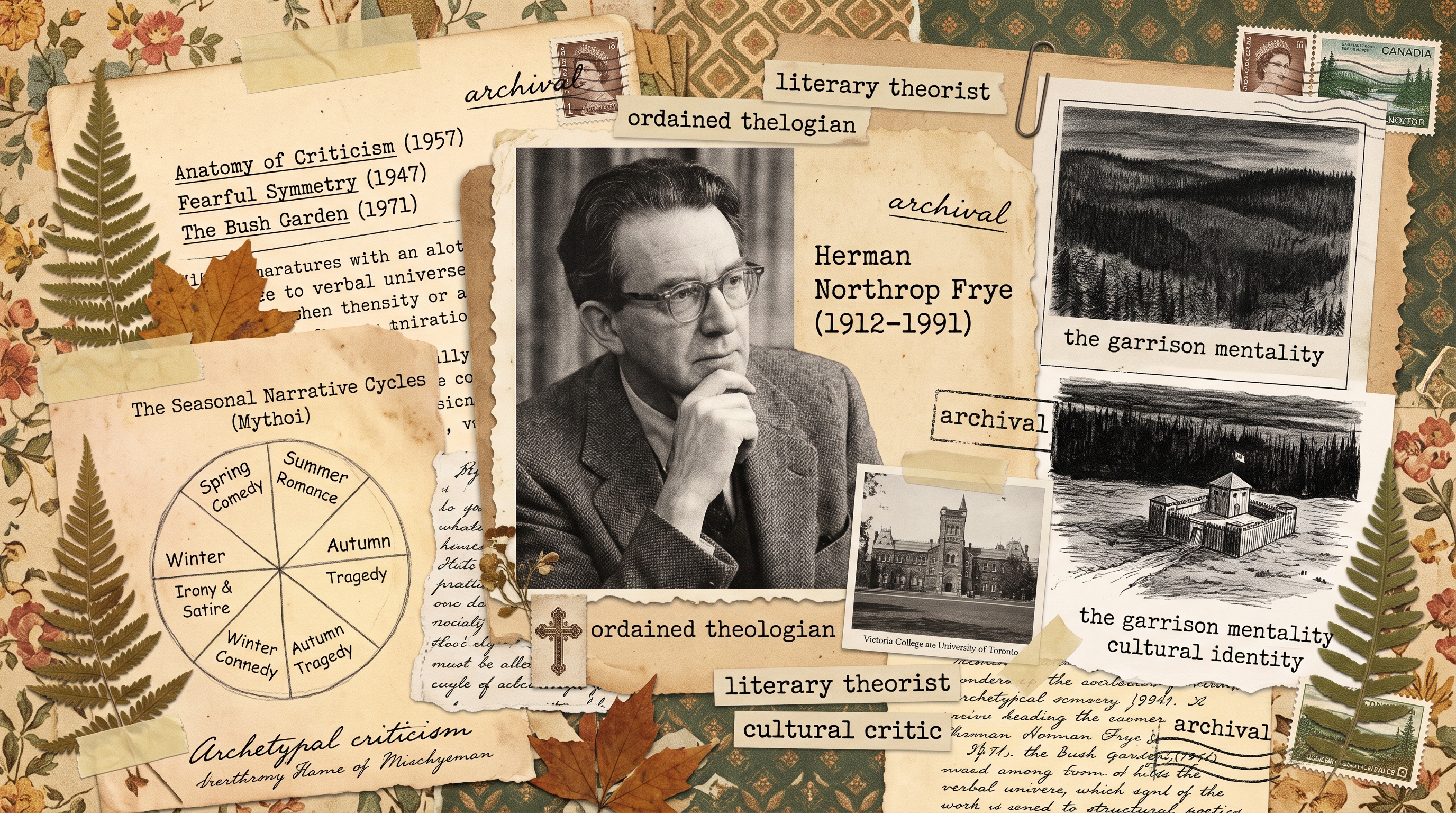
1. Intellectual Biography & The Critical Imperative
Herman Northrop Frye was born in Sherbrooke, Quebec, in 1912, raised in Moncton, New Brunswick, and completed his higher education at Victoria College in the University of Toronto and Merton College, Oxford.[1] In 1936, he was ordained as a minister in the United Church of Canada.[2] Rather than viewing theology and literary theory as contradictory vocations, Frye recognized biblical scripture as the primary imaginative grammar of the Western cultural continuum—a vast architectural matrix of typology, metaphor, and myth that structures Western literature from Dante and Milton to James Joyce and Margaret Atwood.[2:1]
Fearful Symmetry (1947) & The Blakean Breakthrough
Frye's decisive critical breakthrough arrived with Fearful Symmetry: A Study of William Blake (1947). Prior to Frye's intervention, academic literary criticism largely dismissed William Blake's complex prophetic poems (The Four Zoas, Milton, Jerusalem) as the eccentric, unhinged ravings of an isolated mystic.[3] Frye demonstrated that Blake was not operating in idiosyncratic madness, but within a rigorous, deeply coherent mythic system rooted in the Bible, Miltonic epic, and Western hermetic traditions.[3:1][4]
Through his analysis of Blake's mythological pantheon, Frye uncovered the fundamental archetypal architecture of the human imaginative faculty:[3:2]
- Urizen: The petrifying deity of abstract rationalism, spatial measurement, tyrannical moral law, and physical limitation (the architect of mechanical nature).
- Orc: The fiery, rebellious daemon of revolutionary energy, desire, and temporal eruption, doomed to cycle into the tyrannical Urizen when untempered by spiritual vision.
- Los: The heroic prophetic smith and eternal visionary imagination who works at the forge of art to transmute the fallen world of division into poetic form.
- Enitharmon: The spiritual counterpart and female emanation representing space, through whom imaginative creation achieves sensory embodiment.
Grasping that Blake had intuitively reconstructed an overarching grammar of myth, Frye posed the foundational question that would guide the rest of his career: if Blake's verse was governed by an interconnected structural syntax, did all of Western literature share a singular, systematic anatomy?[4:1][5]
The Polemical Introduction: Criticism as an Autonomous Inductive Science
In the mid-twentieth century, literary scholarship was paralyzed between two rival methodologies: traditional biographical-historical philology (which treated literary texts as sociological documents or biographical footnotes) and Anglo-American New Criticism (which championed isolated "close readings" of verbal irony and paradox).[5:1][6] While Frye valued New Criticism's focus on the text, he criticized its atomized insularity: it offered no overarching conceptual framework to connect one poem to another or explain how literature functioned as a totality.[6:1]
In his "Polemical Introduction" to Anatomy of Criticism (1957), Frye diagnosed two crippling theoretical errors in contemporary scholarship:[6:2]
- The Fallacy of Subjective Value Judgments: The confusion of critical analysis with transitory matters of personal taste, moral approval, or prestige-ranking. For Frye, subjective value judgments are culturally variable and pedagogically useless; genuine criticism must discover organizing structures rather than hand out report cards.[6:3]
- The Deterministic Fallacy: The reduction of literary texts to external non-literary frameworks—such as Freudian psychopathology, Marxist dialectical materialism, or orthodox theological dogmatics.[6:4] Deterministic critics treat literature as a collection of symptoms or political propaganda rather than autonomous verbal designs.[6:5]
Frye argued that criticism must operate as an autonomous, inductive science. Just as physics induces laws from the physical cosmos without trying to rewrite gravity, and linguistics derives grammar directly from living speech, literary criticism must discover the organizing principles that inhere directly within the total body of literature—an autonomous order of words.[5:2][6:6]
Centripetal Versus Centrifugal Reading
Frye established that all reading acts navigate between two simultaneous vectors of critical attention:[6:7]
- Centripetal Reading (Inward-Turning): Directs attention inward toward the text's autonomous verbal web, structural motifs, acoustic rhythms, and rhetorical design. In centripetal reading, the primary inquiry is how verbal elements cohere internally within the closed literary structure.[6:8]
- Centrifugal Reading (Outward-Turning): Directs attention outward toward external reality, matching words to empirical facts, historical events, moral propositions, and dictionary definitions.[6:9]
While scientific, philosophical, and informational discourse is fundamentally centrifugal (subordinated to verifiable external facts), imaginative literature is primarily centripetal: its primary meaning arises from its internal verbal coherence and its structural relationship to the broader literary universe.[5:3][6:10]
2. Archetypal Poetics & The Structural Anatomy of Literature
At the center of Anatomy of Criticism is the foundational premise that literature does not directly imitate physical nature or empirical reality; rather, literature imitates other literature.[5:4][7] When a novelist writes a novel or a poet crafts a sonnet, they do not transcribe raw life into language; they reproduce, modify, and reconfigure inherited poetic conventions, genres, tropes, and narrative structures.[7:1]
Literature constitutes an autonomous, self-contained cosmos—the verbal universe—which houses the total imaginative articulation of human desire and dread.[7:2][8] Within this universe, the primary communicative currency is the archetype: a recurring image, symbol, narrative design, or structural convention that links an individual text to the collective tradition of human storytelling.[8:1][9]
| Critical Dimension | Hermeneutic Focus | Directional Vector | Poetic Function |
|---|---|---|---|
| The Verbal Universe | Total imaginative form of human desire | Cosmological totality | Autonomous, self-contained cosmos of literary form that imitates other literature rather than physical nature. |
| Centripetal Reading | Verbal motifs, syntax, and rhetoric | Inward (Textual) | Analyzes internal literary coherence, aesthetic resonance, and autonomous verbal design. |
| Centrifugal Reading | Historical context, signs, and facts | Outward (Referential) | Matches verbal signs to external reality, empirical history, and documentary reference. |
| Archetypal Synthesis | Shared narrative codes and conventions | Intertextual integration | Unites individual verbal motifs with recurring structural archetypes circulating across the literary continuum. |
Frye Versus Carl Gustav Jung: Structural Semiotics vs. Depth Psychology
Although both thinkers popularized the term "archetype" in twentieth-century humanities, Frye was careful to demarcate his formalist literary taxonomy from the biological depth psychology of Carl Gustav Jung:[8:2][9:1]
| Theoretical Dimension | Carl Gustav Jung (Depth Psychology) | Northrop Frye (Structural Poetics) |
|---|---|---|
| Ontological Domain | Psychological, biological, and metaphysical. | Purely structural, linguistic, and literary. |
| Origin of Archetypes | Innate biological memory stored in the neurological "collective unconscious." | Communicable conventions, forms, and genres circulating within the verbal universe. |
| Methodological Function | Used to analyze the psyche, neurotic symptoms, dream-life, and individual individuation. | Used to analyze literary genres, plots, structural motifs, and poetic imagery. |
| Directional Orientation | Backward toward primordial racial memory and animal instinct. | Forward into conscious cultural articulation, art, and poetic form. |
While Jung viewed archetypes as inherited psychological traces residing in the brain, Frye treated archetypes as communicable literary units—objective social conventions that enable authors and readers to share meaning across disparate cultural eras.[8:3][9:2]
The Five Historical Fictional Modes
In the first essay of Anatomy of Criticism, Frye classified narrative literature into five historical fictional modes, determined by the central protagonist's power of action relative to ordinary human beings and their physical environment:[6:11][10]
- Mythic Mode: The protagonist is a divine or supernatural entity, superior in kind both to ordinary human beings and to the laws of physical nature (e.g., creation epics, pantheons of classical deities, scriptural narratives).[10:1]
- Romantic Mode: The protagonist is a human being, but superior in degree to other human beings and to the natural environment. Natural laws are softened: the hero exhibits extraordinary physical prowess, survives impossible trials, and operates in an enchanted landscape (e.g., medieval chivalric romances, Arthurian legends, fairy tales, high fantasy).[10:2]
- High Mimetic Mode: The protagonist is superior in degree to ordinary human beings, but strictly subject to the unforgiving physical and social laws of nature. The hero is a monarch, general, or societal aristocrat whose elevated status amplifies the consequences of their actions. An error in judgment shakes the foundations of the commonwealth (e.g., classical Greek tragedy, Homeric epic, Shakespearean tragedy).[11]
- Low Mimetic Mode: The protagonist is superior neither to other mortals nor to their environment; they are an "everyman" operating on the exact same plane of power and vulnerability as the reader. The narrative explores domestic manners, socio-economic reality, and psychological realism (e.g., eighteenth- and nineteenth-century realistic fiction, Austen, Balzac, Dickens, Flaubert).[10:3]
- Ironic Mode: The protagonist is inferior in power, intellect, or emotional fortitude to the reader. They are trapped in physical bondage, bureaucratic humiliation, or existential absurdity, powerless to alter their oppressive environment (e.g., Franz Kafka, Samuel Beckett, modern existentialism, black satire).[11:1]
| Fictional Mode | Power of Protagonist Relative to Others and Environment | Historical Flowering | Tragic Aspect (Downfall / Isolation) | Comic Aspect (Integration / Renewal) |
|---|---|---|---|---|
| Mythic | Superior in kind to humans and physical nature (Divine). | Ancient Antiquity & Sacred Scripture | The dying and resurrected god; cosmic sacrifice (Dionysus, Osiris). | The apotheosis of the hero; eternal acceptance into the divine pantheon. |
| Romantic | Superior in degree to humans and natural laws (Marvelous). | Middle Ages & Chivalric Epic | The elegiac death of the noble knight (The Song of Roland). | The successful quest, dragon-slaying, and redemption of the kingdom. |
| High Mimetic | Superior in degree to humans, but subject to nature (Epic/Tragic). | Renaissance & Neoclassicism | Aristocratic tragedy; fatal hubris (hamartia) breaking cosmic order (King Lear). | Restorative courtly comedy; noble reconciliation and civic harmony. |
| Low Mimetic | Equal to other humans and physical environment (Realistic). | 18th & 19th Centuries | Domestic pathos; social ruin and bourgeois collapse (Madame Bovary). | Domestic comedy of manners; overcome obstacles culminate in marriage. |
| Ironic | Inferior in power or awareness to reader (Absurd/Victimized). | 20th & 21st Centuries | The complete victimization of the scapegoat (pharmakos); inexplicable dread. | Absurdist exposure of human vanity; intellectual detachment; black comedy. |
The Cyclical Reversal: From Irony Back to Myth
Frye demonstrated that Western literary history followed a linear downward sequence across fifteen centuries: from the mythic narratives of classical antiquity, to medieval romance, Renaissance high mimetic drama, eighteenth- and nineteenth-century low mimetic realism, down to the twentieth-century ironic mode.[6:12][11:2]
Crucially, Frye unmasked a dialectical reversal: when the ironic mode reaches its absolute extreme—stripping the protagonist of all agency and plunging into raw existential absurdity—it curves directly back into myth.[11:3] Modernist and postmodernist literature (such as James Joyce's Ulysses, T. S. Eliot's The Waste Land, and Franz Kafka's parables) employs radical urban irony to reactivate and re-encode primordial archetypes, completing the full wheel of literary history.[6:13][11:4]
Theory of Symbols: The Five Hermeneutic Phases
In the second essay of Anatomy of Criticism, Frye reconfigured the medieval fourfold allegorical schema into five progressive levels or phases of critical reading, demonstrating how the definition of a symbol transforms depending on the critical lens applied:[6:14][12]
| Phase of Interpretation | Primary Critical Focus | Symbol Conception | Directional Vector | Hermeneutic Function |
|---|---|---|---|---|
| 1. Literal Phase | Internal verbal texture, syntax, and acoustic rhythm. | Motif | Purely Centripetal (Inward) | Evaluates the text as a closed verbal pattern; symbols function as repeating motifs. |
| 2. Descriptive Phase | Verisimilitude, representation, and historical facts. | Sign | Purely Centrifugal (Outward) | Matches words to external reality, documentary facts, and historical contexts. |
| 3. Formal Phase | Aesthetic balance between form (gestalt) and content. | Image | Dialectical Equilibrium | Evaluates the work as a conscious imitation of human action (praxis) and thought (theoria). |
| 4. Mythic Phase | Canon-wide narrative conventions and intertextuality. | Archetype | Cultural / Intertextual | Contextualizes the text within the literary continuum, linking it to universal human rituals. |
| 5. Anagogic Phase | Total imaginative containment of reality. | Monad | Infinite / Universal | Comprehends literature in its totality; nature is absorbed inside the human imagination. |
Frye defined a symbol broadly as "any unit of any literary structure that can be isolated for critical attention." At the ultimate anagogic phase, literature ceases to imitate external nature; rather, physical nature is imaginatively captured, transformed, and contained within the infinite human sensorium. The symbol functions as a monad—a unified point of imaginative consciousness embracing all of human existence.[6:15][12:1]
The Four Seasonal Mythoi (The Great Wheel of Narrative)
In the third essay, Frye mapped the narrative structures of all human literature into four cyclical categories, termed mythoi (singular: mythos), which correspond to the astronomical seasons of the natural world:[6:16][13]
| Season | Mythos | Underlying Plot Rhythm | Archetypal Conflict | Terminal Social State |
|---|---|---|---|---|
| Spring | Comedy | Overcoming the obstructive order (senex iratus); rebirth of life and fertility. | Youth vs. Age; Vitality vs. Repressive Law | Inclusive community; reconciliation; marriage banquet. |
| Summer | Romance | The idealized heroic quest: agon (struggle), pathos (death-battle), anagnorisis (recognition). | Good vs. Evil; Light vs. Darkness | Spiritual exaltation; redemption; restored paradise. |
| Autumn | Tragedy | Hubristic violation (hamartia) and fateful collapse; decline from greatness. | Hero vs. Destiny / Cosmic Necessity (nemesis) | Sacrificial death; solemn isolation; catastrophe. |
| Winter | Satire & Irony | Cold empirical realism; unmasking of illusions; bondage of mortal life. | Reality vs. Illusion; Fact vs. Wish | Skeptical disillusionment; prison; existential absurdity. |
| Movement in the Wheel | Seasonal Transition | Narrative & Existential Shift |
|---|---|---|
| Comedy to Romance | Spring → Summer | Advances from the collective integration of society to the elevated quest of the individual hero (agon). |
| Romance to Tragedy | Summer → Autumn | Declines from transcendent fulfillment into heroic vulnerability, hubristic overreach (hamartia), and isolation. |
| Tragedy to Satire & Irony | Autumn → Winter | Descends from aristocratic downfall into skeptical disillusionment, exposure of vanity, and unredeemed mortal limits. |
| Satire & Irony back to Myth / Comedy | Winter → Spring | Completes the dialectical circle: exhausted irony collapses back into primal myth, initiating fresh seasonal renewal and rebirth. |
Each mythos articulates a distinctive stage in the realization or frustration of human desire:[13:1]
- Comedy (Spring): The movement from an irrational, blocking society governed by an authoritarian father-figure (senex iratus) to a free, integrated society consecrated by a wedding or festival.
- Romance (Summer): The pure fulfillment of heroic desire, moving through the perilous journey (agon), the crucial struggle with monsters or death (pathos), and the ultimate recognition of the hero (anagnorisis).
- Tragedy (Autumn): The movement from social inclusion and aristocratic supremacy toward isolation, catastrophe, and sacrificial death, restoring cosmic order through the destruction of an exceptional individual.
- Satire and Irony (Winter): Satire uses militant irony to expose moral vanity and intellectual pedantry, while irony proper depicts human beings trapped in bureaucratic mechanics, physical decay, and absurd suffering without poetic justice.
Polarities of Imagery: Apocalyptic Versus Demoniac
Across all four mythoi, Frye demonstrated that poetic imagery gravitates between two metaphysical poles, representing the complete realization or absolute negation of human desire:[6:17][14]
| Categorical Domain | Apocalyptic Imagery (Fulfilled Desire / Heaven) | Demoniac Imagery (Frustrated Desire / Nightmare) | Analogical Middle World (Physical Nature) |
|---|---|---|---|
| Divine World | Benevolent, unified deity; communion of saints; divine brotherhood. | Capricious, tyrannical despot; blind, hostile fate (moira). | Pagan gods; unpredictable nature spirits; celestial spheres. |
| Human World | One universal human community (Albion; Mystical Body of Christ). | Enslaved mobs; isolated outcasts; cannibalism; the executioner. | Sovereign rulers; domestic families; stratified social classes. |
| Animal World | Gentle pastoral flocks; the lamb, the dove, the faithful hound. | Predatory beasts; the dragon, serpent, wolf, vulture, chimera. | Beasts of burden; domestic cattle; hunted wild game. |
| Vegetable World | The Garden of Eden; fertile orchards; the sacred Tree of Life. | Sinister dark forest; the wasteland; poisonous hemlock and rotting swamps. | Cultivated agricultural fields; seasonal harvest crops; gardens. |
| Mineral World | The Golden City (Jerusalem); palaces of pearl, marble, and gems. | The stone dungeon; the torture chamber; barren crags and labyrinths. | Stone cities; fortress walls; country houses; highways. |
| Water / Fluid World | The Water of Life; sacred cleansing fountains; calm holy rivers. | The tempestuous ocean abyss; stagnant bogs; the lethal deluge. | Navigable rivers; rain clouds; fishing lakes; seasonal tides. |
Between these poles lies the analogical world of physical nature, where mortal humans navigate between the spiritual yearning for apocalyptic communion and the existential dread of demoniac annihilation.[14:1]
Theory of Genres: Radicals of Presentation & Continuous Prose
In the fourth essay, Frye redefined genre not through superficial meters or themes, but through the radical of presentation—the physical and rhetorical relationship established between the author and the audience:[6:18][15]
| Genre | Radical of Presentation | Primary Organizing Rhythm | Historical Manifestations |
|---|---|---|---|
| Epos | The author speaks or chants directly to a physically present, listening audience. | Recurrence (meter, accentual rhythm, rhyme). | Homeric bards, oral epic, ballad singers, troubadours. |
| Fiction | Communicated through the printed book, designed for a solitary, private reader. | Continuity (prose syntax, paragraph architecture). | Modern novels, short stories, philosophical treatises. |
| Drama | Enacted before an audience by performers who impersonate the characters directly. | Decorum (character-appropriate dialogue and dramatic timing). | Classical theatre, Elizabethan drama, modern plays. |
| Lyric | The poet turns their back to the audience; the speech is rhetorically "overheard." | Association (dream-logic, psychological leaps, emotional sound). | Choral odes, meditative sonnets, modern confessional lyric. |
Frye also identified three internal textural elements operating within poetic diction: Melos (musicality, rhythm, and auditory resonance), Opsis (visual design, pattern, and spectacle), and Lexis (the semantic diction and verbal texture).[15:1]
The Four Forms of Continuous Prose Fiction
Frye attacked the uncritical convention of labeling all long narrative prose as "novels," demonstrating that Western prose fiction consists of four distinct, intersecting traditions:[6:19][15:2]
| Form of Prose Fiction | Psychological Focus | Structural Dynamic | Historical Exemplars |
|---|---|---|---|
| Novel | Personal character, manners, and social class. | Realistic, extroverted, social observation. | Jane Austen, George Eliot, Gustave Flaubert, Henry James. |
| Romance | Idealized heroic archetypes and moral allegories. | Mythic, stylized, projection of desire. | Chivalric epics, Walter Scott, Nathaniel Hawthorne, Herman Melville. |
| Confession | Intellectual autobiography and internal spiritual crisis. | Introspective, subjective, philosophical. | St. Augustine, Jean-Jacques Rousseau, Thomas De Quincey. |
| Anatomy (Menippean Satire) | Intellectual pedantry, eccentric theories, and abstract ideas. | Encyclopedic, dialectical, systemic satire. | Robert Burton, Jonathan Swift, Laurence Sterne, Thomas Pynchon. |
Frye emphasized that major prose masterpieces frequently synthesize these four traditions: for example, Herman Melville's Moby-Dick weaves together romance, novel, and anatomy, while James Joyce's Ulysses integrates all four into a single monumental work.[6:20][15:3]
3. Biblical Typology: The Great Code & Words with Power
In the final phase of his scholarly career, Frye produced two landmark treatises: The Great Code: The Bible and Literature (1982) and Words with Power (1990). Frye argued that the Christian Bible provides the overarching imaginative syntax of Western literature, supplying its narrative arc, imagery, and archetypal vocabulary from Genesis (Creation) to Revelation (Apocalypse).[16][17]
Frye highlighted two essential hermeneutic mechanisms:[16:1]
- Typology: The historical and literary structure wherein events, figures, and rituals in the Old Testament function as "types" (prefigurations) that find their spiritual fulfillment in New Testament "antitypes" (e.g., the crossing of the Red Sea prefigures Christian Baptism; the sacrifice of Isaac prefigures the Crucifixion). Typology is not mechanical causality or chronological history; it is a metaphorical and imaginative grammar connecting distinct moments across time into a unified narrative design.[16:2]
- Kerygma: Frye categorized biblical language as kerygmatic—the language of existential proclamation, myth, and imperative metaphor. Kerygma does not function as descriptive, logical proposition (evaluating scientific truth vs. falsehood); rather, it operates as an imaginative revelation that addresses the human will directly, demanding an existential, transformative response from human consciousness.[16:3][17:1]
4. Canadian Cultural Poetics: The Geography of Dread & The Garrison Mentality
In his essays collected in The Bush Garden: Essays on the Canadian Imagination (1971)—and preeminently in his 1965 "Conclusion" to Carl F. Klinck's Literary History of Canada—Frye applied his structural and archetypal framework to the cultural consciousness of Canada.[18][19]
| Dialectical Stage | Spatial & Material Anchor | Affective & Psychological Driver | Cultural & Institutional Outcome |
|---|---|---|---|
| 1. Primary Encounter (The Unclaimed Wilderness) | Vast, indifferent, silent, and menacing northern territory. | Affective shock; terror of physical oblivion and somatic erasure. | Existential dread of an unanswering physical void. |
| 2. Defensive Spatialization (The Fortified Garrison) | Stockade of wood, stone church, colonial outpost, and militia. | Psychic contraction; moral conformity; collective solidarity. | Strict mechanical solidarity; mutual physical reliance. |
| 3. Cultural Internalization (The Garrison Consciousness) | Fortified community; social structures prioritized over individual autonomy. | Suppression of individual deviance and artistic eccentricity. | "Social but not creative"; defensive, didactic, and moralizing art. |
The Spatial Trauma of the Northern Wilderness
Frye argued that early Canadian culture was conditioned not by political ideology or class warfare, but by a distinct geographical trauma: European settlers confronting a colossal, indifferent, and topographically terrifying landmass.[18:1][19:1]
Unlike Europe (which had been humanized, cultivated, and mythologized over millennia) or the American territory (which unfolded across accessible agricultural coastal plains), Canada presented a fractured, non-Euclidean geography dominated by the Canadian Shield: millions of square kilometers of exposed Precambrian granite, dense muskeg, violent waterways, and extreme winter freezes.[18:2][20]
Settlers were not introduced to Canada through a gradual frontier border; rather, they were swallowed whole by the St. Lawrence River—an enormous inland gulf that funneled explorers deep into a continental interior without visible boundaries:[18:3]
"Small and isolated communities surrounded with a physical or psychological 'frontier,' separated from one another and from their American and British cultural sources, then and for a long time made up by immigration, are compelled to feel a great respect for the law and order that holds them together, yet are also conscious of an uncreated emptiness that can easily become a menacing presence." — Northrop Frye, The Bush Garden[18:4]
In this immense emptiness, nature was experienced not as an idyllic garden, but as an active, menacing absence—a silent void threatening to swallow human language, sanity, and bodily life.[18:5][19:2] The affective response was not aesthetic contemplation, but somatic terror, aligning directly with Edmund Burke's physiological sublime, where vastness, obscurity, and the threat of personal destruction provoke involuntary psychological contraction.[20:1]
The Four Pillars of the Garrison Mindset
The garrison was simultaneously a physical fortress of timber stockades and an internalized psychological apparatus. Frye identified four interdependent dynamics that defined this mentality:[18:6][19:3]
- Terror of the Unclaimed Landscape: Nature was coded as an indifferent or malignant antagonist. The settler felt swallowed by a landscape that refused to reflect human meaning, generating an existential dread of disappearing into the "bush" or succumbing to psychic delirium (windigo psychosis or cabin fever).[19:4][21]
- Hyper-Conformity and Mechanical Solidarity: Physical survival against the harsh climate and isolated geography required total, unquestioned devotion to shared institutional authorities: the church, the colonial administrator, and the military garrison.[18:7] In Durkheimian terms, the outpost operated through intense mechanical solidarity; social cohesion was maintained through the rigorous policing of boundaries, strict moral orthodoxy, and punitive suppression of deviancy (see Durkheimian Sociology).[22]
- Suppression of Individualism and Creative Eccentricity: Any deviation from group norms—whether artistic eccentricity, intellectual skepticism, or non-conformist behavior—was perceived as a crack in the palisade that threatened the physical survival of the outpost.[18:8][19:5] The individual ego was forcibly subordinated to collective preservation.
- Didactic, Defensive, and Conservative Art: Literature and visual art produced within the garrison were fundamentally defensive (see Defensive communication tactics).[18:9] Art served a conservative, didactic utility: documenting settlement struggles, instilling Christian morality, recording local topography, or preserving imperial ties to Britain or France, while avoiding radical aesthetic experimentation or philosophical exploration.[18:10][19:6]
CanLit Archetypes: The Literary Anatomy of the Garrison
Frye’s garrison thesis provided the foundational interpretive lens for generations of Canadian literary scholars in English-language Canadian Literature (English CanLit):[19:7][23]
| Paradigm | Author & Landmark Text | Core Spatial Adversary | Garrison Mechanism |
|---|---|---|---|
| Pioneer Terror | Susanna Moodie Roughing It in the Bush (1852) | Landscape as alien monster; physical wilderness and disease. | Breakdown of British social class; retreat behind moral piety and imperial manners. |
| Epic Resistance | E.J. Pratt Brébeuf and His Brethren (1940) Towards the Last Spike (1952) | Precambrian granite; primeval reptilian topography. | Disciplined human collective; the transcontinental railway as an iron garrison. |
| Prairie Claustrophobia | Sinclair Ross As for Me and My House (1941) | Vast, empty sky; barren horizontal plains and drought. | Town gossip as a psychological stockade; false building fronts guarding against the void. |
| The Victim Thesis | Margaret Atwood Survival: A Thematic Guide (1972) | Indifferent nature; cultural imperialism; cosmic disregard. | Survival as endurance; classification of four victim positions. |
| The Theological Rebuttal | D.G. Jones Butterfly on Rock (1970) | Old Testament wilderness exile of rock and snow. | Dismantling garrison walls; cultivating vulnerability and reconciliation with the land. |
Susanna Moodie: Pioneer Exile (Roughing It in the Bush, 1852)
An educated British gentlewoman expecting a romantic Arcadia, Moodie encountered crude log shanties, blackfly swarms, cholera, and an impenetrable forest.[23:1] Moodie depicted the bush as a dark monster stripping settlers of civilized veneer, wavering between imperial moralizing and unvarnished horror at the physical and psychological toll of pioneer exile.[19:8][23:2]
E.J. Pratt: The Disciplined Collective Against the Shield
Poet E.J. Pratt transposed the garrison into modernist verse in Towards the Last Spike (1952), personifying the Canadian Shield as a primeval reptilian monster whose granite ribs crush human intruders.[24] The heroic agent in Pratt's work is never an isolated frontiersman, but the disciplined collective—laborers, technicians, and politicians working in coordinated harmony.[18:11][24:1] The transcontinental railway functions as a linear, mobile iron garrison slicing through an untamed continent to bind isolated outposts into a confederation.[18:12]
Margaret Atwood: Survival and the Four Victim Positions (1972)
Margaret Atwood synthesized Frye's thesis, arguing that while American literature is organized around the Frontier (conquest) and British literature around the Island (imperial order), Canadian literature is organized around Survival / The Victim:[21:1]
| Position | Stance | Psychological Posture | Operational Dynamic |
|---|---|---|---|
| Position One | Deny victimhood | Unconscious repression | "Everything is fine; no trauma exists." Ignorance of systemic oppression or threat. |
| Position Two | Acknowledge victimhood | Passive resignation | Attributes suffering to inevitable fate, malignant nature, or divine will; paralysis. |
| Position Three | Repudiate victimhood | Active resistance | Identifies systemic causes of oppression; channels anger into collective political resistance. |
| Position Four | The Creative Non-Victim | Transcendent autonomy | Transcends defensive paranoia into authentic, self-determined cultural creation. |
Comparative Matrix: Canadian Garrison vs. American Frontier Myth
The Canadian garrison mentality is best illuminated through a direct dialectical comparison with the American frontier mythology formulated by Frederick Jackson Turner in The Significance of the Frontier in American History (1893):[18:13][25]
| Spatial & Mythic Dimension | American Frontier Myth | Canadian Garrison Mentality |
|---|---|---|
| Directional Dynamic | Centrifugal (outward territorial expansion; border-crossing). | Centripetal (inward defensive retreat; perimeter-maintenance). |
| Perception of Nature | Romantic challenge; virgin territory awaiting heroic conquest. | Indifferent abyss; silent void threatening human erasure. |
| Heroic Archetype | Rugged individualist; solitary pioneer, scout, or cowboy. | Disciplined collective; Mountie, priest, surveyor, survivalist. |
| Civic Orientation | Skeptical and adversarial toward centralized state authority. | Deferential to legal order, the Crown, and institutional authority. |
| Constitutional Axiom | "Life, Liberty, and the Pursuit of Happiness" (1776). | "Peace, Order, and Good Government" (1867). |
| Overarching Imperative | Manifest Destiny; heroic mastery and continuous mobility. | Survival; vigilant preservation of the physical and moral perimeter. |
| Metaphysical Horror | Terror of confinement, enclosure, and domestication. | Terror of being swallowed or erased by empty space (nature's silence). |
| Ideological Counterpart | American Transcendentalism (Emerson, Thoreau's communion with nature). | Edmund Burke-The Physiological Sublime (Somatic terror of vastness). |
5. The Spatial Mutation: From Walls of Wood to Walls of Glass (The Condominium Mentality)
By the late 1980s, Frye observed that Canada had undergone a rapid sociological transition: the rural, resource-extraction settler nation had transformed into one of the most hyper-urbanized societies on earth, with the overwhelming majority of its population concentrated in metropolitan clusters like Toronto, Montreal, and Vancouver.[18:14][26]
Addressing this spatial evolution, Frye noted that while the historic wooden garrison had vanished from the physical landscape, the underlying psychology of isolation had not dissolved. Instead, it had mutated into a far more alienating urban pathology: the condominium mentality.[18:15][26:1]
- The Historic Garrison (Walls of Wood): "Social but not creative." It forced intense, visceral human interdependence, mutual reliance, and rigorous community organization out of physical necessity against a lethal climate. While its defensive conformism stifled artistic risk, it forged authentic communal solidarity.[18:16][26:2]
- The Modern Condominium (Walls of Glass): "Neither social nor creative." It packs thousands of individuals into dense, vertical concrete hives while completely atomizing them socially. Inhabitants dwell in extreme physical proximity while maintaining absolute psychological and civic detachment.[26:3][27]
| Dimension | Historic Timber Garrison (18th–19th Century) | Modern Glass Condominium (Late 20th–21st Century) |
|---|---|---|
| Physical Material | Logs, earth, timber stockades, stone churches. | Reinforced concrete, value-engineered glass curtain walls. |
| Defensive Perimeter | Keeps out hostile wilderness, freezing cold, and solitude. | Walls off the public street, socioeconomic inequality, and civic friction. |
| Social State | Interdependent survival; mechanical solidarity. | Radical atomization; vertical density without community. |
| Inhabitant Psychology | Mutual reliance, moral surveillance, and existential dread. | Deliberate anonymity, neighborly detachment, and Simmel's blasé attitude. |
| Frye's Cultural Formula | "Social but not creative" (solidarity forged by necessity). | "Neither social nor creative" (introverted consumer detachment). |
The Four Dimensions of Modern High-Rise Pathology
- The Architecture of Introverted Enclosure and Public Retreat: Where the log stockade was engineered to hold back blizzards and wild animals, the glass condominium tower is engineered to wall off the chaotic, unpredictable public sphere of the late-capitalist city: traffic, homelessness, social inequality, noise, and civic friction.[26:4][28] Equipped with electronic keyfobs, private concierges, surveillance cameras, underground parking, and subterranean shopping corridors (such as Toronto's PATH system), the resident can live, work, exercise, and consume without ever stepping onto the municipal street.[26:5][28:1]
- Proximity Without Community (Vertical Density): The condominium embodies a profound sociological paradox: hyper-density paired with radical social isolation.[26:6][27:1] Hundreds of people live separated by eight inches of poured concrete, yet consciously develop rigid behavioral defense mechanisms to safeguard privacy. In elevators and lobbies, residents avert eye contact and maintain silence—manifesting Georg Simmel's "blasé attitude" formulated in The Metropolis and Mental Life (see Georg Simmel's concept of The Stranger).[27:2][29] Shared amenities (rooftop pools, screening rooms) simulate community within a controlled, commercially sanitized environment restricted strictly to property owners.[26:7][28:2]
- Financialization of Domestic Space and Transience: In the condominium regime, the architectural unit undergoes a radical metaphysical shift: it ceases to be an authentic home (Heim) rooted in neighborhood memory; instead, it is experienced primarily as a financial asset, speculative deposit box, or transient investment vehicle.[26:8][27:3] As real estate is integrated into global capital circuits, speculative ownership breeds civic disengagement. Occupants view their living space as a temporary stepping stone for capital appreciation, investing zero emotional or political energy in local schools, municipal politics, or neighborhood preservation.[26:9][27:4]
- Psychological Repercussions on Art and Consciousness: Frye warned that the condominium mentality exerts an even more debilitating effect on artistic and intellectual production than the historic garrison.[18:17][26:10] While the settler writer struggled against an unmastered, awe-inspiring physical nature that elicited profound (if terrified) emotional responses, the condominium dweller is enclosed within an environment of sterile, climate-controlled comfort.[26:11][27:5] The walls of glass provide panoramic visual access to the horizon, but this view is entirely passive, voyeuristic, and disembodied.[26:12] Modern urban alienation shifts from the struggle to survive the elements to the struggle to survive claustrophobia, digital atomization, and existential invisibility.[27:6][30]
Architectural Affinities: Modernist Transparency & The Urban Uncanny
Northrop Frye’s diagnosis of the transition from wooden walls to glass walls directly intersects with architectural history and spatial theory:
| Architectural Phase | Material & Structural Form | Ideological Vector | Experiential Reality |
|---|---|---|---|
| High Modernist Utopia (The Bauhaus Ideal) | Transparent glass curtain walls, open spans, clean geometry. | Democratic liberation, physical hygiene, daylight, and civic openness. | Optimistic dissolution of bourgeois domestic enclosure. |
| Corporate Commodification (Speculative Enclosure) | Value-engineered curtain walls, thin drywall skins, micro-unit footprints (MURBs). | Real estate financialization; capital extraction; acoustic leakage. | Compression of private space; commodified pseudo-amenities. |
| Panoptic Condos of Estrangement (The Architectural Uncanny) | High-rise vertical hives; floor-to-ceiling glass exposure without privacy. | Late-capitalist real estate assetization; disembodied visual consumption. | Anthony Vidler's architectural uncanny: total exposure without connection; spatial dread and voyeurism. |
The glass curtain wall was originally championed by avant-garde architects of The Bauhaus School (such as Walter Gropius and Mies van der Rohe) as a utopian instrument of democratic liberation and spiritual transparency.[31] However, as architectural theorist Anthony Vidler demonstrated in The Architectural Uncanny (1992), this dream underwent a catastrophic inversion when co-opted by speculative late capitalism:[27:7][31:1]
- The Transparent Trap: By eliminating protective masonry, glass towers subject residents to panoptic exposure.[27:8] The inhabitant lives on display behind a transparent skin, exposed to adjacent towers while feeling completely disconnected from the bodies visible across the void.[27:9]
- Material Pathology and the MURB: As analyzed in Canada's Housing Crisis - Designing Better Buildings, commercial developers stripped modernism of its social ideals, deploying value-engineered curtain walls and micro-unit footprints in Multi-Unit Residential Buildings (MURBs).[32] Defective acoustic compartmentalization (hearing neighbors' footsteps, appliances, or voices through drywall) creates an invasive, unhomely intimacy with strangers, forcing residents deeper into psychological withdrawal.[32:1]
- The Uncanny Home (Das Unheimliche): Modern functionalist architecture converted the home into an apparatus of estrangement.[27:10] Frye's condominium tower is the architectural uncanny materialized as a vertical city: a site engineered for domestic shelter that produces acute existential homelessness.[18:18][27:11]
The Toronto School Media Ecology Synthesis: Innis & McLuhan
Frye’s spatial insights operate in deep synergy with his University of Toronto colleagues in media ecology: Harold Innis and Marshall McLuhan.[20:2][33]
- Innis and Space-Binding Architecture: In Innis (1950) - Empire and Communications and Innis (1951) - The Bias of Communication, Innis demonstrated that imperial systems rely on space-binding media (railroads, print, administrative networks) to control vast peripheries from central hubs.[20:3] The Canadian railway praised by Pratt was the ultimate space-binding technology, welding disparate outposts into a single nation.[18:19][20:4] The modern condominium represents the terminal phase of space-binding: an architecture that compresses physical space to maximum economic yield, while annihilating time-binding traditions—local folkways, historical memory, and enduring communal ties.[20:5]
- McLuhan and the Electronic Surround: McLuhan declared in McLuhan's The Medium is the Message that electronic media abolish spatial distance, returning humanity to an acoustic "global village."[33:1] Yet Frye understood that this electronic village does not produce harmonious community; rather, it produces an intensely introverted, nervous consciousness. Inside the condominium, residents interact with the globe via computer screens and fiber-optic cables, while maintaining complete numbness toward the human being living behind the adjacent plaster wall.[26:13][33:2]
6. Historical Synthesis, Critiques & Decolonial Revaluations
| Dimension | 1. Settler Garrison (18th–19th Century) | 2. Industrial / National Frontier (Early–Mid 20th Century) | 3. High-Rise Condominium (Late 20th–21st Century) | 4. Digital / Algorithmic Enclosure (Contemporary) |
|---|---|---|---|---|
| Architectural Form | Wooden log stockade, stone church, frontier fort, agricultural clearing.[18:20][23:3] | Transcontinental railway, industrial factory, mining camp, prairie grain elevator.[20:6][24:2] | High-rise concrete and glass tower, multi-unit residential building (MURBs), underground concourse.[26:14][27:12] | Smart condo, home-office work pod, biometric surveillance corridor, digital delivery platform.[27:13][33:3] |
| External Menace | Immense, silent northern wilderness; freezing climate; physical annihilation.[18:21][20:7] | Precambrian granite, geographic distance, continental disintegration, economic collapse.[24:3] | The chaotic municipal street, crime, social inequality, pollution, urban decay.[26:15][28:3] | Algorithmic tracking, informational overload, sensory fatigue, public health crises.[33:4] |
| Social Mechanism | Mechanical solidarity; absolute moral conformity; suppression of deviance.[18:22][22:1] | Coordinated industrial labor; corporate organization; national infrastructure projects.[24:4] | Radical atomization; deliberate neighborly anonymity; Simmel's blasé attitude.[26:16][29:1] | Platform capitalism; continuous network modulation; digital consumption pods (see Postscript on the Societies of Control).[27:14] |
| Frye's Formula | "Social but not creative." (Survival through collective cohesion).[18:23][26:17] | Institutional and productive. (Mastery through coordinated engineering).[24:5] | "Neither social nor creative." (Proximity without community; passive consumption).[18:24][26:18] | Hyper-connected yet profoundly disembodied. (Algorithmic isolation).[33:5] |
| Artistic Manifestation | Didactic journals, pioneer memoirs, hymns, moralizing colonial verse (Moodie).[23:4] | Heroic documentary verse, corporate national epics (E.J. Pratt), regional realism.[24:6] | Claustrophobic urban fiction, poetry of metropolitan estrangement, minimalist prose.[27:15][30:1] | Postmodern media critique, autofiction, fragmented digital narratives (see Don DeLillo Major Themes Analysis).[30:2] |
Major Theoretical Challenges
Despite its immense influence, Frye's corpus provoked intense debate across multiple disciplines:
- Settler-Colonial Solipsism & Indigenous Erasure: Indigenous writers and scholars (such as Thomas King, Lee Maracle, and Armand Garnet Ruffo) demonstrated that Frye’s foundational premise—that early Canada was an unpeopled, terrifying, and hostile "wilderness"—universalized the psychological pathology of the European colonizer while completely erasing Indigenous peoples.[34] For First Nations, Inuit, and Métis nations, the northern landscape was never an indifferent void or menacing beast, but a sacred ancestral home stewarded through reciprocal ecological kinship.[34:1] The garrison was not a heroic outpost of civilization holding back barbarism; it was an armed colonial beachhead deployed to dispossess Indigenous nations and extract resources.[34:2] Settler dread was fundamentally an expression of colonial guilt and displacement—the psychological terror of living upon stolen land without authentic belonging.[34:3]
- Thematic Reductionism (Frank Davey): In Surviving the Paraphrase (1976), Frank Davey criticized thematic criticism for reducing literature to crude sociological content.[35] Davey argued that Frye and Atwood evaluated literary texts merely to see if they confirmed a pre-determined national victim neurosis, ignoring poetic language, aesthetic form, postmodern irony, and experimental craft. Furthermore, it imposed a monolithic, Toronto-centric Anglo-Canadian myth that marginalized French-Canadian writing, immigrant voices, and urban complexity.[23:5][35:1]
- Environmental Determinism vs. Discursive Construction (Eli Mandel): Scholar Eli Mandel challenged Frye’s implication that raw physical geography mechanically dictates human psychology.[36] Landscape in literature is never raw geology; it is always an invented textual construct, mediated through inherited language, cultural mythologies, and ideological frameworks.[36:1] The Canadian wilderness did not create the garrison; the European settler’s cultural baggage constructed the garrison and projected its own anxieties onto the northern horizon.[23:6][36:2]
- Ahistorical Formalism: Marxist critics (notably Terry Eagleton and Fredric Jameson) argued that in Anatomy of Criticism, Frye detached literature from material class struggle and economic production, enclosing art within a self-generating, politically sanitized verbal universe insulated from historical violence.[37]
7. Synoptic Key Concepts Matrix
| Term | Analytical Domain | Operational Definition |
|---|---|---|
| Verbal Universe | Structural Poetics | The total, self-contained cosmos of imaginative writing that imitates other literature rather than physical nature. |
| Archetype | Symbolic Theory | A recurring literary convention, motif, or narrative design that connects an individual text to the collective literary tradition. |
| Mythos (pl. Mythoi) | Narrative Theory | One of four primary cyclical plots aligned with astronomical seasons: Comedy (Spring), Romance (Summer), Tragedy (Autumn), Satire/Irony (Winter). |
| Radical of Presentation | Theory of Genres | The physical and rhetorical relationship between author and audience determining genre (Epos, Fiction, Drama, Lyric). |
| Anagogy | Hermeneutics | The ultimate phase of symbolism wherein the natural universe is completely absorbed inside infinite human imagination. |
| Centripetal Reading | Critical Method | Inward-turning analysis focusing on internal verbal motifs, syntax, and structural patterns. |
| Centrifugal Reading | Critical Method | Outward-turning analysis referencing external historical facts, biographical data, and empirical realities. |
| Anatomy | Prose Theory | Menippean satire characterized by encyclopedic erudition, intellectual debates, and systemic critique of human folly. |
| Typology | Biblical Hermeneutics | The imaginative historical grammar connecting Old Testament "types" (prefigurations) to New Testament "antitypes" (fulfillments). |
| Kerygma | Biblical Hermeneutics | Proclamatory, mythic language in scripture that transcends descriptive logic to provoke existential transformation. |
| Garrison Mentality | Cultural Poetics | The inward-turned, defensive psychological stance of isolated settler communities confronting an indifferent wilderness. |
| Condominium Mentality | Urban Poetics | Modern high-rise urban existence characterized by dense physical proximity coupled with absolute social atomization. |
🎴 Interactive Web Practice (Comprehension Check)
Question 1 (Archetypal Poetics & The Verbal Universe): How does Northrop Frye define the "verbal universe," and why does his conceptualization of the literary archetype differ fundamentally from Carl Gustav Jung's psychological model?
Answer: Northrop Frye defines the "verbal universe" as the autonomous, self-contained totality of imaginative writing. In Frye's poetics, literature does not directly imitate physical reality or empirical nature; rather, it imitates other literature, drawing upon inherited genres, structural tropes, and symbolic codes. Within this framework, an archetype is a communicable structural unit, convention, or recurring symbol that integrates an individual literary work into the broader literary continuum.
This diverges fundamentally from Carl Gustav Jung's archetype:
- Jung's Archetype: Grounded in evolutionary psychology and the occult unconscious; viewed as an innate, inherited neuro-biological trace or racial memory residing in the human "collective unconscious."
- Frye's Archetype: Grounded purely in literary form and structural semiotics; treated as a communicable artistic convention circulating within the social and verbal universe. Frye rejects psychological reductionism, insisting that literary archetypes must be understood through the formal grammar of storytelling rather than clinical case studies.
Question 2 (Fictional Modes & The Cyclical Reversal): How does Frye classify the five historical fictional modes, and what constitutes the dialectical reversal that occurs when the ironic mode reaches its extreme limit?
Answer: Frye classifies fictional modes based on the central protagonist's power of action relative to other human beings and their physical environment:
- Mythic: The hero is a divine being, superior in kind both to humans and to natural laws.
- Romantic: The hero is human, but superior in degree to others and to natural constraints (performing marvelous feats under enchanted laws).
- High Mimetic: The hero is superior in degree to ordinary humans, but strictly bound by physical and social laws (aristocratic, tragic, or national leaders).
- Low Mimetic: The hero is an everyday "everyman," equal in degree to the reader and bound by ordinary realistic laws.
- Ironic: The protagonist is inferior in power, intellect, or awareness to the reader, trapped in frustration, absurdity, or social servitude.
Question 3 (The Seasonal Mythoi & Polarities of Imagery): Explain the operational relationship between Frye's four seasonal mythoi and the two metaphysical extremes of poetic imagery (Apocalyptic vs. Demoniac).
Answer: Frye's four seasonal mythoi represent the cyclical movement of narrative matching the natural astronomical and biological cycles:
- Spring (Comedy): Movement from social rigidity and repression to rebirth, social integration, and festive communion.
- Summer (Romance): The pure fulfillment of human desire through the tripartite heroic quest (agon, pathos, anagnorisis).
- Autumn (Tragedy): The decline from greatness into isolation, hubris (hamartia), and inevitable sacrificial death (nemesis).
- Winter (Satire & Irony): The cold unmasking of illusions, moral satire, and the depiction of unredeemed human bondage.
- Apocalyptic Imagery: The world of completely fulfilled human desire (Heaven, New Jerusalem, the fertile Garden of Eden, gentle pastoral flocks, divine communion). Romance operates in proximity to the apocalyptic pole, while Comedy moves upward toward it.
- Demoniac Imagery: The world of rejected desire and nightmare (the labyrinth, the torture chamber, barren wastelands, ferocious monsters, predatory wolves, and social enslavement). Tragedy moves toward the demoniac pole, while Satire and Irony depict existence trapped within it.
Question 4 (The Garrison Mentality vs. American Frontier): What historical conditions produced the Canadian "garrison mentality," and how does early Canadian settlers' psychological response to the wilderness diverge from the American frontier myth?
Answer: Northrop Frye formulated the "garrison mentality" in his 1965 "Conclusion" to the Literary History of Canada to describe the defensive, inward-turning psychological posture of early European settlers confronted by an overwhelming, unmapped, and physically forbidding northern wilderness. Lacking the cultural familiarity of Europe or the accessible, agricultural terrain of early America, Canadian settlers perceived nature not as a romantic garden to be enjoyed or an open frontier to be conquered, but as an active, indifferent abyss capable of obliterating human identity, language, and physical life.
To survive against this existential terror, settler communities organized themselves into tightly enclosed physical and psychological outposts (the garrison). This condition produced four interlocking cultural traits:
- Terror of the Unclaimed Void: The landscape was viewed as an alien force threatening human erasure.
- Compulsory Moral Conformity: Group survival demanded absolute submission to institutional authority (church, colonial state, military hierarchy) and intense mechanical solidarity.
- Suppression of Individualism: Artistic eccentricity or individual non-conformity was aggressively suppressed because social deviance was viewed as a fatal breach in the community's defensive perimeter.
- Didactic, Survival-Oriented Art: Cultural expression prioritized moral preservation, practical instruction, and defensive utility over aesthetic exploration.
Question 5 (The Condominium Mentality & The Architectural Uncanny): How does Frye contrast the modern "condominium mentality" with the historic "garrison mentality," and how does high-rise architecture embody Anthony Vidler's architectural uncanny?
Answer: In his late cultural writings during the late 1980s, Frye diagnosed the mutation of the Canadian landscape from rural settler outposts into hyper-dense metropolitan cores. He identified a crucial dialectical shift in the psychology of isolation:
- The Historic Garrison: "Social but not creative." Although its moral rigidity and conformity suppressed individual artistic experimentation, it forced intense mutual dependence, human solidarity, and visceral communal organization out of raw physical necessity against a hostile climate.
- The Modern Condominium: "Neither social nor creative." The modern high-rise condominium tower stacks thousands of human beings into vertical concrete hives while completely atomizing them socially, fostering an introverted lifestyle centered around private domestic consumption and digital detachment.
- The Blasé Gaze: In elevators, lobbies, and corridors, residents avert eye contact and maintain silence, adopting Georg Simmel's "blasé attitude" as a defensive shield against unwanted interpersonal intimacy.
- The Enclosure of the Street: Where the wooden fort was designed to keep out wild beasts and freezing blizzards, the condominium's keyfobs, private concierges, underground parking, and indoor shopping tunnels wall off the civic street—isolating residents from the messy, heterogeneous public realm.
- The Architectural Uncanny (Anthony Vidler): Transparent glass curtain walls eliminate the protective domestic envelope, leaving residents exposed to panoptic surveillance from adjacent towers without genuine connection. Combined with poor acoustic compartmentalization in modern multi-unit residential buildings (MURBs), the home ceases to be a rooted sanctuary (*Heim*) and becomes an uncanny site of spatial estrangement and speculative financial transience (*das Unheimliche*).
Resonant Notes
The following notes in the vault share direct thematic, sociological, and literary connections with Northrop Frye:
🔴 Archetypal Poetics, Myth & Narrative Structure
- Joseph Campbell and the Hero's Journey — Campbell's Monomyth represents the Jungian psychological counterpart to Frye's Summer mythos of Romance; while Campbell interprets the quest cycle through internal psychic individuation, Frye treats it as an objective structural pattern circulating within the verbal universe.
- Arnold van Gennep (1873–1957) — Van Gennep's tripartite anthropological schema of rites of passage (Separation, Transition, Incorporation) directly informed the archetypal quest rhythm (agon, pathos, anagnorisis) that Frye systematizes in the seasonal mythoi.
- Goethe's Faust — Goethe's two-part verse tragedy encapsulates Frye's entire modal wheel, ascending from the Low Mimetic bourgeois crisis of the scholar's study into the High Mimetic Gretchen tragedy, the Romantic realm of Helen of Troy, and the final Mythic-Anagogic redemption governed by the Eternal Feminine.
- Friedrich Nietzsche (1844-1900) — Nietzsche's tragic paradigm in The Birth of Tragedy—balancing the Apollonian drive for architectural form and clarity against the Dionysian abyss of dissolution—resonates directly with Frye's dialectic between apocalyptic form and the demoniac chaos of the unredeemed world.
- Carl Gustav Jung — The primary psychological interlocutor for archetypal theory; Frye's structural criticism adapts Jung's concept of the archetype while stripping away its biological and occult claims, transposing the archetype into a purely communicable literary convention.
- Edgar Allan Poe (1809-1849) — Poe's aesthetic doctrine of the "Unity of Effect"—insisting that every linguistic unit within a tale must serve a predetermined structural architecture—exemplifies Frye's centripetal literal reading phase and the autonomy of the verbal artifice, while his tales of claustrophobic doom dramatize the demoniac pole of imagery and the descent into irony.
- Henry James (1843—1916) — James's developmental trajectory from international social realism to dense psychological interiority maps directly onto Frye's structural progression from the Low Mimetic to the Ironic mode of literary history, while his use of the "central consciousness" exemplifies the formal radical of presentation.
- Norman Mailer — Mailer's Manichean worldview—framing human existence as a visceral battle against technocratic stasis, corporate conformity, and spiritual entropy—operates at the turbulent intersection of High Mimetic heroic striving and Ironic defeat, echoing Frye's dialectic between apocalyptic vision and demoniac entrapment.
- Analytic Philosophy — While approaching language from a logical rather than poetic orientation, this note's engagement with systematic classification, formal rigor, and the demarcation problem mirrors Frye's ambition to establish literary criticism as an autonomous, inductive discipline.
🟡 Canadian Cultural Identity, Landscape & The Geography of Isolation
- English-language Canadian Literature (English CanLit) — The historical canon survey illustrating how Frye's garrison thesis and Margaret Atwood's Survival shaped Canadian Prairie realism, thematic criticism, and contemporary post-colonial revisions.
- Group of Seven (also known as the Algonquin School) — The visual arts manifestation of the garrison crisis; Canadian landscape painters confronted the vast, unyielding granite of the Canadian Shield, translating settler terror and topographical sublime into a national visual iconography.
- Innis (1951) - The Bias of Communication & Innis (1950) - Empire and Communications — Harold Innis and Frye stand as the intellectual twin pillars of the Toronto School; where Innis examined how space-binding and time-binding media physicalize empires across geography, Frye examined how the verbal universe binds imaginative consciousness against geographic emptiness.
- Edmund Burke-The Physiological Sublime & The Sublime — Burke's somatic sublime—centered on terror, vastness, obscurity, and the threat of self-preservation—provides the affective philosophical vocabulary for settler dread of the Canadian wilderness, explaining the defensive contraction into the garrison.
- American Transcendentalism — The sharpest ideological counter-model to Frye's garrison mentality; while Emerson and Thoreau celebrated untamed nature as a Romantic temple of individual freedom and divine communion, the Canadian imagination historically experienced untamed nature as an indifferent, crushing antagonist.
- Why Canada Will Never Have a WeChat — Explores Canadian cultural preferences for institutional fragmentation, minimalism, and resistance to monolithic systems—reflecting the deep historical legacy of regionalism, boundary maintenance, and the defensive "garrison mentality."
- Durkheimian Sociology — Émile Durkheim's concepts of mechanical solidarity and collective consciousness illuminate the early garrison's moral conservatism, where external survival pressures enforce punitive conformity and subordinate individual deviation to group preservation.
- Defensive communication tactics — Frye's garrison mentality operates as a macro-cultural defensive apparatus—erecting psychological, moral, linguistic, and physical barriers to insulate vulnerable communities from perceived external threat and chaotic change.
- The Nightmare — Henry Fuseli's Gothic depiction of sleep paralysis, incubus oppression, and somatic dread visually manifests the horror of the unprotected subject; the fragile threshold of the bed mirrors the vulnerable perimeter of the garrison holding back the threatening darkness of the wilderness and the unconscious.
- Sehnsucht — The profound, unfulfillable yearning at the core of Romanticism directly echoes the Canadian settler's spatial melancholia—an unresolved longing for an ancestral European home combined with existential dislocation in an unanswering northern topography.
🟢 Architecture, Modernist Estrangement & Semiotic Systems
- Anthony Vidler-The Architectural Uncanny — Vidler maps Freud's das Unheimliche onto modern architecture, demonstrating how environments built for domestic refuge become sites of spatial dread and bodily estrangement; Frye's condominium tower is the architectural uncanny materialized as a vertical glass fortress producing dense proximity without community.
- The Bauhaus School — Pioneers of functionalist geometry and transparent glass curtain walls; Frye diagnoses the modern condominium's glass perimeter as the late-capitalist commodification of Bauhaus utopian transparency—substituting genuine civic solidarity with sterile, privatized vertical enclosures.
- Canada's Housing Crisis - Designing Better Buildings — An evidence-based analysis of multi-unit residential buildings (MURBs); examines how speculative value-engineering, poor acoustic compartmentalization, and spatial defects physically reinforce the social alienation and psychological withdrawal of Frye's condominium mentality.
- Ayn Rand's The Fountainhead - An Explanation — Howard Roark's uncompromising architectural functionalism champions geometric purity, structural integrity, and anti-ornamental modernism, providing the ideological counterpoint to Frye's critique of the sterile, dehumanizing effects of modern functionalist high-rises.
- William H. Whyte's The Organization Man & William H. Whyte's Social Ethics — Whyte diagnoses mid-century corporate conformity (the "Social Ethic") as an ideological surrender of individual autonomy to group belonging, echoing Frye's garrison where collective survival demands rigid moral consensus and the suppression of creative eccentricity.
- Walter Benjamin (1892–1940) & The flâneur — Benjamin's analysis of nineteenth-century Parisian arcades and the urban wanderer stands as the historic antithesis to the condominium mentality; where the flâneur immersed himself in the fleeting democratic spectacle of the public street, the condominium dweller retreats into keyfob-secured private enclosures.
- Georg Simmel's concept of The Stranger & Georg Simmel (1858-1918) — Simmel's spatial sociology of the stranger—defined by the synthesis of physical nearness and social remoteness—together with his diagnosis of the "blasé attitude" in metropolitan mental life, provides the core sociological explanation for condominium inhabitants living inches apart while sustaining deliberate anonymity.
- Marshall McLuhan (1911-1980) & McLuhan's The Medium is the Message — Frye's Victoria College colleague at the University of Toronto; while Frye mapped the internal symbolic codes of the "verbal universe," McLuhan investigated the sensory and psychic impact of the media environments that transmit those codes.
- Jacques Lacan — Lacan's formulation of the Symbolic Order as an autonomous linguistic network that pre-exists and constructs human subjectivity closely mirrors Frye's insistence that literature constitutes a self-contained verbal universe that shapes human consciousness.
- Don DeLillo Major Themes Analysis — DeLillo's postmodern novels operate squarely within Frye's Winter mythos of Satire and Irony, dramatizing a society where heroic agency is paralyzed by media saturation, systems paranoia, and commercial simulation.
- The Dehumanization of Art — Ortega y Gasset's modernist thesis that art must achieve autonomy from human sentimentality and direct realism directly mirrors Frye's formalist principle that literature does not imitate physical life, but rather refines its own internal formal codes.
- Theories of the Avant-Garde (Poggioli & Bürger) — Peter Bürger's institutional critique and Renato Poggioli's sociology of the vanguard provide a crucial dialogue with Frye's poetics; where Bürger interrogates whether art can escape bourgeois institutional autonomy to sublate into life-praxis, Frye demonstrates that literature preserves its critical cognitive sovereignty precisely by remaining an autonomous, self-generating verbal universe.
- Postscript on the Societies of Control — Gilles Deleuze outlines the transition from closed disciplinary institutions (the garrison, the factory) to fluid, open-circuit networks of control, illustrating how the modern smart condominium functions as an electronic control pod regulating movement and access.
References
The Editors of Encyclopaedia Britannica / Northrop Frye | Canadian Literary Critic / Britannica ↩︎
Victoria University in the University of Toronto / Northrop Frye Biography / Victoria University ↩︎ ↩︎
Northrop Frye / Fearful Symmetry: A Study of William Blake / Princeton University Press, 1947 / Princeton University Press ↩︎ ↩︎ ↩︎
Literary Theory and Criticism / Myth Criticism of Northrop Frye / Literariness ↩︎ ↩︎
David Rampton / Northrop Frye and the Verbal Universe / University of Toronto Quarterly, Vol. 81, No. 1, 2012. ↩︎ ↩︎ ↩︎ ↩︎ ↩︎
Northrop Frye / Anatomy of Criticism: Four Essays / Princeton University Press, 1957. ↩︎ ↩︎ ↩︎ ↩︎ ↩︎ ↩︎ ↩︎ ↩︎ ↩︎ ↩︎ ↩︎ ↩︎ ↩︎ ↩︎ ↩︎ ↩︎ ↩︎ ↩︎ ↩︎ ↩︎ ↩︎
Northrop Frye / The Educated Imagination / Indiana University Press, 1964. ↩︎ ↩︎ ↩︎
Robert D. Denham / Northrop Frye and Critical Method / Pennsylvania State University Press, 1978. ↩︎ ↩︎ ↩︎ ↩︎
A. C. Hamilton / Northrop Frye: Anatomy of his Criticism / University of Toronto Press, 1990. ↩︎ ↩︎ ↩︎
Northrop Frye / Anatomy of Criticism: Four Essays / "First Essay: Historical Criticism: Theory of Modes." ↩︎ ↩︎ ↩︎ ↩︎
Paul Ricoeur / Time and Narrative (Volume 2) / University of Chicago Press, 1985. ↩︎ ↩︎ ↩︎ ↩︎ ↩︎
Northrop Frye / Anatomy of Criticism: Four Essays / "Second Essay: Ethical Criticism: Theory of Symbols." ↩︎ ↩︎
Northrop Frye / Anatomy of Criticism: Four Essays / "Third Essay: Archetypal Criticism: Theory of Myths." ↩︎ ↩︎
Fredric Jameson / The Political Unconscious: Narrative as a Socially Symbolic Act / Cornell University Press, 1981. ↩︎ ↩︎
Northrop Frye / Anatomy of Criticism: Four Essays / "Fourth Essay: Rhetorical Criticism: Theory of Genres." ↩︎ ↩︎ ↩︎ ↩︎
Northrop Frye / The Great Code: The Bible and Literature / Harcourt Brace Jovanovich, 1982. ↩︎ ↩︎ ↩︎ ↩︎
Northrop Frye / Words with Power: Being a Second Study of "The Bible and Literature" / Penguin Books, 1990. ↩︎ ↩︎
Northrop Frye / The Bush Garden: Essays on the Canadian Imagination / House of Anansi Press, 1971. ↩︎ ↩︎ ↩︎ ↩︎ ↩︎ ↩︎ ↩︎ ↩︎ ↩︎ ↩︎ ↩︎ ↩︎ ↩︎ ↩︎ ↩︎ ↩︎ ↩︎ ↩︎ ↩︎ ↩︎ ↩︎ ↩︎ ↩︎ ↩︎ ↩︎
Carl F. Klinck (Ed.) / Literary History of Canada: Canadian Literature in English / University of Toronto Press, 1965. ↩︎ ↩︎ ↩︎ ↩︎ ↩︎ ↩︎ ↩︎ ↩︎ ↩︎
Harold A. Innis / The Bias of Communication / University of Toronto Press, 1951. ↩︎ ↩︎ ↩︎ ↩︎ ↩︎ ↩︎ ↩︎ ↩︎
Margaret Atwood / Survival: A Thematic Guide to Canadian Literature / House of Anansi Press, 1972. ↩︎ ↩︎
Émile Durkheim / The Division of Labour in Society / Free Press, 1984. ↩︎ ↩︎
W. H. New / A History of Canadian Literature / McGill-Queen's University Press, 2003. ↩︎ ↩︎ ↩︎ ↩︎ ↩︎ ↩︎ ↩︎
E. J. Pratt / Towards the Last Spike / Macmillan of Canada, 1952. ↩︎ ↩︎ ↩︎ ↩︎ ↩︎ ↩︎ ↩︎
Frederick Jackson Turner / The Significance of the Frontier in American History / American Historical Association, 1893. ↩︎
Ouno Design / Of Culture and Condos - Northrop Frye on condo mentality/garrison mentality / Ouno Design ↩︎ ↩︎ ↩︎ ↩︎ ↩︎ ↩︎ ↩︎ ↩︎ ↩︎ ↩︎ ↩︎ ↩︎ ↩︎ ↩︎ ↩︎ ↩︎ ↩︎ ↩︎ ↩︎
Anthony Vidler / The Architectural Uncanny: Essays in the Modern Unhomely / MIT Press, 1992. ↩︎ ↩︎ ↩︎ ↩︎ ↩︎ ↩︎ ↩︎ ↩︎ ↩︎ ↩︎ ↩︎ ↩︎ ↩︎ ↩︎ ↩︎ ↩︎
Roger Keil and Douglas Young / In-Between Infrastructure: Urban Connectivity in an Age of Vulnerability / Praxis (e-flux), 2011. ↩︎ ↩︎ ↩︎ ↩︎
Georg Simmel / The Metropolis and Mental Life (1903) / In The Sociology of Georg Simmel, translated by Kurt H. Wolff / Free Press, 1950. ↩︎ ↩︎
Dennis Lee / Civil Elegies and Other Poems / House of Anansi Press, 1972. ↩︎ ↩︎ ↩︎
Walter Gropius / The New Architecture and the Bauhaus / MIT Press, 1965. ↩︎ ↩︎
Ted Kesik / State of the Art: High-Performance Multi-Unit Residential Buildings / University of Toronto Daniels Faculty of Architecture, 2018. ↩︎ ↩︎
Marshall McLuhan / Understanding Media: The Extensions of Man / McGraw-Hill, 1964. ↩︎ ↩︎ ↩︎ ↩︎ ↩︎ ↩︎
Thomas King / The Inconvenient Indian: A Curious Account of Native People in North America / Doubleday Canada, 2012. ↩︎ ↩︎ ↩︎ ↩︎
Frank Davey / Surviving the Paraphrase: Eleven Essays on Canadian Literature / Turnstone Press, 1983. ↩︎ ↩︎
Eli Mandel / Contexts of Canadian Criticism / University of Chicago Press, 1971. ↩︎ ↩︎ ↩︎
Terry Eagleton / Literary Theory: An Introduction / University of Minnesota Press, 1983. ↩︎