Walter Benjamin (1892–1940)
🗂️ Interactive Notebook: Open Study Companion (Video Summary, Flashcards, Mind Map) ↗
Walter Bendix Schönflies Benjamin (1892–1940) was a German-Jewish philosopher, cultural theorist, aesthetician, and literary essayist whose kaleidoscopic intellectual production occupies a singular, irreducible position in twentieth-century Continental thought. Operating at the turbulent crossroads of German Romanticism, Jewish messianism, Western Marxism, and the Parisian avant-garde, Benjamin forged an idiosyncratic critical method centered on fragmentation, micrological observation, and the dialectical philosophy of history. Refusing orthodox academic systems, he developed foundational theories across two primary aesthetic poles: Frankfurt School aesthetics and the aura in The Work of Art in the Age of Mechanical Reproduction (1935–1936)—charting how industrial mass media liquidate cultic ritual, reveal the optical unconscious, and invert bourgeois contemplation into distracted political appraisal—and urban dialectics and commodity phantasmagoria in The Arcades Project (Das Passagen-Werk, 1927–1940), an epic archival montage interrogating nineteenth-century Paris as the primeval threshold of consumer capitalism, flânerie, and historic awakening. Together with his messianic historiography in Theses on the Philosophy of History (1940), Benjamin's aesthetic essays dismantle bourgeois doctrines of linear progress, reframing revolutionary praxis as pulling the emergency brake on runaway modernity.
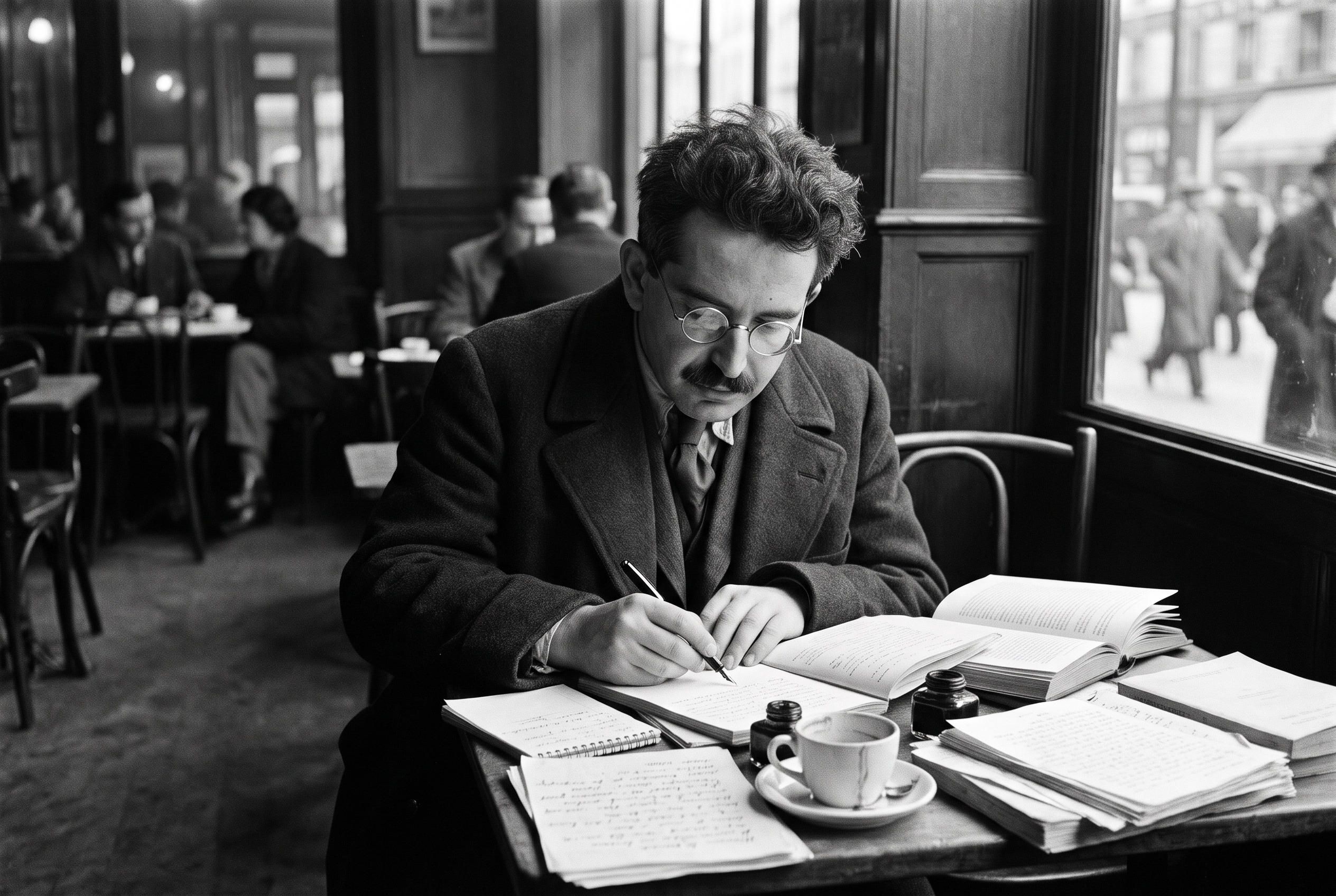
1. Biographical Trajectory: Between Mysticism and Historical Materialism
Walter Benjamin was born on July 15, 1892, into an affluent, assimilated Jewish family in Berlin-Charlottenburg. His childhood—later immortalized in his nostalgic, phenomenological memoir Berlin Childhood around 1900 (Berliner Kindheit um neunzehnhundert)—was steeped in the suffocating bourgeois comfort of Imperial Germany, an environment against which Benjamin would rebel for the rest of his intellectual life.[^1]
Youth Movement and the Great War
During his student years at the universities of Freiburg, Munich, and Berlin, Benjamin was drawn to the German Youth Movement (Jugendbewegung), falling under the charismatic spell of educational reformer Gustav Wyneken. Benjamin served as president of the Freie Studentenschaft (Free Students' Association) and published articles calling for a spiritual and cultural renewal of youth.[^1]
However, the outbreak of World War I in August 1914 shattered this early idealism. When Wyneken enthusiastically endorsed Germany's imperial war effort, Benjamin severed ties with him in disgust. Deeply traumatized by the suicide of his close friend, the poet Fritz Heinle, who killed himself alongside his partner Rika Seligson in protest against the war, Benjamin avoided military conscription by feigning severe sciatica and withdrew into philosophical isolation in Switzerland.[^2] In Bern, he completed his doctoral dissertation in 1919 under the supervision of Richard Herbertz, published as The Concept of Art Criticism in German Romanticism (Der Begriff der Kunstkritik in der deutschen Romantik).
The Habilitation Catastrophe: Expulsion from the Academy
Benjamin's dream of securing a conventional university professorship collapsed decisively in 1925. He submitted his monumental, notoriously dense treatise The Origin of German Tragic Drama (Ursprung des deutschen Trauerspiels) as his Habilitation thesis to the University of Frankfurt.[^3]
The evaluators, including the neo-Kantian philosopher Hans Cornelius and aesthetician Franz Schultz, were utterly baffled by Benjamin's dense, non-linear methodology, which fused Platonic theory of Ideas with baroque allegorical ruin. Warned that he faced a humiliating public rejection, Benjamin withdrew his application. This defeat permanently severed him from the German academic establishment, casting him into a precarious, peripatetic existence as a freelance feuilletonist, translator, literary critic, and radio essayist for the remainder of his life.[^3]
Competing Gravitational Poles: Scholem, Brecht, and Adorno
Throughout the Weimar Republic, Benjamin’s thought developed within an extraordinary intellectual magnetic field pulled in conflicting directions:
| Gravitational Pole | Key Figure(s) | Intellectual Domain | Nature of Influence on Benjamin |
|---|---|---|---|
| Theological Pull | Gershom Scholem | Kabbalah, Jewish Mysticism, Theological Anarchism, Zionism | Urged metaphysical contemplation, linguistic theology (Tikkun / redemption), and abandonment of European politics.[^4] |
| Materialist Pull | Bertolt Brecht | Epic Theatre, Dialectics, "Crude Thinking" (plumpes Denken), Political Action | Encouraged direct functional intervention, radical mass media engagement, and shedding metaphysical obscurity.[^5] |
| Critical Theoretical Pull | Theodor W. Adorno & Max Horkheimer (ISR) | Frankfurt School Critical Theory, Negative Dialectics, Modernist Aesthetics | Mentored and challenged Benjamin, demanding dialectical rigor over mystical-materialist oscillation.[^6] |
| Romantic & Urban Catalyst | Asja Lācis | Bolshevik Avant-Garde, Proletarian Children's Theatre, Capri / Moscow | Catalyzed Benjamin's conversion to Marxism and experimental typography (One-Way Street).[^5] |
- Gershom Scholem and Jewish Mysticism: Benjamin met Scholem in Berlin in 1915. Scholem—who would become the foremost twentieth-century scholar of the Kabbalah—remained Benjamin's most demanding metaphysical interlocutor. Scholem urged Benjamin to abandon European politics, emigrate to Jerusalem, and devote himself to Hebrew philology and Jewish mysticism. Benjamin absorbed Scholem's Kabbalistic categories (such as Tikkun / redemption and the broken vessels), but secularized them into cultural criticism.[^4]
- Bertolt Brecht and Revolutionary Marxism: In 1924, while convalescing on the Italian island of Capri, Benjamin fell in love with Latvian Bolshevik theatre director Asja Lācis, who introduced him to Marxist political theory. Through Lācis, Benjamin met dramatist Bertolt Brecht in 1929. Brecht exerted a powerful materialist pull on Benjamin, encouraging him to abandon metaphysical obscurantism in favor of "crude thinking" (plumpes Denken) and direct functional intervention in mass media.[^5]
- Theodor W. Adorno and the Frankfurt School: Beginning in the late 1920s, Theodor W. Adorno and Max Horkheimer recognized Benjamin's genius and brought him into the periphery of the Institute for Social Research (the Frankfurt School). Adorno viewed Benjamin as his primary intellectual mentor, yet frequently criticized Benjamin's essays for oscillating recklessly between esoteric mysticism and uncritical, vulgar Marxist materialism, urging him toward a rigorous negative dialectic.[^6]
Parisian Exile and the Final Flight at Portbou
The rise of Adolf Hitler and the National Socialist seizure of power in early 1933 forced Benjamin into permanent exile. Stripped of his German citizenship by the Nazi regime in 1939, Benjamin lived in impoverishment in Paris, spending his days in the reading room of the Bibliothèque Nationale laboring over his unfinished magnum opus, the Passagenwerk (The Arcades Project).[^1]
Following the outbreak of World War II and the Nazi invasion of France in May 1940, Benjamin was interned as an enemy alien in a camp at Nevers for three months. Released through the intervention of French intellectual friends, he fled to Marseille, obtaining an emergency transit visa to the United States provided by Max Horkheimer and the Institute for Social Research.[^1]
In September 1940, guided across the Pyrenees along an arduous smuggling route led by Lisa Fittko, Benjamin reached the Spanish border town of Portbou. When Spanish border officials abruptly announced that they would cancel transit visas and return the group of stateless Jewish refugees to occupied France and the waiting Gestapo, Benjamin succumbed to despair. On the night of September 26, 1940, he ingested a fatal overdose of morphine. Paradoxically, shocked by his suicide, the Spanish authorities allowed the remainder of his refugee party to cross the border safely into Spain the following morning.[^2]
2. Epistemology, Language, and the Theory of Allegory
Benjamin's philosophical system rejects the systematic, deductive epistemologies of Enlightenment Cartesianism and Kantianism. For Benjamin, truth is not an intentional, cognitive conquest of an object by a subject; it is an objective, linguistic configuration that reveals itself through immersion in the concrete particulars of reality.[^7]
The Metaphysics of Language: Naming and Translation
In his early foundational essay On Language as Such and on the Language of Man (Über Sprache überhaupt und über die Sprache des Menschen, 1916), Benjamin articulated a theological philosophy of language grounded in the Book of Genesis:[^7]
- Edenic Language and the Act of Naming: In Paradise, human language was not an arbitrary semiotic sign system or a utilitarian tool for communicating mundane information. Instead, Adam's God-given task was to give names to creation (Namegeben). In the Edenic state, language was purely immanent, an expressive medium wherein the silent language of nature was translated into the human word without communicative distortion.[^7]
- The Fall into Chatter (Geschwätz): The Fall of Man was simultaneously a catastrophe of language. Language fell from the divine, participatory act of naming into utilitarian instrumentality, judgment, and abstraction—what Benjamin terms "mere signs" and bourgeois communication (Mitteilung / chatter). Language was degraded into a device about things rather than the divine essence in things.[^7]
- The Task of the Translator (1923): In his celebrated preface to his translation of Baudelaire's Tableaux parisiens, Benjamin argued that translation is an autonomous art form that does not aim to convey information or mimic the original. Rather, by releasing the "pure language" (reine Sprache) imprisoned within foreign idioms, translation harmonizes disparate tongues, pointing toward the messianic reconciliation of all fragmented human speech.[^8]
| Linguistic Stage / Dimension | Linguistic Modality | Epistemic and Spiritual Character |
|---|---|---|
| Divine Logos (Creation) | Creative Word | Absolute divine genesis; the origin of spiritual reality and ontological meaning.[^7] |
| Edenic Language (Adamite Naming) | Immanent Naming (Namegeben) | Direct translation of nature's silent essence into human speech without semiotic distortion or instrumental separation.[^7] |
| The Fall (Human Hubris) | Degraded Instrumentality & "Chatter" (Geschwätz) | Language declines into utilitarian communication (Mitteilung), moral abstraction, arbitrary signs, and instrumental judgment.[^7] |
| Redemptive Task (Reine Sprache) | Pure Language & Translation | The messianic task of the translator: liberating pure language from foreign tongues and reassembling the fragmented mosaic of meaning.[^8] |
The Trauerspiel and Allegory vs. Symbol
In The Origin of German Tragic Drama (1928), Benjamin conducted a radical re-evaluation of seventeenth-century German baroque drama (Trauerspiel, mourning play), contrasting it sharply with classical Greek tragedy:[^9]
| Aesthetic / Philosophical Dimension | Classical Greek Tragedy | Baroque Trauerspiel (Mourning Play) |
|---|---|---|
| Cosmic Horizon | Mythic destiny, heroic sacrifice, reconciliation with the Olympian gods | Secular, fallen historical time (Naturgeschichte), immanent despair |
| Central Figure | The tragic hero defying hubris | The tyrant and the martyr; the monarch paralyzed by court intrigue |
| Governing Dominant | Transcendent myth and heroic redemption | Melancholia (acedia), bodily decay, grief, and the historical catastrophe |
| Dominant Rhetorical Mode | The Organic Symbol (Symbol) | The Destructive Allegory (Allegorie) |
| Ontological Status of the Object | Wholeness, eternal presence, luminous totality | The Ruin (Ruine), the fragment, the corpse, mortified nature |
Benjamin launched a blistering critique of the Goethean and Romantic exaltation of the Symbol. The Romantic tradition claimed that the symbol represents the seamless, organic fusion of the infinite and the finite, the concept and the sensory object. For Benjamin, this harmonious synthesis is an ideological illusion—a premature, deceptive reconciliation with a broken world.[^9]
In contrast, Benjamin rehabilitated the Allegory:[^9]
- Allegory as Mortification: While the symbol masquerades as a living organism, allegory deliberately exposes the transient, corpse-like nature of reality. In allegory, any person, object, or relationship can mean absolutely anything else; things are violently wrenched from their natural context and made to signify a conceptual truth.
- The Realm of the Ruin: "Allegories are, in the realm of thoughts, what ruins are in the realm of things." The baroque allegorist gazes upon the world through the lens of profound melancholy (acedia), seeing human history not as organic progress, but as a continuous landscape of decay, skull-piles, and petrified ruins.[^9]
3. Primary Aesthetic Essays I: Frankfurt School Aesthetics, the Aura & Technological Reproduction (1935–1936)
Composed in Parisian exile between September and December 1935, Benjamin's seminal aesthetic essay, "The Work of Art in the Age of Mechanical Reproduction" (Das Kunstwerk im Zeitalter seiner technischen Reproduzierbarkeit), represents a foundational milestone in media ecology, cultural studies, and Western Marxist aesthetics.[^10] Sponsored by Max Horkheimer's Institute for Social Research, the essay investigates how industrial technologies—principally photography and cinematography—strip the traditional artwork of its singular, ritualistic "aura," permanently restructuring human sensory perception (sensorium) and transforming the social function of art from sacred cult contemplation into collective political contestation.[^10]
Historical, Political, and Materialist Context
Benjamin conceived the essay amidst extreme geopolitical crisis and technological mobilization. In Nazi Germany and Fascist Italy, totalitarian regimes were weaponizing mass media—rotogravure photo-presses, public loudspeakers, synchronized newsreels, and sound cinema—to hypnotize and unify the public. Simultaneously, Soviet cinema pioneers (Sergei Eisenstein, Dziga Vertov) were demonstrating that filmic montage could operate as a dynamic instrument of revolutionary dialectics.[^10]
Benjamin grounded his analysis in an innovative Marxist critique of cultural superstructure:[^10]
- Materialist Superstructure Analysis: Nearly a century after Karl Marx analyzed industrial capital at its foundation, technological mechanization had finally saturated the sphere of cultural production. A dialectical aesthetic critique could no longer treat art as an ethereal reflection of economic conditions, but had to investigate the technical apparatus of production itself.[^10]
- Diagnostic Neutralization of Fascist Vocabulary: Benjamin explicitly engineered his aesthetic concepts to be completely useless for fascism. By dissolving traditional bourgeois categories—such as "genius," "eternal value," "mystery," and "mastery"—his formulations neutralized the conceptual vocabulary routinely exploited by authoritarian regimes to aestheticize social subjugation.[^10]
The Genealogy of Technical Reproduction: From Lithography to Film
While human hands had always been capable of copying artifacts (stamping, coin-minting, woodcut engravings, etching), industrial reproduction introduced a categorical qualitative rupture:[^10]
- The Hand vs. The Eye: Lithography enabled graphic art to illustrate daily life alongside the printing press, yet remained tied to manual craft. With the invention of photography (announced by Louis Daguerre in 1839), the human hand was relieved of the primary artistic responsibilities in image production, which were transferred entirely to the optical lens and chemical emulsion.[^11]
- Synchronizing with Modern Tempo: Because the camera captures an image in a fraction of a second, pictorial reproduction synchronized with the rapid pace of metropolitan speech and traffic. Cinematography then mobilized this capacity into moving celluloid strips, enabling technical reproduction to match the velocity of industrial factory machinery.[^10]
Mechanical reproduction differs fundamentally from manual forgery in two decisive ways:[^10]
- Autonomous Optical Revelation: The camera functions independently of unassisted human vision, penetrating perspectives, angles, and micro-durations invisible to the naked eye through zooms, close-ups, and slow motion.[^11]
- Spatial-Temporal Relocation: Mechanical reproduction transports the artifact into situations inaccessible to the original itself. A photograph or phonograph record allows a choir recorded in a medieval cathedral or a canvas hanging in the Louvre to be experienced inside a worker's apartment, a union hall, or a public street.[^10]
The Anatomy of the Aura (der Hauch) and Its Liquidation
The centerpiece of Benjamin's aesthetic theory is the aura (der Hauch):
"What is aura, actually? A strange weave of space and time: the unique apparition of a distance, however near it may be." (Ein sonderbares Gespinst von Raum und Zeit: einmalige Erscheinung einer Ferne, so nah sie sein mag.)
— Walter Benjamin, Little History of Photography (1931) / The Work of Art in the Age of Mechanical Reproduction (1935)[^10][^11]
The aura encapsulates the singular, unrepeatable presence of the original work of art in time and space:
- The Here and Now (Das Hier und Jetzt): Authenticity resides strictly in the unique, physical existence of the artwork at the place where it happens to be. It encompasses the material alterations caused by aging paint, the physical patina on bronze, the subtle fissures on a canvas, and the historical records of ownership through which the object has traveled across centuries.[^10]
- The Collapse of Authenticity: In technical reproduction, the category of "authenticity" (Echtheit) becomes entirely meaningless. One cannot identify an "authentic" print from a photographic negative or an "original" celluloid film strip; reproduction is structural to the medium from its inception.[^10]
Traditional Cultic Artwork (Aura Intact)
  │
  ├── Physical \"Here and Now\" (Unique time, space, and material patina)
  ├── Historical Authority & Provenance (Unbroken witness / Zeugenschaft)
  └── Imbedded in Sacred Ritual & Distance (\"A distance, however near\")

               │
         [ TECHNOLOGICAL SHOCK ]
    (Industrial Photography & Cinematography)
               │
               ▼

Mass-Reproduced Artifact (Aura Liquidated)
  │
  ├── Plurality of Identical Copies (Dissolution of the original)
  ├── Relocation into Mass Environments (Everyday public circulation)
  └── Emancipation from Ritual (Art refounded upon Political Praxis)
The liquidation of the aura is driven by profound socio-historical urges within the modern urban masses:[^10]
- Overcoming Distance: The contemporary masses exhibit an intense psychological compulsion to "bring things closer" spatially and humanly, refusing to tolerate the aristocratic distance and reverent seclusion demanded by traditional art.[^10]
- Universal Equality of Objects: Mass consciousness possesses an acute sense for the universal equivalence of all things, extracting unique artifacts from their singular shells through standardized replication.[^10]
Cult Value (Kultwert) vs. Exhibition Value (Ausstellungswert)
Benjamin traces the historical evolution of art through the dialectical polarity between Cult Value (Kultwert) and Exhibition Value (Ausstellungswert):[^10]
| Dimension | Cult Value (Kultwert) | Exhibition Value (Ausstellungswert) |
|---|---|---|
| Historical Origin | Prehistoric magic, religious liturgy, sacred tradition | Modern industrial capitalism, secular public sphere |
| Spatial Condition | Fixed in a specific sacred precinct (cave, temple, altar, church) | Mobile, ubiquitous, capable of instantaneous mass circulation |
| Accessibility | Deliberately hidden or restricted; reserved for initiates | Universally visible, disseminated to the general public |
| Temporal Status | Eternal, permanent, anchored in singular historical time | Ephemeral, transient, reproducible on demand |
| Spectator Posture | Devotional contemplation (Sammlung), reverent submission | Critical appraisal, sensory distraction (Zerstreuung), collective assessment |
| Exemplary Media | Paleolithic cave paintings, medieval icons, altar polyptychs | Photography, cinematography, posters, digital networks |
- Art as Ritual Talisman: Art originated in the service of magical and religious rites. Stone Age cave paintings were hidden in dark, subterranean chambers intended for spirits, not human observers. Medieval statues of the Virgin Mary remained veiled or mounted high in cathedral spires. The aura is the secularized residue of this sacred, ritual distance.[^10]
- The Triumph of Exhibition Value: As art emancipated itself through the secularization of The Renaissance and bourgeois institutions (salons, public museums, galleries), its display capacity expanded. With photography and film, exhibition value triumphed so completely that the quantitative increase produced a qualitative transformation: rather than being based on ritual, art began to be based on politics.[^10]
- Eugène Atget and the Crime Scene of History: Early portrait photography maintained a final, mournful redoubt of cult value in the preserved gazes of deceased ancestors. But when French photographer Eugène Atget photographed deserted Parisian streets around 1900, he wiped the image clean of human presence. Atget photographed Paris like a crime scene, transforming photographs into documentary evidence for the historical trial and demanding a viewer who interrogates the image analytically.[^10][^11]
The Screen Actor and the Industrial Alienation of Performance
Benjamin examines how cinema fundamentally alters human artistic performance by comparing the stage actor to the screen actor:[^10]
- Performance Before the Apparatus: On stage, the actor presents their performance directly to a living audience in real time, preserving their personal aura through physical co-presence. The film actor, however, performs before a mechanical apparatus—microphones, lenses, electric floodlights, and boom cameras. The performance is broken into discontinuous, fragmented segments, filmed out of chronological order, and reassembled by the editor (montage).[^10]
- The Actor as Industrial Specimen: Quoting Luigi Pirandello (Shoot!), Benjamin notes that the screen actor feels an acute sense of exile. Estranged from their living voice and physical body, their likeness is transformed into a shadow, a commodity packaged and shipped to distant cinemas. The screen actor mirrors the factory worker on the assembly line: both are tested by machinery, alienated from their bodily labor, and estranged from the finished commodity.[^10]
- Hollywood's Manufactured Star System: Capitalism compensates for the liquidation of the actor's genuine aura by engineering an artificial substitute: the star system (Star-Kult). Through studio public relations, glamorous celebrity profiles, and fan magazines, Hollywood constructs a synthetic, commercial commodity-aura designed to re-mystify the alienated consumer.[^10]
The Optical Unconscious (Das optische Unbewusste)
Benjamin coins the term "optical unconscious" to articulate the camera's revolutionary epistemological capacity:[^10]
"Evidently a different nature opens itself to the camera than opens to the naked eye—if only because an unconsciously penetrated space is substituted for a space consciously explored by man... It is through the camera that we first discover the optical unconscious, just as we discover the instinctual unconscious through psychoanalysis."
— Walter Benjamin, The Work of Art in the Age of Mechanical Reproduction (1935)[^10]
Just as Sigmund Freud's psychoanalysis demonstrates that slips of the tongue and minute gestures expose the subterranean instinctual unconscious, cinematic techniques reveal hidden structural dimensions of reality:[^10]
- Slow Motion & Magnification: Slow motion isolates the biomechanics of human movement, the muscular contractions of a stride, or the physics of a falling drop.
- Close-ups & Spatial Blasting: The close-up isolates everyday objects—a pocketknife, a hand, a fabric weave—exploding the familiar prison of domestic routine and revealing unexpected architectures of matter.
Contemplation vs. Distraction (Sammlung und Zerstreuung)
Mechanical media alter the psychic reception of art, replacing bourgeois contemplation (Sammlung) with collective distraction (Zerstreuung):[^10]
- The Shock Effect of Cinema: Before a painting, the bourgeois spectator can abandon themselves to solitary associations. Before a film strip, however, the spectator cannot do so. No sooner has the eye grasped an image than it has already transformed; the moving image assaults the viewer with a rapid, discontinuous sequence of perceptual shocks (Chocwirkung), mirroring the sensory bombardment of modern traffic and factory machinery diagnosed by Georg Simmel in The Metropolis and Mental Life.[^10]
- The Absent-Minded Examiner: Cinematic reception occurs collectively in distraction. Far from being a passive stupor, distraction allows the mass public to evaluate the medium through habit: "The public is an examiner, but an absent-minded one." (Das Publikum ist ein Examinator, doch ein zerstreuter.)[^10]
- Architecture as Prototype: Benjamin notes that architecture has always been appropriated through tactile habit (Gewohnheit) and physical use rather than concentrated optical contemplation. Cinema inherits this architectural mode, training the modern human sensorium to withstand the traumatic shocks of industrial modernity.[^10]
- Dadaist Prefiguration: Dadaism anticipated the cinema's technical shock effects through poetry and collage, hurling artworks like physical projectiles against the public to degrade bourgeois auratic contemplation.[^10]
The Political Crossroads: Fascist Aestheticization of Politics vs. Communist Politicization of Art
The famous epilogue to the essay articulates the definitive political dilemma of the twentieth century, presenting a stark binary between fascism and communism:[^10]
                    THE CRISIS OF MODERNITY
               (Proletarianization & Mass Media)
                              │
               ┌──────────────┴──────────────┐
               ▼                             ▼
       FASCIST STRATEGY              COMMUNIST STRATEGY
   \"Aestheticization of Politics\"   \"Politicization of Art\"
               │                             │
  ├── Preserves Property Relations    ├── Overthrows Class Hierarchies
  ├── Spectacularizes Mass Rallies    ├── Dismantles Illusion / Montage
  ├── Cult of the Führer / Leader     ├── Transforms Spectator to Critic
  └── Culminates in Imperialist War   └── Emancipates Proletarian Consciousness
- The Fascist Aestheticization of Politics: Fascism organizes the newly proletarianized masses without touching the capitalist property relations that exploit them. It grants the masses an aesthetic expression—synchronized Nuremberg rallies, monumentality, and the charismatic cult of the Führer—while denying them structural rights. This aestheticization logically culminates in imperialist war, which mobilizes technological forces while preserving the economic base. Citing F.T. Marinetti's Futurist manifesto celebrating the beauty of aerial bombardments, Benjamin warns that human self-alienation reaches the point where humanity experiences its own physical destruction as a supreme aesthetic pleasure.[^10]
- The Communist Politicization of Aesthetics: "Communism responds by politicizing art." (Der Kommunismus antwortet ihm mit der Politisierung der Kunst.) Politicizing art does not mean producing crude didactic propaganda. Rather, it demands utilizing technical media (montage, documentary realism, and Bertolt Brecht's epic theater) to shatter bourgeois illusionism, transform the spectator into an analytical collaborator, and organize collective consciousness for class emancipation.[^10]
The Adorno-Benjamin Debate: "Two Torn Halves of an Integral Freedom"
The essay sparked a legendary debate within the Frankfurt School, crystallized in Theodor W. Adorno's famous letter of March 18, 1936:[^6]
- Critique of Mass Distraction: Adorno cautioned that Benjamin naively attributed progressive potential to cinematic distraction. Under monopoly capitalism, mass distraction is not revolutionary; it is the primary psychological mechanism through which the Culture Industry (Kulturindustrie) pacifies workers and enforces social conformity.[^6]
- The Defense of Autonomous Modernism: Adorno defended difficult, autonomous high modernism (such as the music of Arnold Schoenberg or the prose of Franz Kafka), arguing that autonomous art resists capitalist commodification precisely by refusing easy consumption, whereas commercial film instantly capitulates to market exchange.[^6]
- The Dialectical Verdict: Adorno famously concluded that autonomous high art and mass commercial entertainment are "two torn halves of an integral freedom, to which however they do not add up."[^6]
Postmodern Acceleration & Digital Afterlives
Benjamin's diagnosis has accelerated exponentially across late capitalism and digital culture:
- John Berger's Ways of Seeing (1972): Berger adapted Benjamin's insights for television, showing how modern advertising (publicity) appropriates the visual language of classical oil paintings, transmuting the historic aura of aristocratic prestige into manufactured consumer envy.[^12]
- Jean Baudrillard and the Simulacrum: In Defining a Simulacrum, Baudrillard radicalized Benjamin's thesis. If mechanical reproduction destroyed the aura of the original, digital reproduction creates a universe of simulacra where copies exist without any original referent whatsoever (hyperreality).
- Don DeLillo's "Most Photographed Barn": In Don DeLillo Major Themes Analysis, DeLillo stages Benjamin's theory in White Noise: tourists gather to photograph "The Most Photographed Barn in America," worshiping not the physical barn, but the collective aura of the image's reproduction.[^13]
- Generative AI and Algorithmic Synthesis: In twenty-first-century generative AI (neural network image and text synthesis), media are generated instantaneously without physical cameras or bodily performance. When algorithmic synthesis detaches cultural artifacts from human labor, Benjamin's foundational inquiries into authenticity, alienation, and the political control of the technological apparatus become the defining battleground of our era.
4. Primary Aesthetic Essays II: Urban Dialectics, the Flâneur & The Arcades Project (1927–1940)
Between 1927 and his death in 1940, Benjamin dedicated himself to his colossal, unfinished masterwork: The Arcades Project (Das Passagen-Werk). Conceived as an archaeological and philosophical history of nineteenth-century Paris—the "capital of the nineteenth century"—the project spans thousands of pages of categorized archival fragments, citations, and reflections organized into 36 alphabetized thematic folders termed Convolutes (Konvolute).[^14]
Historical Genesis and Compositional Trajectory
The Arcades Project originated in 1927 as a modest collaboration between Benjamin and journalist Franz Hessel to write an essay on the covered Parisian shopping arcades (passages couverts), which were rapidly falling into obsolescence.[^14] Deeply stimulated by Louis Aragon's Surrealist novel Paris Peasant (Le Paysan de Paris, 1926), which celebrated the decaying Passage de l'Opéra as a dreamscape of modern mythology within The Avant-Garde, Benjamin realized the investigation demanded an expansive historical-materialist framework.[^14]
Working tirelessly beneath the painted ceiling of the Bibliothèque Nationale in Paris, Benjamin transformed the study into what he called "the theater of all my struggles and all my ideas":[^14]
- The Early Metaphysical-Surrealist Phase (1927–1930): Focused on collective dream states, Surrealist intoxication, and the enchanted phenomenology of decaying urban commodities.[^14]
- The Mature Historical-Materialist Phase (1934–1940): Following his exile in 1933 and closer association with the Institute for Social Research, Benjamin anchored his analysis in Marxist critique, producing two programmatic summaries known as the Exposés of 1935 and 1939 ("Paris, Capital of the Nineteenth Century").[^15]
When German forces invaded France in June 1940, Benjamin entrusted his massive manuscript to French writer and librarian Georges Bataille, who concealed the papers inside the Bibliothèque Nationale until after the war.[^14]
Methodological Architecture: The Convolutes and Literary Montage
Rather than composing a continuous narrative treatise, Benjamin constructed The Arcades Project as a vast experimental apparatus organized into 36 folders labeled A through Z, and a through w:[^14]
| Structural Stage | Architectural Component | Methodological & Epistemological Function |
|---|---|---|
| I. Archival Substratum | 19th-Century Archival Fragments & Commentary | Archival citations, newspaper clippings, police dossiers, architectural pamphlets, and aphoristic reflections.[^14] |
| II. Categorical Taxonomy | Thematic Convolutes (Folders A–Z, a–w) | Thematic clustering around key archetypes and motifs (arcades, fashion, flânerie, iron construction, Baudelaire).[^14] |
| III. Compositional Praxis | Literary Montage Technique | Spatial juxtaposition without authorial moralizing; historical collisions replacing linear causality.[^14] |
| IV. Epistemological Telos | The Dialectical Image (Dialektik im Stillstand) | Sudden constellation between past and present, sparking historical awakening from the capitalist dream-sleep.[^16] |
In Convolute N ("On the Theory of Knowledge, Theory of Progress"), Benjamin articulated the epistemological engine of the work: literary montage—a radical methodology directly prefiguring modern database aesthetics in Conceptual Writing and Digital Poetics (Goldsmith & Perloff):[^16]
- Carrying Montage into History: Benjamin wrote that his method was to carry over the principle of montage into history—assembling monumental structures out of the smallest, precisely cut historical components.[^16]
- Juxtaposition over Linear Causality: By placing nineteenth-century fashion advertisements, municipal records, railway timetables, and Baudelaire's poetry alongside his own aphorisms without quotation marks, Benjamin allowed historical fragments to speak through their dialectical collision.[^14]
- Refusing Empathy with the Victors: The historical materialist refuses to empathize with the ruling classes; instead, he salvages the discarded detritus and "refuse" of civilization to reveal the hidden violence and utopian longings buried within outmoded objects.[^16]
Major Thematic Convolutes
| Convolute | Title / Theme | Core Analytical Focus |
|---|---|---|
| Convolute A | Arcades, Magasins de Nouveautés, Sales Clerks | The emergence of iron-and-glass commercial corridors and early luxury retail.[^14] |
| Convolute B | Fashion | The eternal return of the new; fashion as a compact between the living body and the inorganic commodity fetish and Kitsch.[^1] |
| Convolute E | Haussmannization, Barricade Fighting | Baron Haussmann's "strategic beautification" designed to prevent proletarian insurrections, analyzed as spatial estrangement in Anthony Vidler-The Architectural Uncanny.[^15] |
| Convolute F | Iron Construction | The tension between engineering functionality (iron/glass) and classical ornamentation, anticipating The Bauhaus School.[^14] |
| Convolute H | The Collector | The redemptive act of detaching objects from their utilitarian market value into a private historical system.[^17] |
| Convolute J | Baudelaire | Charles Baudelaire as the lyric poet of high capitalism, allegory, and urban shock.[^18] |
| Convolute K | Dream City and Dream House, Dreams of the Future | The nineteenth century as a collective dream state requiring historical awakening, engaging Freud's The Uncanny (Das Unheimliche).[^17] |
| Convolute M | The Flâneur | The flâneur: the alienated urban stroller, the crowd, and the transformation of the intellectual into a commodity.[^18] |
| Convolute N | On the Theory of Knowledge, Theory of Progress | Epistemological foundations: the dialectical image, montage, and the critique of progress in Walter Benjamin’s Theses on the Philosophy of History.[^16] |
Core Theoretical Categories of Urban Dialectics
1. The Dialectical Image and "Dialectics at a Standstill"
The foundational epistemological category of The Arcades Project is the dialectical image (dialektisches Bild):[^14]
"It is not that what is past casts its light on what is present, or what is present its light on what is past; rather, image is that wherein what has been comes together in a flash with the now to form a constellation. In other words: image is dialectics at a standstill."
— Walter Benjamin, Convolute N2a, 3[^16]
Against bourgeois historicism (which views time as a continuous additive chain of events) and vulgar Marxism (which posits an automatic evolutionary progression), Benjamin argues that historical comprehension occurs in an explosive flash. The "What-has-been" (das Gewesene) collides with the "Now of Recognizability" (das Jetzt der Erkennbarkeit), crystallizing historical contradictions into a frozen constellation that exposes capitalist progress as an ongoing catastrophe.[^16]
2. Phantasmagoria and the Commodity Fetish
Expanding upon Karl Marx's analysis of commodity fetishism, Benjamin theorized nineteenth-century Paris as the material manifestation of phantasmagoria—originally an eighteenth-century optical theater where magic lanterns projected ghostly illusions onto smoke while concealing the mechanical apparatus from the audience:[^15]
- The Ideological Halo of Capital: The arcades, World Exhibitions (Expositions Universelles), panoramas, and department stores functioned as vast phantasmagorias. They endowed mass-produced commodities with a magical halo of luxury and eternal novelty, mesmerizing the urban public and concealing the exploited labor that produced them.[^14]
- The Bourgeois Interior as Casing: As public streets were colonized by commercial spectacle, the private bourgeois apartment retreated into an introverted fortress—a velvet-lined casing stuffed with plush fabrics, heavy carpets, and exotic knick-knacks where the property owner sought emotional refuge from market competition, inducing the domestic estrangement analyzed in Anthony Vidler-The Architectural Uncanny.[^18]
3. Collective Dreaming and Historical Awakening (Erwachen)
In Convolute K, Benjamin applied Freudian dream-analysis to collective social classes:[^17]
- The 19th Century as Dream-State: The material architecture of the nineteenth century—its iron train stations, winter gardens, exhibition halls, and glass arcades—represented the physical dream-images of a collective yearning for a harmonious, classless society, yet trapped inside the nightmare of industrial exploitation.[^17]
- The Historian as Dream-Interpreter: The historical materialist does not passively admire the dream; rather, by deciphering the discarded refuse and outmoded commodities of the recent past, the critic triggers a sudden awakening (Erwachen) in the present generation, mobilizing revolutionary energy to dissolve the capitalist trance.[^17]
Urban Spatiality, Archetypes & Haussmann's Spatial Surgery
The Architecture of the Arcades
Constructed during the textile boom of the 1820s and 1830s, the Parisian arcades were glass-roofed, marble-lined passages cutting through blocks of commercial buildings:[^14]
- Spatial Ambiguity: The arcade is a threshold space: an exterior street transformed into an interior bourgeois salon, and an interior commercial shop transformed into a public thoroughfare.[^18]
- Technological Dialectics: Utilizing industrial cast iron and sheet glass for the first time, architects disguised these revolutionary materials beneath classical Corinthian columns and Pompeian murals—demonstrating how emergent productive forces are initially dressed in archaic mythic forms, an aesthetic contradiction resolved later by The Bauhaus School.[^14]
Social Typologies of Modernity: The Flâneur, Collector, Gambler, and Ragpicker
Benjamin populated the architectural landscape of Paris with a gallery of threshold figures (Schwellenkundige):[^14]
- The Flâneur: Conceptualized by Charles Baudelaire and rooted in Edgar Allan Poe's "The Man of the Crowd," The flâneur is the bourgeois gentleman who strolls aimlessly through the metropolitan crowds, "botanizing on the asphalt." Around 1839, it was fashionable for flâneurs to walk pet tortoises on leashes to protest the frantic pace of industrial Taylorism.[^17] Yet the flâneur's detachment is a tragic illusion: as the arcades gave way to giant department stores, the flâneur's subversive idling was domesticated into consumer window-shopping, and as an essayist or journalist, he too entered the marketplace to sell his observations as a commodity.[^18]
- The Collector: Analyzed in Convolute H, the collector rescues objects from the market by stripping them of both utilitarian use-value and commercial exchange-value, integrating them into an intimate, curated historical cosmos.[^17]
- The Gambler & The Ragpicker: While the gambler mirrors the factory worker through the repetitive, empty reflex of placing bets against the clock, the ragpicker (chiffonnier) serves as a double for the materialist poet-historian—scavenging the city's discarded trash at dawn to construct an alternative history of civilization, a figure whose dark modern foil re-emerges in Travis Bickle.[^14]
Haussmannization and the Destruction of Old Paris
Under Napoleon III, Prefect of the Seine Baron Georges-Eugène Haussmann demolished medieval working-class neighborhoods and early arcades to carve out expansive, straight boulevards lined with uniform neoclassical facades.[^15] Benjamin analyzed Haussmann's "strategic beautification": the boulevards were engineered specifically to prevent the erection of revolutionary street barricades and to secure clear lines of artillery fire and rapid troop transport from barracks directly into proletarian quarters.[^15] As detailed in Anthony Vidler-The Architectural Uncanny, this spatial surgery induced widespread metropolitan agoraphobia. Despite these military defenses, the Paris Commune of 1871 resurrected the barricade one final, heroic time.[^15]
Editorial Legacy, Database Aesthetics & Media Ecology
Following World War II, Georges Bataille returned Benjamin's hidden manuscripts to Theodor W. Adorno, who transferred them to the Frankfurt School archives.[^15] The work was first published in German in 1982 by Suhrkamp Verlag under the editorship of Rolf Tiedemann, and translated into English in 1999 by Howard Eiland and Kevin McLaughlin.[^15]
Today, The Arcades Project is recognized as a foundational work of media ecology and architectural theory, directly anticipating Marshall McLuhan's insights in McLuhan's The Medium is the Message, contemporary database aesthetics and hypertextual poetics in Conceptual Writing and Digital Poetics (Goldsmith & Perloff), and the critique of late-capitalist digital enclosures in Postscript on the Societies of Control.[^14]
5. Historical Materialism and Messianic Temporality (1940)
Composed in early 1940 under the shadow of the Hitler-Stalin Pact and the fascist conquest of Western Europe, Benjamin’s final masterwork, Walter Benjamin’s Theses on the Philosophy of History (Über den Begriff der Geschichte), represents one of the most radical reformulations of political philosophy and temporality in modern thought.[^19]
The Mechanical Turk and the Dwarf of Theology (Thesis I)
Benjamin opens the Theses with an allegorical dissection of Wolfgang von Kempelen's famous eighteenth-century chess-playing automaton:[^19]
"The puppet called 'historical materialism' is to win all the time. It can easily be a match for anyone if it enlists the services of theology, which today, as we know, is wizened and has to keep out of sight."
— Walter Benjamin, Theses on the Philosophy of History (1940)[^19]
- The Puppet (Historical Materialism): Marxist theory, which in its dogmatic Second International guise had degraded into an arrogant, deterministic machine convinced that technological advancement guaranteed inevitable socialist victory.[^20]
- The Dwarf (Theology): Jewish messianism, remembrance (anamnesis), and the spiritual claim of redemption (Tikkun). Without this hidden metaphysical impulse to avenge the oppressed, historical materialism becomes an inert, technocratic calculation.[^20]
Historicism vs. Brushing History Against the Grain
Benjamin mounted a devastating assault on bourgeois historicism (epitomized by Leopold von Ranke's dictum to reconstruct the past "as it actually was"):
- Empathy with the Victors: Historicism inevitably empathizes with the ruling classes, viewing history as an unbroken triumphal procession where current rulers step over those who lie prostrate.[^19]
- Documents of Barbarism: "There is no document of civilization which is not at the same time a document of barbarism." The cultural treasures celebrated by museums and academies were forged through the unrecorded suffering of anonymous slaves and laborers.[^19]
- The Materialist Task: The historical materialist regards it as his task to brush history against the grain (die Geschichte gegen den Strich zu bürsten)—rescuing the memory of defeated ancestors and unfinished struggles from the amnesia of the ruling class.[^19]
The Angel of History (Thesis IX)
Benjamin's most celebrated allegory emerged from his contemplative engagement with Paul Klee's 1920 oil-transfer watercolor Angelus Novus, which hung in Benjamin's study for two decades:[^21]
"A Klee painting named Angelus Novus shows an angel looking as though he is about to move away from something he is fixedly contemplating. His eyes are staring, his mouth is open, his wings are spread. This is how one pictures the angel of history. His face is turned toward the past. Where we perceive a chain of events, he sees one single catastrophe which keeps piling wreckage upon wreckage and hurls it in front of his feet. The angel would like to stay, awaken the dead, and make whole what has been smashed. But a storm is blowing from Paradise; it has got caught in his wings with such violence that the angel can no longer close them. The storm irresistibly propels him into the future to which his back is turned, while the pile of debris before him grows skyward. This storm is what we call progress."
— Walter Benjamin, Theses on the Philosophy of History (1940)[^19]
The Angel of History stands as the definitive refutation of bourgeois optimism:[^21]
- Historicism perceives a comforting, evolutionary "chain of events." The Angel sees the horrifying truth: one single catastrophe that incessantly accumulates corpses and ruins.
- The Angel longs to pause, heal the fractured cosmos, and awaken the dead, but is paralyzed by the tempest blowing from Paradise. This destructive tempest, which traps humanity in violence, is what modern civilization euphemistically celebrates as progress.[^21]
Jetztzeit (Now-Time) and the Emergency Brake
Benjamin directly attacked the temporal foundation of capitalism: homogeneous, empty time (homogene und leere Zeit)—the mechanical, quantitative clock-time of bourgeois progress wherein moments are identical containers ticking toward an indefinite future.[^22]
In opposition, Benjamin championed Jetztzeit (Now-Time):[^19]
- A messianic temporal rupture that blasts open the continuum of history.
- The revolutionary moment does not construct an unmapped future; rather, it forms a constellation with past moments of oppression, drawing on a weak messianic power (eine schwache messianische Kraft) bequeathed by our defeated ancestors.[^19]
- As Benjamin recorded in his preparatory notes for the Theses:
"Marx says that revolutions are the locomotive of world history. But perhaps it is quite otherwise. Perhaps revolutions are an attempt by the passengers on this train—namely, the human race—to pull the emergency brake."
— Walter Benjamin, Selected Writings, Vol. 4[^23]
6. Synoptic Theoretical Matrix: Frankfurt School Aesthetics, the Aura, and Urban Dialectics
| Analytical Dimension | The Origin of German Tragic Drama (1928) | The Work of Art in the Age of Mechanical Reproduction (1935–1936) | The Arcades Project (Das Passagen-Werk, 1927–1940) | Theses on the Philosophy of History (1940) |
|---|---|---|---|---|
| Primary Thematic Focus | Baroque mourning play (Trauerspiel), allegory vs. symbol, melancholia | Frankfurt School media theory, decay of the aura, mass reproduction | Urban archaeology of 19th-century Paris, flânerie, commodity fetish | Messianic historiography, critique of progress, revolutionary temporality |
| Material / Architectural Locus | Baroque court theater, emblems, skulls, corpses, ruins | Photographic darkroom, film studio, movie theater, public street | Iron-and-glass arcades, department stores, Haussmann boulevards | The chess automaton, Paul Klee's Angelus Novus, the historical wreckage |
| Aesthetic / Dialectical Mechanism | Allegorical Mortification: violent detachment of objects from organic context | Liquidation of the Aura: dissolution of Hier und Jetzt through mass replication | Literary Montage & Phantasmagoria: dialectical images arresting dream-sleep | Dialectical Rupture (Jetztzeit): blasting open homogeneous, empty time |
| Epistemological Key | Critique of Romantic symbol; history as natural decay (Naturgeschichte) | The Optical Unconscious: revealing micro-kinetics and hidden structures | Dialectics at a Standstill: collision of past and present in a flash | The Angel of History: progress unmasked as accumulating catastrophe |
| Spectator / Subject Posture | Melancholy contemplation (acedia), intellectual mourning | Collective distraction (Zerstreuung), tactile habit, absent-minded examiner | The detached flâneur strolling the crowd, domesticated into consumer | Revolutionary actor wielding weak messianic power to pull the emergency brake |
| Political Stakes | Sovereign crisis; impotence of the baroque monarch before court intrigue | Fascist Aestheticization of Politics vs. Communist Politicization of Art | Awakening the proletarian collective from capitalist consumer dream-trance | Rescuing the memory of defeated ancestors before fascism triumphs |
| Modern Theoretical Legacy | Post-structuralism (Derrida, de Man), critique of aesthetic organicism | Film studies, Frankfurt School critical theory, media ecology (McLuhan, Berger) | Urban geography, database aesthetics, hypertext, digital poetics (Perloff) | Critical historiography, decolonial theory, Walter Benjamin studies |
🎴 Interactive Web Practice (Comprehension Check)
Question 1 (Aesthetic Theory & The Liquidation of the Aura): What constitutes the \"aura\" of a traditional work of art according to Walter Benjamin, and why does mechanical reproduction inevitably cause it to wither?
Answer: Benjamin defines the aura as a \"strange weave of space and time: the unique apparition of a distance, however near it may be.\" In traditional art, the aura resides in the object's absolute uniqueness, physical authenticity, and historical situatedness (its Hier und Jetzt—here and now). It encompasses the material aging, patina, and unbroken provenance of the artifact. Crucially, the aura is the secularized descendant of the artwork's original cult value—its embedment in sacred magic or religious rituals that maintained an unapproachable distance between the sacred object and the devotee.
Mechanical reproduction (such as photography and cinema) inevitably liquidates the aura because it detaches the reproduced artifact from the domain of tradition and physical situatedness. By substituting an infinite plurality of mass-produced copies for a singular existence and placing those copies into contexts completely removed from the original (e.g., viewing a cathedral painting in a private living room or illustrated magazine), mechanical reproduction eliminates authenticity, shatters sacred distance, and fulfills the modern urban masses' intense desire to \"bring things closer.\"
Question 2 (The Optical Unconscious, Mechanical Mediation & Performance): How does the camera uncover the \"optical unconscious,\" and why does Benjamin draw a structural parallel between the film actor performing before the camera and the factory worker on an assembly line?
Answer: Benjamin coins the term \"optical unconscious\" (*das optische Unbewusste*) by analogy with Sigmund Freud's instinctual unconscious. Just as psychoanalysis reveals the hidden instinctual drives and slips of the tongue that escape conscious awareness, the technical interventions of the camera—such as extreme close-ups, slow motion, stop-action, and framing—reveal structural and kinetic realities imperceptible to unassisted human vision. Slow motion isolates the exact muscular dynamics of a human stride, while the close-up explodes the domestic environment into unfamiliar architectures of matter.
Benjamin draws a direct structural parallel between the film actor and the industrial factory worker:
- On stage, the theater actor presents their performance directly to a living audience in real time, retaining their personal aura. In the film studio, however, the screen actor performs not for an audience, but for a mechanical apparatus of lenses, microphones, and lighting rigs.
- The actor's performance is fragmented into discontinuous, isolated takes filmed out of chronological order, which are subsequently spliced together by the editor. Like the factory worker on the assembly line, the film actor is tested by machinery, forced to relinquish bodily labor to mechanical equipment, estranged from their living presence, and alienated from the finished commodity shipped to mass markets.
Question 3 (The Architecture of the Arcades, Phantasmagoria & The Flâneur): In The Arcades Project, how do the Parisian covered arcades embody the \"commodity phantasmagoria,\" and what is the dialectical tragedy of the flâneur?
Answer: In nineteenth-century Paris, the covered iron-and-glass arcades (*passages*) served as the architectural threshold of capitalist modernity. They functioned as interior-exterior spaces: outdoor municipal streets covered with industrial glass roofs, transformed into luxurious bourgeois living rooms lined with display windows.
Drawing on Marx's concept of commodity fetishism, Benjamin identifies the arcades as the material incarnation of **phantasmagoria**—originally an optical theater where magic lanterns projected ghostly illusions while hiding the mechanical projector. The arcades, World Exhibitions, and panoramas surrounded mass-produced goods with a theological halo of novelty and luxury, dazzling the public and veiling the exploited industrial labor that produced them.
The **flâneur**—the aristocratic, detached gentleman strolling through the metropolitan crowd—embodies the central dialectical tragedy of this urban landscape:
- The flâneur imagines himself to be an autonomous, subversive rebel protesting industrial speed (famously walking pet tortoises on leashes to enforce a slow pace).
- In reality, his detachment is an illusion: as the arcades gave way to giant department stores, the flâneur's idle gaze was co-opted into consumer window-shopping. As an essayist or journalist, the flâneur too was forced into the marketplace, parading himself through the crowds in search of a buyer—the intellectual fully transformed into a commodity.
Question 4 (Dialectical Images, Collective Dreaming & Revolutionary Awakening): What is a \"dialectical image\" (Dialektik im Stillstand), and how does Benjamin's concept of historical awakening differ from conventional linear models of progress?
Answer: A dialectical image (*dialektisches Bild*) is the central epistemological category of The Arcades Project. Rejecting both bourgeois historicism (which views history as an additive continuum of facts) and deterministic Marxism (which posits automatic, linear technological progress), Benjamin argues that true historical insight occurs when the \"What-has-been\" (*das Gewesene*) collides with the \"Now of Recognizability\" (*das Jetzt der Erkennbarkeit*) in a sudden, explosive flash. Benjamin defines this moment of arrest as \"dialectics at a standstill\" (*Dialektik im Stillstand*).
In this frozen constellation, historical contradictions become visible. Benjamin adapts Freudian dream-work to social classes, arguing that nineteenth-century material culture (iron train stations, glass arcades, world fairs) was the physical expression of a collective dream-sleep yearning for utopia while trapped in capitalism. Historical awakening (*Erwachen*) occurs when the historical materialist salvages the discarded ruins and outmoded commodities of the recent past, unmasking the myth of eternal progress and jolting the present generation into revolutionary consciousness.
Question 5 (Fascist Aestheticization of Politics vs. Messianic Now-Time): Contrast fascism's \"aestheticization of politics\" with Benjamin's concept of revolutionary Jetztzeit (Now-Time) and the pulling of the emergency brake.
Answer: In the epilogue to the reproduction essay, Benjamin diagnoses fascism's \"aestheticization of politics\":
- Fascism organizes the proletarian masses without altering the capitalist property relations that exploit them. Instead of socializing the means of production, fascism grants the masses an aesthetic spectacle—synchronized rallies, monumental architecture, and the charismatic cult of the Führer—allowing them to view their own reflection while denying them economic power.
- This aestheticization inexorably culminates in imperialist industrial war, which mobilizes technological forces while preserving private property. As celebrated by Futurist F.T. Marinetti, human self-alienation reaches the grotesque zenith where society experiences its own physical annihilation as an aesthetic thrill.
- Rather than progressing smoothly through \"homogeneous, empty time\" (the mechanical clock-time of bourgeois progress), Jetztzeit represents a messianic temporal rupture that blasts open the continuum of history.
- Revolution does not march toward an abstract, technologically determined future; rather, it forms a constellation with past moments of oppression, mobilizing the \"weak messianic power\" bequeathed by defeated ancestors. Revolution is therefore not the locomotive of world history, but humanity reaching for the emergency brake to halt a runaway catastrophe.
Resonant Notes
The following notes in the vault share direct thematic, sociological, and literary connections with Walter Benjamin:
🔴 Frankfurt School Critical Theory, Dialectical Materialism & Politics
- Walter Benjamin’s Theses on the Philosophy of History — The dedicated monograph analyzing Benjamin's 1940 eighteen theses, detailing his critique of historicism, the Mechanical Turk allegory, the Angel of History, and Jetztzeit.
- Karl Marx - Economic and Philosophic Manuscripts of 1844 — Marx's foundational theory of alienated labor (Entfremdung) and commodity fetishism, which Benjamin synthesized with theology and urban sociology in The Arcades Project.
- Continental Philosophy — Locates Benjamin within the Continental philosophical lineage, tracing how he revolutionized Western Marxism and phenomenology through the dialectical critique of modernity.
- Theodor W. Adorno's Aesthetic Theory (1970) — Adorno's culminating aesthetic treatise, building upon and critically revising Benjamin's reproduction essay and their legendary 1936 debate regarding autonomous art versus the Culture Industry.
- George Orwell (1903-1950) — Orwell's depiction of totalitarian spectacle, Newspeak, and historical erasure in Nineteen Eighty-Four parallels Benjamin's warning that even the dead will not be safe if fascism triumphs.
- Michel Foucault — Foucault's archaeological and genealogical methods directly inherit Benjamin's mandate to "brush history against the grain" by exhuming marginalized, subjugated discourses obscured by official institutional histories.
- Postscript on the Societies of Control — Gilles Deleuze's formulation of continuous modulation and digital surveillance deepens Benjamin's thesis that the "state of emergency" under capitalism is the structural rule rather than the exception.
- Georg Lukács's formulation of reification (Verdinglichung) in History and Class Consciousness (1923) — Lukács's theory of reification and commodity fetishism provided the primary Western Marxist foundation for Benjamin's analysis of the contemplative stance and urban distraction.
🟡 Media Ecology, Mechanical Reproduction & Postmodern Simulation
- Paul Klee (1879–1940) — Modernist Bauhaus master whose 1920 oil-transfer watercolor Angelus Novus was purchased by Benjamin and immortalized in Thesis IX as the Angel of History.
- Marshall McLuhan (1911-1980) & McLuhan's The Medium is the Message — McLuhan's media ecological insights regarding technological extensions of human senses and the psychic shocks of electric media directly build upon Benjamin's analysis of the optical unconscious and sensory alteration.
- Defining a Simulacrum — Jean Baudrillard's hyperreality—where copies exist without an authentic original—marks the postmodern culmination of Benjamin's liquidation of the artistic aura.
- Don DeLillo Major Themes Analysis — DeLillo's postmodern anatomy of televised disaster spectacle, crowds, and the hyperreal image ("The Most Photographed Barn in America") in White Noise and Mao II directly extends Benjamin's aura theory into late-stage consumer capitalism.
- Conceptual Writing and Digital Poetics (Goldsmith & Perloff) — Marjorie Perloff and Kenneth Goldsmith identify The Arcades Project as the paramount proto-hypertextual ancestor of 21st-century conceptual poetics, database aesthetics, and citational montage.
- The Avant-Garde & Theories of the Avant-Garde (Poggioli & Bürger) — Peter Bürger's institutional critique and Renato Poggioli's sociology of the vanguard provide the theoretical framework for analyzing Benjamin's Dadaist shock effects and the sublation of art into life-praxis.
- The Bauhaus School — Weimar and Dessau design institute that mediated between mechanical mass production and artistic form, providing the immediate German cultural context for Benjamin's debates on art and industrial technique.
- Entropy — The thermodynamic and informational drift toward disorder and noise, mirroring the Angel of History's vision of linear progress as a mounting, irreversible heap of wreckage.
🟢 Urban Dialectics, Modernity, Flânerie & Spatial Architecture
- The flâneur — The sociological profile of the metropolitan stroller, examining how modern capitalism transformed Baudelaire's poetic observer into a commodified consumer.
- The Painter of Modern Life, a seminal 1863 essay by French poet and art critic Charles Baudelaire — Baudelaire's foundational 1863 essay defining modernity (modernité) as the ephemeral, fleeting, and contingent, which Benjamin made the central literary axis of The Arcades Project.
- Georg Simmel (1858-1918) & The Metropolis and Mental Life — Simmel's sociological diagnosis of metropolitan sensory overload, money abstraction, and the blasé attitude provided the empirical foundation for Benjamin's theory of urban shock and the flâneur.
- The Philosophy of Money (Philosophie des Geldes) & Georg Simmel's concept of The Stranger — Simmel's examination of monetary quantification and the stranger's dialectic of proximity and remoteness directly mirror the flâneur's ambivalent status in the marketplace.
- Simmel and the Attention Economy — Abstraction, Alienation, and Cognitive Capture — Explores how money and urban stimuli fragment human attention, directly prefiguring Benjamin's contrast between contemplative absorption (Sammlung) and distracted reception (Zerstreuung).\n- Eugène Atget (1857–1927) — The French documentary photographer cited by Benjamin as the pivotal figure who stripped Paris of bourgeois aura, photographing deserted streets like crime scenes for the historical trial.\n- Anthony Vidler-The Architectural Uncanny — Vidler draws extensively on Benjamin's Arcades Project and Haussmann's urban surgery to conceptualize how metropolitan architecture produces spatial estrangement, agoraphobia, and the urban uncanny.\n- Freud's The Uncanny (Das Unheimliche) & Sigmund Freud — Freudian psychoanalysis provides Benjamin with the categories of dream-work, repression, and the uncanny, used to decode the collective unconscious of nineteenth-century bourgeois society.\n- Edgar Allan Poe (1809-1849) — Author of "The Man of the Crowd" (which Benjamin analyzed as the first depiction of the flâneur confronting the anonymous crowd) and "Maelzel's Chess-Player," which exposed the hidden chess dwarf that Benjamin allegorized in Thesis I.\n- Franz Kafka (1883-1924) — Benjamin's major literary essays on Kafka decode the Prague author's bureaucratic night terrors as allegories of fallen tradition, opaque law, and the pre-mythic world awaiting messianic redemption.\n- Henri Bergson — Bergson's distinction between clock-time and subjective duration (durée) served as a critical foil for Benjamin's assault on the "homogeneous, empty time" of bourgeois industrial progress.\n- The Dehumanization of Art — José Ortega y Gasset's 1925 diagnosis of the avant-garde's rejection of nineteenth-century realism provides an aristocratic, conservative mirror to Benjamin's revolutionary politicization of modernist aesthetics.\n- Kitsch — Clement Greenberg's critique of synthetic, pre-digested cultural commodities connects directly to Benjamin's analysis of fashion in Convolute B as the eternal return of the new.\n- Travis Bickle — Scorsese and Schrader's alienated cab driver represents a toxic, mechanized distortion of the flâneur and ragpicker, drifting through nocturnal urban decay in search of cathartic violence.\n- Northrop Frye & From Walls of Wood to Walls of Glass - Northrop Frye’s Geography of Isolation — Frye's spatial critique of architectural enclosure and glass transparency explores the isolation of modern urban dwellers, echoing Benjamin's analysis of the iron-and-glass arcade.\n- Virginia Woolf — Woolf adapts the peripatetic flâneur into the modernist flâneuse in essays like "Street Haunting", capturing the fleeting sensory kaleidoscope of the modern street.\n- Johann Wolfgang von Goethe (1749-1832) — Benjamin's early breakthrough essay on Goethe's Elective Affinities (Goethes Wahlverwandtschaften, 1922) established his foundational distinction between the material content (Sachgehalt) and truth content (Wahrheitsgehalt) of art.\n\n---\n\n## References\n\n[^1]: Howard Eiland and Michael W. Jennings / Walter Benjamin: A Critical Life / Harvard University Press, 2014 / Harvard University Press\n\n[^2]: Hannah Arendt / "Walter Benjamin: 1892–1940" (Introduction to Illuminations) / Schocken Books, 1968 / Schocken Books\n\n[^3]: Fredric Jameson / Marxism and Form: Twentieth-Century Dialectical Theories of Literature / Princeton University Press, 1971 / Princeton University Press\n\n[^4]: Gershom Scholem / Walter Benjamin: The Story of a Friendship (trans. Harry Zohn) / New York Review Books, 2001 / New York Review Books\n\n[^5]: Walter Benjamin / Selected Writings, Volume 2: Part 1, 1927–1930 (eds. Michael W. Jennings, Howard Eiland, and Gary Smith) / Harvard University Press, 1999 / Harvard University Press\n\n[^6]: Theodor W. Adorno and Walter Benjamin / The Complete Correspondence 1928–1940 (ed. Henri Lonitz, trans. Nicholas Walker) / Harvard University Press, 1999 / Harvard University Press\n\n[^7]: Walter Benjamin / "On Language as Such and on the Language of Man" in Selected Writings, Volume 1: 1913–1926 (eds. Marcus Bullock and Michael W. Jennings) / Harvard University Press, 1996 / Harvard University Press\n\n[^8]: Walter Benjamin / "The Task of the Translator" in Illuminations: Essays and Reflections (ed. Hannah Arendt, trans. Harry Zohn) / Schocken Books, 1968 / Schocken Books\n\n[^9]: Walter Benjamin / The Origin of German Tragic Drama (trans. John Osborne) / Verso Books, 1998 / Verso Books\n\n[^10]: Walter Benjamin / "The Work of Art in the Age of Mechanical Reproduction" in Illuminations (ed. Hannah Arendt, trans. Harry Zohn) / Schocken Books, 1968 / Schocken Books\n\n[^11]: Walter Benjamin / "Little History of Photography" in Selected Writings, Volume 2: Part 2, 1931–1934 (eds. Michael W. Jennings, Howard Eiland, and Gary Smith) / Harvard University Press, 1999 / Harvard University Press\n\n[^12]: John Berger / Ways of Seeing / Penguin Books, 1972 / Penguin Books\n\n[^13]: Don DeLillo / White Noise / Viking Press, 1985 / Penguin Random House\n\n[^14]: Walter Benjamin / The Arcades Project (trans. Howard Eiland and Kevin McLaughlin) / Harvard University Press, 1999 / Harvard University Press\n\n[^15]: Susan Buck-Morss / The Dialectics of Seeing: Walter Benjamin and the Arcades Project / MIT Press, 1989 / MIT Press\n\n[^16]: Walter Benjamin / Arcades Project Convolute N: On the Theory of Knowledge, Theory of Progress / Harvard University Press, 1999 / platypus1917.org\n\n[^17]: Rolf Tiedemann / "Dialectics at a Standstill: Approaches to the Passagen-Werk" / In On Walter Benjamin: Critical Essays and Recollections (ed. Gary Smith) / MIT Press, 1988.\n\n[^18]: Walter Benjamin / Charles Baudelaire: A Lyric Poet in the Era of High Capitalism (trans. Harry Zohn) / Verso Books, 1983 / Verso Books\n\n[^19]: Walter Benjamin / "On the Concept of History" (Theses on the Philosophy of History) in Illuminations (ed. Hannah Arendt, trans. Harry Zohn) / Schocken Books, 1968 / Schocken Books\n\n[^20]: Michael Löwy / Fire Alarm: Reading Walter Benjamin's 'On the Concept of History' / Verso Books, 2005 / Verso Books\n\n[^21]: O.K. Werkmeister / "Walter Benjamin's Angel of History, or the Transfiguration of the Revolutionary into the Historian" / Critical Inquiry, Vol. 22, No. 3 (1996), pp. 456–483.\n\n[^22]: Peter Osborne / A Philosophy of History: Walter Benjamin and the Arcades / Palgrave Macmillan, 1994.\n\n[^23]: Walter Benjamin / Selected Writings, Volume 4: 1938–1940 (eds. Howard Eiland and Michael W. Jennings) / Harvard University Press, 2003 / Harvard University Press\n