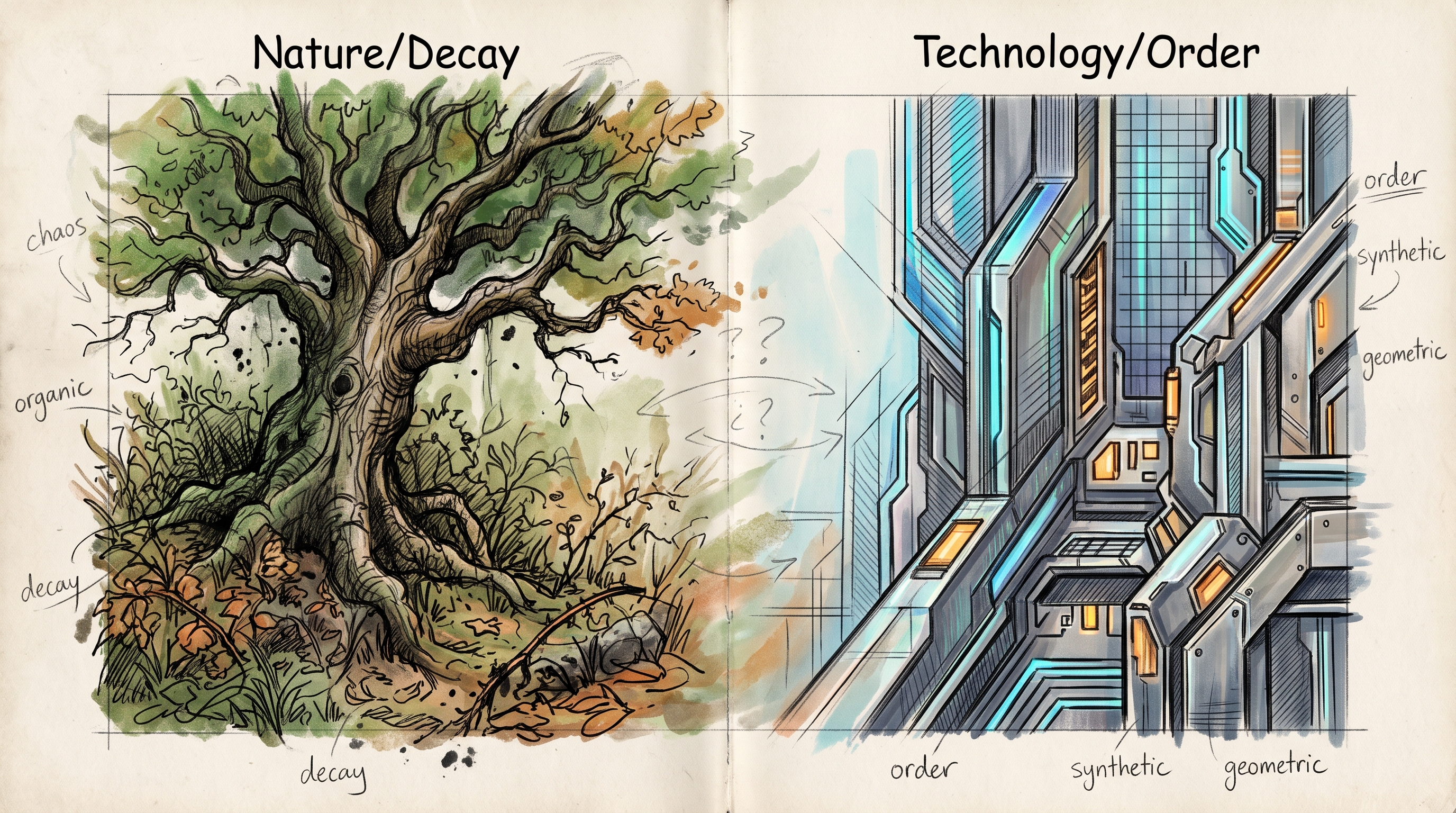
Juxtaposition in aesthetics is the intentional placement of two or more contrasting elements side by side to elicit comparison, amplify inherent qualities, or generate emergent meaning that neither element possesses in isolation.[^1] Across visual art, cinema, literature, and architecture, it operates as a cognitive and perceptual catalyst—disrupting passive observation by forcing the viewer's mind to bridge the gap between disparate concepts, textures, or forms.
Theoretical Foundations of Aesthetic Juxtaposition
At its core, juxtaposition relies on the relational nature of human perception: we rarely evaluate stimuli in an absolute vacuum, but rather in relation to their immediate context.[^2] When an artist places two distinct objects, colors, or ideas in close proximity, the boundary between them becomes an active site of aesthetic tension.
Dialectical Meaning and the "Third Idea"
In aesthetic theory, juxtaposition is rarely about mere difference; it is about synthesis. When two elements ( and ) are juxtaposed, the viewer does not simply perceive . Instead, the collision produces a synthesis ()—a conceptual or emotional resonance that transcends the sum of its parts.[^3]
Semantic Shift: An object's perceived meaning changes depending on its neighbor. A pair of worn boots placed next to a pile of soil suggests labor; the same boots placed next to a velvet crown suggest usurpation, mortality, or the fall of power.
Mutual Amplification: Contrasting traits become sharper when paired. Softness appears more delicate beside jagged stone; silence feels heavier immediately following cacophony.
Defamiliarization (Ostranenie): Coined by Viktor Shklovsky, defamiliarization describes the artistic technique of presenting common things in an unfamiliar way to refresh perception.[^4] Juxtaposition is one of the primary engines of defamiliarization, stripping objects of their everyday banality by placing them in alien contexts (a dynamic later analyzed in modernist aesthetics).
Quote
"It is the distant and just relation of two juxtaposed realities whose connection is grasped by the spirit... The more the relationship between the two juxtaposed realities is distant and true, the stronger the image will be—the greater its emotional power and poetic reality." — Pierre Reverdy[^5]
Perceptual and Cognitive Mechanisms
From the perspective of neuroaesthetics and Gestalt psychology, juxtaposition exploits how the brain processes visual and conceptual anomalies.
Simultaneous Contrast
First systematically documented by the chemist Michel Eugène Chevreul in 1839, the law of simultaneous contrast demonstrates that the human eye exaggerates the difference between two adjacent colors or tones.[^6]
Chromatic Enhancement: Complementary colors (such as ultramarine blue and cadmium orange) appear significantly more vibrant when placed directly beside one another than when viewed against a neutral background.[^6]
Luminance Distortion: A mid-tone gray square appears bright when surrounded by pitch black, yet dark and heavy when surrounded by pure white. Painters from J.M.W. Turner to Josef Albers have used this physiological quirk to create illusions of light and spatial depth on flat canvases.[^7]
Cognitive Dissonance and Resolution
In empirical aesthetics, Daniel Berlyne’s theory of arousal potential posits that aesthetic pleasure is closely tied to how an artwork manages complexity, novelty, and incongruity.[^8]
Foraging for Meaning: The prefrontal cortex attempts to resolve the incongruity by searching for hidden metaphors, structural parallels, or ironic commentary.
Aesthetic Aha! Moment: When the viewer successfully constructs a conceptual bridge between the juxtaposed elements, the brain experiences a rush of reward-related neural activity—transforming initial confusion into deep aesthetic satisfaction.[^9]
Manifestations Across Artistic Mediums
Juxtaposition adapts its mechanics to the structural vocabulary of each medium, operating spatially in the visual arts and temporally in film, music, and literature.
Medium
Primary Dimension
Core Mechanism
Classic Example
Painting & Sculpture
Spatial / Formal
Simultaneous contrast of color, texture, or iconography
Vanitas still lifes (skulls beside blooming flowers)
Old vs. new fabric; heavy vs. weightless materials
I.M. Pei’s glass Louvre Pyramid against Renaissance stone
Literature & Poetry
Linguistic
Oxymoron, antithetical phrasing, and imagist parataxis
Ezra Pound’s In a Station of the Metro
1. Visual Arts: From Chiaroscuro to Surrealist Collage
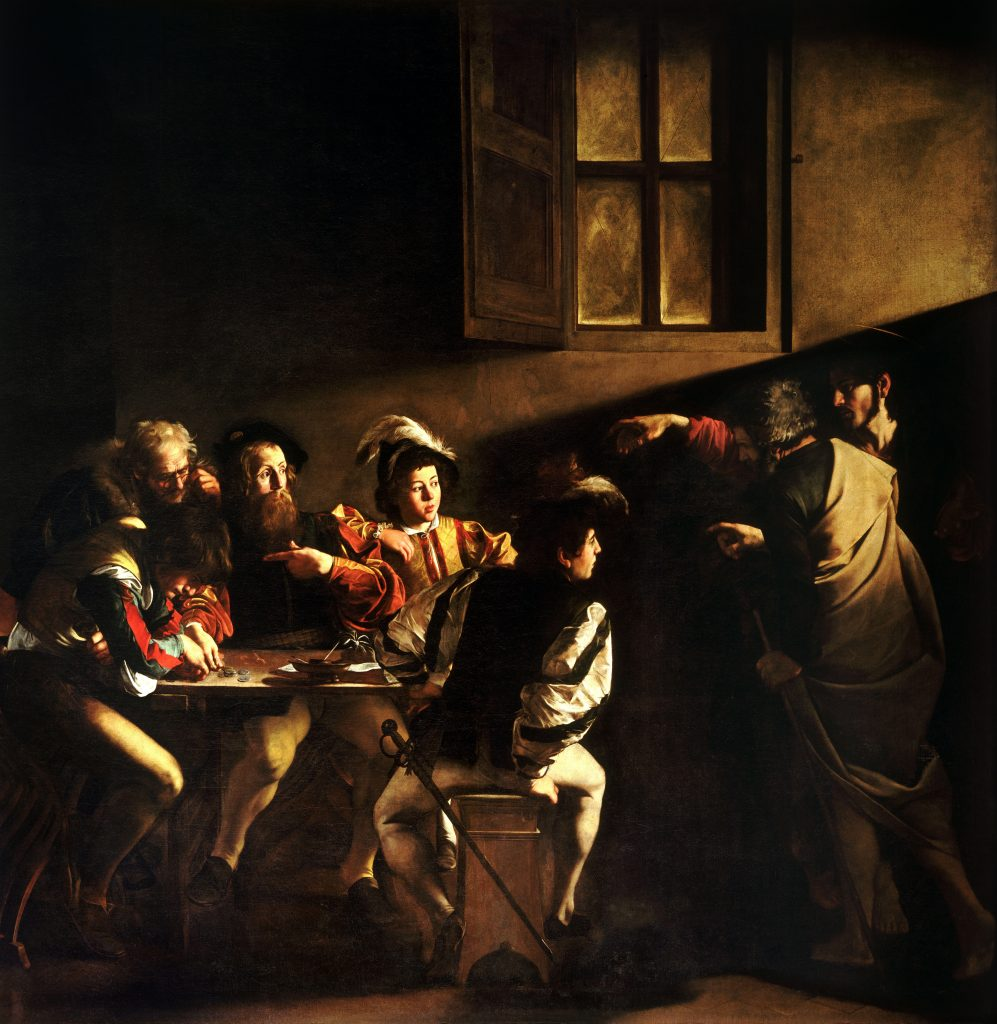
In traditional European painting, juxtaposition operated through formal opposition and allegorical symbolism. Baroque masters like Caravaggio utilized tenebrism—the violent juxtaposition of blinding light and impenetrable shadow—to heighten psychological drama (a technique codified in classical studio studies such as Leonardo da Vinci's A Treatise on Painting (Trattato della pittura)).[^1] During the Dutch Golden Age, vanitas paintings placed symbols of wealth and vitality (peeled lemons, silk, blooming tulips) directly alongside skulls and hourglasses to underscore the fragility of human existence.
Caravaggio, The Calling of Saint Matthew_,_ 1599–1600, San Luigi dei Francesi, Rome, Italy.
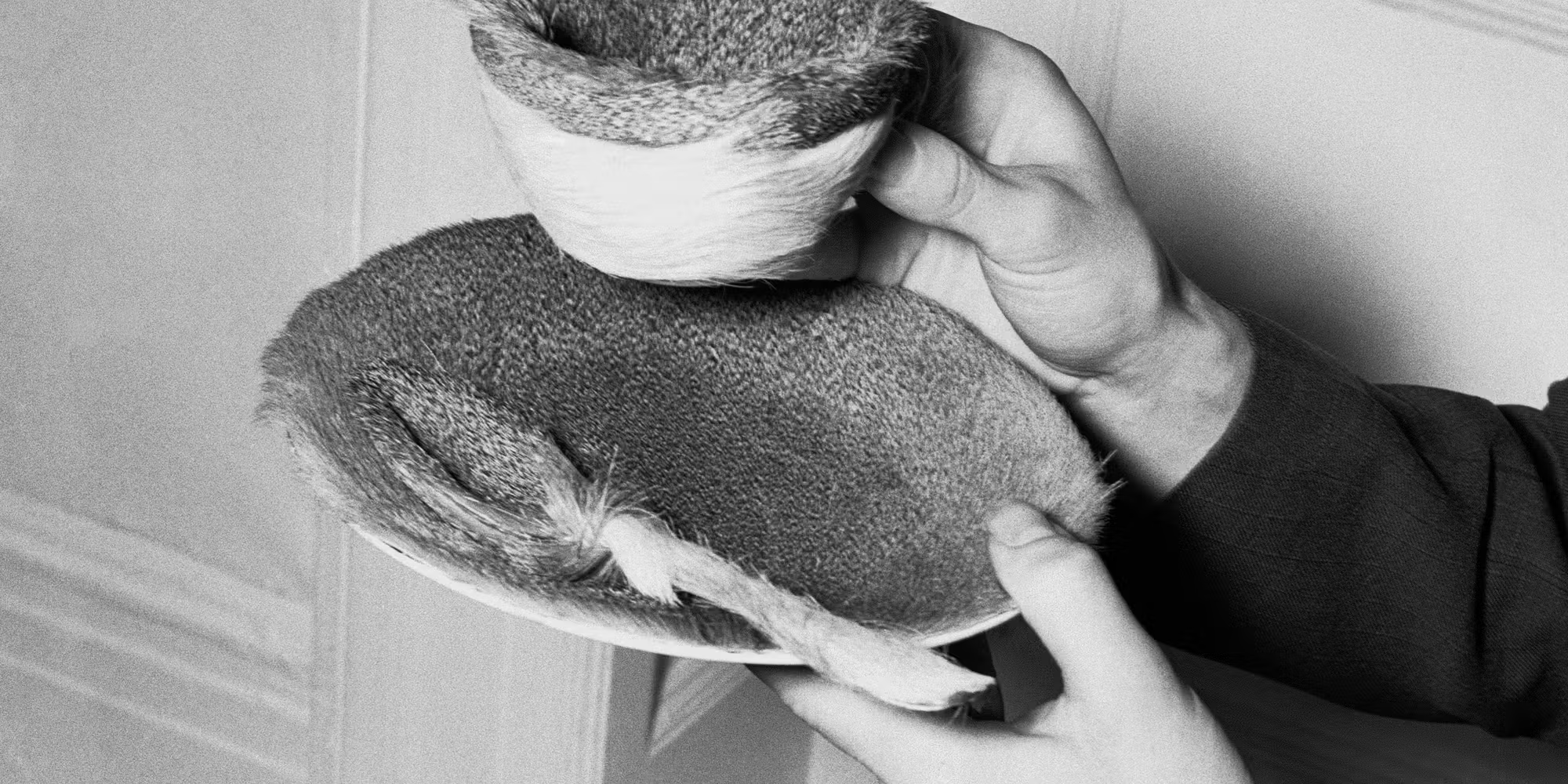
In the 20th century, Dadaists and Surrealists weaponized conceptual juxtaposition (see The Avant-Garde). Drawing inspiration from Comte de Lautréamont’s famous line describing beauty as "the chance meeting on a dissecting-table of a sewing-machine and an umbrella," Surrealists used dépaysement (displacement) to bypass rational thought and tap into the unconscious (a strategy explored extensively by René Magritte and Giorgio de Chirico (1888-1978)).[^5] Meret Oppenheim’s Object (1936)—a teacup, saucer, and spoon wrapped in gazelle fur—juxtaposes the refined, oral intimacy of drinking tea with the primal, tactile repulsion of wet animal hair.
Meret Oppenheim’s Furry Teacup
2. Cinema: The Kuleshov Effect and Dialectical Montage
In cinema, juxtaposition transitions from space to time. Early Soviet filmmakers realized that the true power of film lay not within individual shots, but in the cut between them (a transformation in mass reception examined by Walter Benjamin (1892–1940) in The Work of Art in the Age of Mechanical Reproduction).\n\n \n\n- The Kuleshov Effect: Filmmaker Lev Kuleshov demonstrated that viewers derive more meaning from the interaction of two sequential shots than from a single shot in isolation.[^10] By splicing the exact same expressionless close-up of an actor with a bowl of soup, a child in a coffin, and a woman on a divan, Kuleshov showed that the audience projected hunger, grief, and desire onto the actor's neutral face.[^10]\n \n \n \n- Intellectual Montage: Sergei Eisenstein expanded this into a formal Marxist aesthetic theory. In his 1925 film Strike, Eisenstein juxtaposed shots of tsarist soldiers gunning down protesting workers with non-diegetic footage of a bull being slaughtered in an abattoir.[^3] The collision of these two realities forces the audience to visceralize the political brutality of the state.\n\n<div style="aspect-ratio: 16 / 9; width: 100%;">\n <iframe loading="lazy" src="https://www.youtube.com/embed/hG_yM7We0C8?si=hnTfGj_XLoKBZieG\" title="YouTube video player" width="100%" height="100%" style="border: none;" allowfullscreen>\n
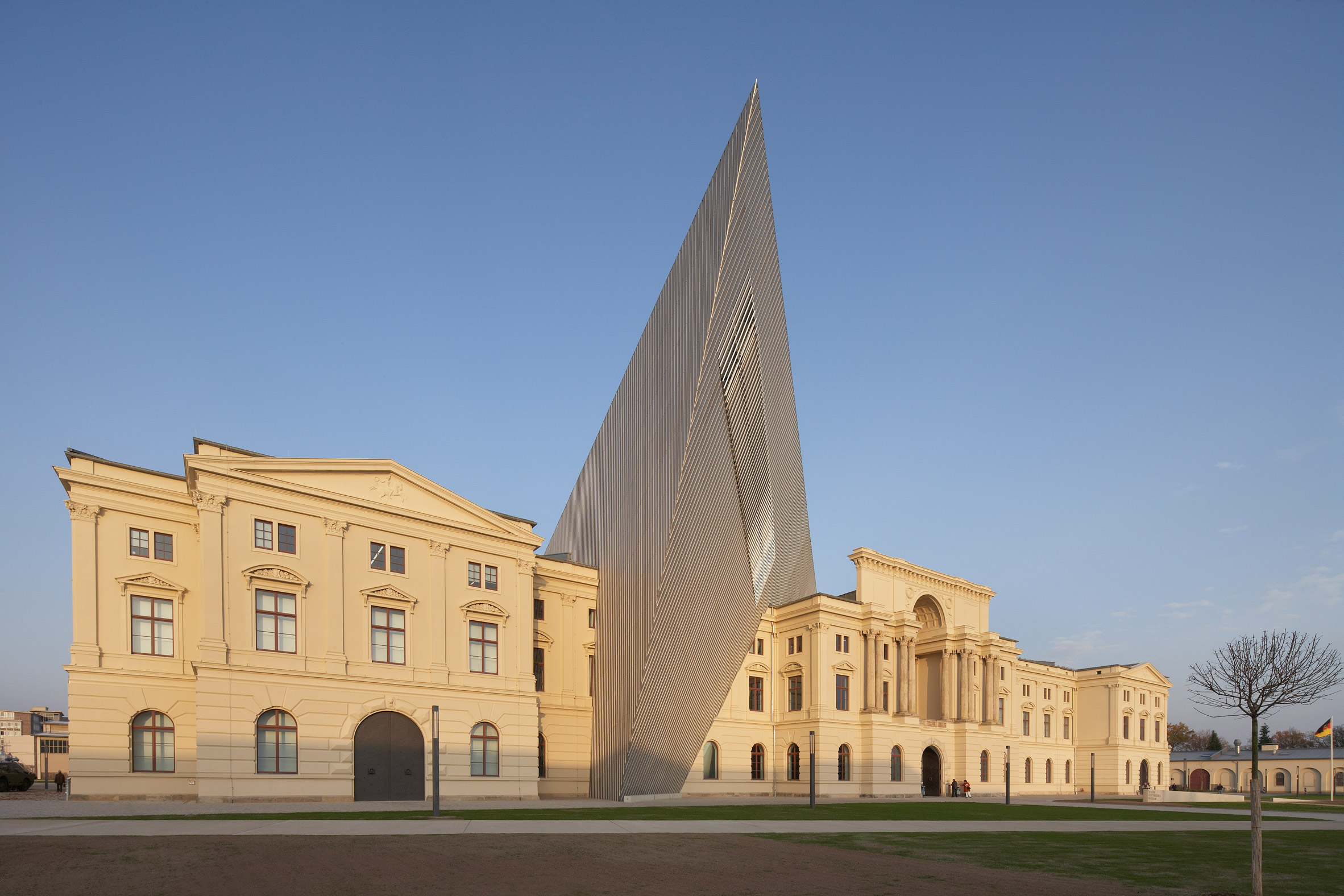
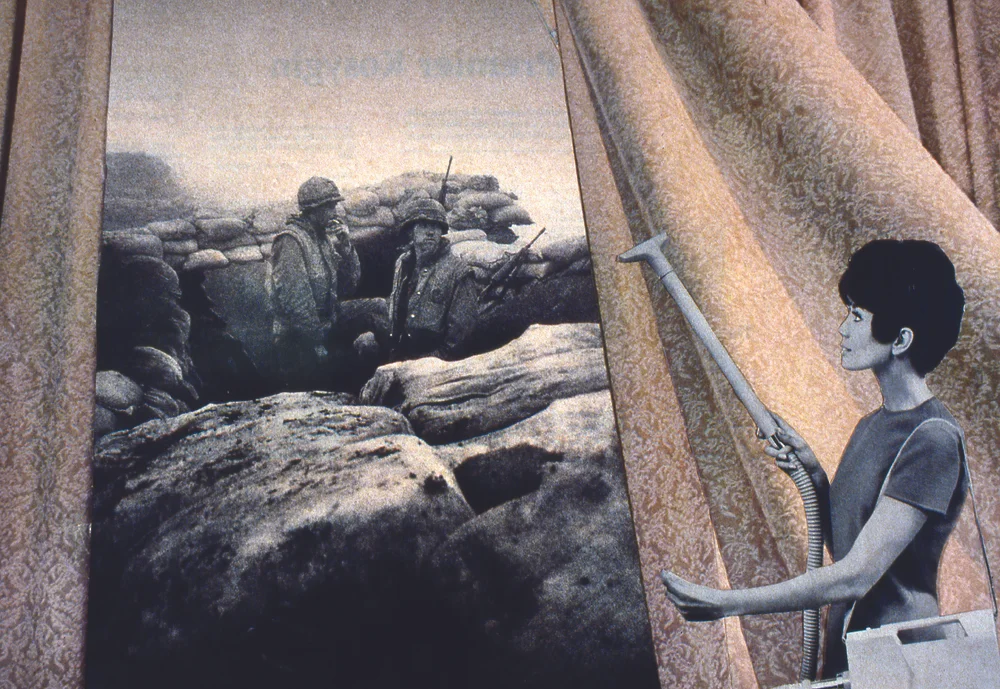
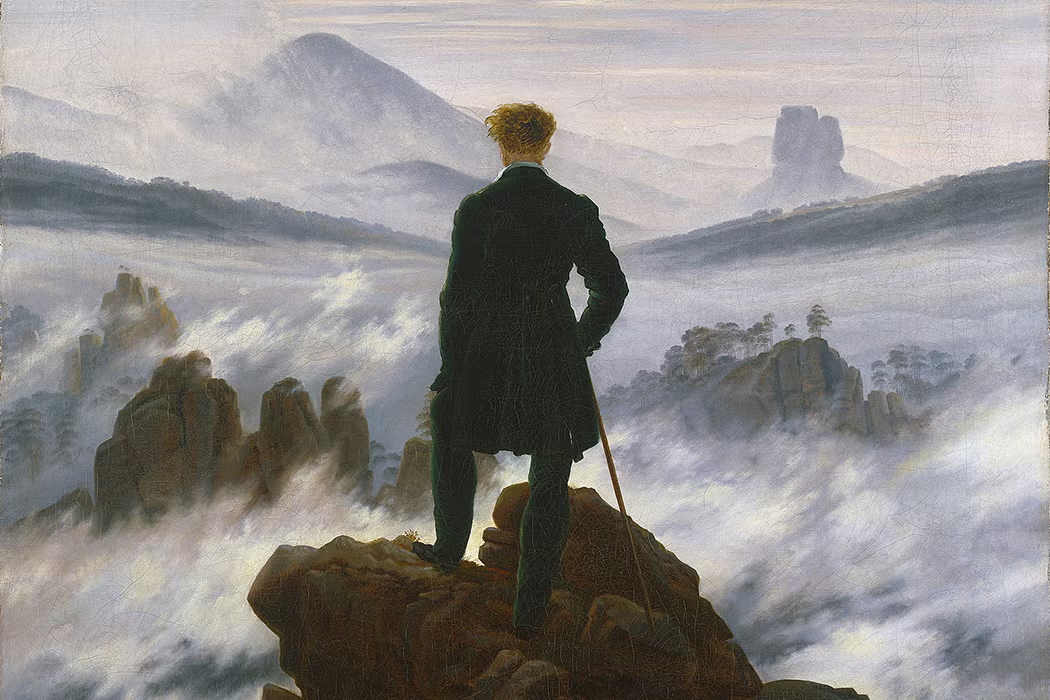
\n\n### 3. Architecture: Material and Temporal Dialogue\n\nIn architecture, juxtaposition is frequently employed in adaptive reuse and contemporary additions to historic structures. Rather than mimicking historical styles (pastiche), modernist and deconstructivist architects often use stark contrast to honor both eras.\n\n \n\n> [!info]\n> \n> Architectural Honesty through Contrast: The Venice Charter of 1964 (a foundational document for architectural conservation) explicitly states that replacements or additions to historic monuments "must be distinguishable from the original so that restoration does not falsify the artistic or historic evidence."[^11] Juxtaposition is the primary design tool used to achieve this clarity.\n> \n> \n\nWhen Daniel Libeskind designed the extension to the Military History Museum in Dresden, he drove a massive, five-story wedge of perforated steel and glass directly through the neoclassical arsenal building. The jarring juxtaposition interrupts the symmetry of the authoritarian structure, physically manifesting the rupture of war and the transparency of modern democratic reflection (a spatial encounter examined in Anthony Vidler-The Architectural Uncanny).\n\n\n\n### 4. Literature and Poetics: Parataxis\n\nIn literary aesthetics, juxtaposition often takes the form of parataxis—placing clauses or images one after another without coordinating or subordinating conjunctions that explain how they relate (a direct precursor to the procedural collage techniques explored in Conceptual Writing and Digital Poetics (Goldsmith & Perloff)).\n\n \n\nIn traditional Haiku and Modernist Imagism, two distinct images are placed side by side (in Japanese poetics, separated by a kireji or "cutting word"). Consider Ezra Pound’s two-line poem In a Station of the Metro (1913):\n\n \n\n_The apparition of these faces in the crowd:\n\n_Petals on a wet, black bough.[^12]\n\n \n\nPound provides no verb and no explanatory "like" or "as." By directly juxtaposing the gritty, industrial anonymity of a Paris subway station with the delicate, organic beauty of wet blossoms, the poem compels the reader's imagination to inhabit the space between the two lines.\n\n \n\n## Functional Roles in Aesthetic Experience\n\nWhy do artists across millennia continually return to juxtaposition? Its endurance stems from four irreplaceable functions in aesthetic communication:\n\n \n\n1. Generating Irony and Satire: By placing an idealized cultural narrative next to gritty material reality, artists expose hypocrisy. Pop artist Martha Rosler’s photo-collage series House Beautiful: Bringing the War Home (c. 1967–72) pasted harrowing images of the Vietnam War directly into pristine spreads from American interior design magazines, critiquing domestic complicity and media detachment.\n \n \n \n2. Evoking the Sublime and the Uncanny: When the familiar is juxtaposed with the alien or the vast, it destabilizes the viewer's sense of security (the psychological mechanism underlying Freud's The Uncanny (Das Unheimliche)). Romantic painters like Caspar David Friedrich juxtaposed tiny, solitary human figures against boundless, turbulent landscapes to evoke the Kantian Sublime (see The Sublime and Edmund Burke-The Physiological Sublime)—the simultaneous feeling of physical insignificance and spiritual elevation.\n \n \n \n3. Resisting Aesthetic Habituation: Pure harmony and uniformity quickly lead to sensory adaptation; the eye glides over a seamless surface without friction. Strategic juxtaposition introduces productive friction, arresting the viewer's gaze, prolonging contemplative engagement, and triggering the human drive for pattern recognition (see Apophenia and Pareidolia).[^8]\n \n \n \n4. Expressing the Ineffable: Complex human experiences—grief, nostalgia, trauma, ecstasy—often resist direct, literal depiction. By juxtaposing concrete fragments, an artist can triangulate an emotion that cannot be named directly, allowing the viewer to feel the unstated connection in the silence between the elements.\n \n \n \n\n> [!important]\n> \n> The Threshold of Coherence: For juxtaposition to function aesthetically rather than devolving into random noise, there must be an underlying frame of containment or an implicit thread of connection. If two elements are too similar, the result is monotony; if they are completely unmoored without any compositional or thematic anchor, the result is incoherence.[^8] Mastery of juxtaposition lies in balancing maximum tension with latent unity.\n\n---\n\n## Resonant Notes\n\nThe following notes in the vault share direct thematic, sociological, and literary connections with Juxtaposition:\n\n### 🔴 Avant-Garde Montage, Form & Institutional Critique\n- Theories of the Avant-Garde (Poggioli & Bürger) — Peter Bürger identifies montage and the non-organic work as the defining structural device of vanguard art, while Renato Poggioli analyzes the agonistic and activist psychology of radical juxtaposition as an aesthetic provocation against academic consensus.\n- The Avant-Garde — Serves as the overarching historical framework for vanguard art movements; traces how Dadaists, Surrealists, and Constructivists deployed jarring conceptual and material collisions to assault academic traditions and reintegrate art into everyday life-praxis.\n- The Dehumanization of Art — José Ortega y Gasset diagnoses how modernist art methodically purges sentimental, human-centered realism through anti-mimetic juxtaposition and formal estrangement, demanding a detached, contemplative aesthetic attitude.\n- Walter Benjamin (1892–1940) & Walter Benjamin's The Arcades Project — Benjamin’s materialist method relies on "dialectical images" and historiographical montage—juxtaposing discarded commodity fragments, nineteenth-century Parisian arcades, and revolutionary dreams to induce a sudden flash of historical awakening.\n- The Work of Art in the Age of Mechanical Reproduction — Benjamin analyzes cinematic cutting and optical shock; the rapid temporal juxtaposition of sequential film shots shatters contemplative absorption, transforming the spectator into a critical examiner.\n- Conceptual Writing and Digital Poetics (Goldsmith & Perloff) — Marjorie Perloff and Kenneth Goldsmith examine contemporary conceptual poetics, showing how digital collage, appropriation, and constraint-based text production inherit modernist parataxis by juxtaposing unoriginal language fragments.\n- Kitsch — Forms the dialectical foil to critical juxtaposition; whereas aesthetic montage introduces productive friction and unresolved contradiction, kitsch synthesizes pre-digested, harmonious sentimentality to eliminate cognitive tension.\n\n### 🟡 Perception, Gestalt & Cognitive Dissonance\n- Gestalt Psychology-The Mechanics of the Whole — Demonstrates how the perceptual system actively organizes visual stimuli into unified wholes (proximity, similarity, continuity, and figure-ground); juxtaposition deliberately violates or strains these grouping laws to generate perceptual ambiguity and interpretive tension.\n- Cognitive Dissonance — Leon Festinger’s theory explains the psychological discomfort triggered by mutually contradictory beliefs or sensory inputs; aesthetic juxtaposition induces a mild, productive dissonance that prompts the prefrontal cortex to forage for latent metaphorical bridges.\n- Perception vs. Apperception — Juxtaposition disrupts automatic, habitual sensory perception, forcing the observer into conscious, reflective apperception—actively integrating disparate, anomalous stimuli into cognitive schemas.\n- Apophenia & Pareidolia — Investigates the human neurological drive to perceive meaningful patterns and structural coherence across random or discordant data; juxtaposition exploits this cognitive bias by provoking the mind to generate synthetic third meanings between unlinked elements.\n- The Interface Theory of Perception (ITP) — Donald Hoffman’s evolutionary model shows that human perception operates as a species-specific interface rather than an objective mirror of reality; juxtaposition manipulates this evolutionary user interface by altering contextual visual cues to distort size, luminance, and meaning.\n- Bergson’s Eliminative Model of Perception and Memory — Henri Bergson illustrates how the brain filters out sensory data irrelevant to practical action; aesthetic juxtaposition arrests utilitarian habituation, forcing the subject out of instrumental reaction into contemplative, intuitive perception.\n\n### 🟢 Aesthetics, The Sublime & The Architectural Uncanny\n- Aesthetics — The overarching foundational note examining the philosophy of beauty, taste, and sensory perception (aisthesis); contextualizes juxtaposition as an essential formal technique spanning painting, cinema, architecture, and everyday design.\n- The Sublime — Explores the aesthetic category of boundless magnitude and overwhelming force; Romantic artists like Caspar David Friedrich juxtapose tiny, fragile human figures against immense landscapes to trigger the Kantian sublime—a cognitive collision between sensory inadequacy and rational transcendence.\n- Edmund Burke-The Physiological Sublime — Burke grounds aesthetic intensity in somatic contrast, showing how sudden transitions between blinding illumination and total darkness, or profound silence and thunderous roar, provoke the physiological tension of "delightful horror."\n- Freud's The Uncanny (Das Unheimliche) — Sigmund Freud demonstrates that the uncanny (unheimlich) emerges when something intimately familiar is suddenly defamiliarized or estranged; Surrealist juxtaposition operates by placing domestic, mundane objects into disturbing, irrational configurations.\n- Anthony Vidler-The Architectural Uncanny — Vidler traces how contemporary and deconstructivist architecture uses aggressive material and spatial juxtaposition (such as Daniel Libeskind's fractured geometries or glass wedges driven through historic masonry) to defamiliarize domestic spaces and embody historical rupture.\n- René Magritte — Magritte's Surrealist masterpieces systematically weaponize conceptual and semantic juxtaposition (e.g., night skies over sunlit houses, floating rocks, locomotives emerging from fireplaces) to subvert the assumed identity between images, linguistic labels, and reality.\n- Giorgio de Chirico (1888-1978) — Metaphysical painting achieves haunting poetic resonance through the enigmatic juxtaposition of classical marble statues, deserted Italian arcades, industrial smokestacks, and clocks, suspending normal temporal narrative.\n- McLuhan's The Medium is the Message & Marshall McLuhan (1911-1980) — McLuhan explains that electric media dismantle linear, sequential print logic, replacing it with an all-at-once, mosaic field where disparate global information streams are constantly juxtaposed in real time.\n\n---\n\n## References\n\n[^1]: Tate Modern / Art Term: Juxtaposition / tate.org.uk\n\n[^2]: Rudolf Arnheim / Art and Visual Perception: A Psychology of the Creative Eye / ucpress.edu\n\n[^3]: Sergei Eisenstein / Film Form: Essays in Film Theory / archive.org\n\n[^4]: Viktor Shklovsky / Art as Technique / monoskop.org\n\n[^5]: André Breton / Manifestoes of Surrealism / press.umich.edu\n\n[^6]: Michel Eugène Chevreul / The Principles of Harmony and Contrast of Colors / archive.org\n\n[^7]: Josef Albers / Interaction of Color / yalebooks.yale.edu\n\n[^8]: Daniel E. Berlyne / Aesthetics and Psychobiology / apa.org\n\n[^9]: Vilayanur S. Ramachandran and William Hirstein / The Science of Art: A Neurological Theory of Aesthetic Experience / imprint.co.uk\n\n[^10]: David Bordwell and Kristin Thompson / Film Art: An Introduction / mheducation.com\n\n[^11]: ICOMOS / International Charter for the Conservation and Restoration of Monuments and Sites (The Venice Charter 1964) / icomos.org\n\n[^12]: Ezra Pound / In a Station of the Metro / poets.org\n