The Architectural Uncanny in Depth Psychology
🗂️ Interactive Notebook: Open Study Companion (Video Summary, Flashcards, Mind Map) ↗

Across analytical psychology, spatial phenomenology, and architectural criticism, domestic architecture operates as a primary structural metaphor for the human psyche. While Sigmund Freud and architectural historian Anthony Vidler frame the "architectural uncanny" (das Unheimliche) as the terrifying return of repressed material within familiar domestic boundaries, Carl Gustav Jung reinterprets spatial estrangement through a prospective, teleological lens. In Jungian dream analysis, uncanny architectural anomalies—such as subterranean vaults, haunted rooms, and undiscovered wings—are not merely symptoms of past trauma, but symbolic blueprints of unintegrated personality structures and the collective unconscious awaiting conscious integration.
| Thinker / Framework | Disciplinary Locus | Conceptualization of Domestic Space | Etiology of the Uncanny (Das Unheimliche) | Hermeneutic Vector & Function | Primary Spatial Archetype |
|---|---|---|---|---|---|
| Ernst Jentsch (1906) | Cognitive Neuropsychiatry & Psychopathology | Space as habituated sensory field and navigational framework | Intellectual Uncertainty (intellektuelle Unsicherheit); cognitive hesitation at boundary lines | Retrospective / Perceptual: failure to integrate ambiguous sensory inputs into existing schemas | Lifelike automata, wax panopticons, mechanical figures |
| Sigmund Freud (1919) | Psychoanalysis & Psychosexual Depth Psychology | The dwelling (Heim) as secondary envelope; maternal womb as original Heimat | The Return of the Repressed (Wiederkehr des Verdrängten); resurfacing of infantile trauma | Causal-Reductive: somatic displacement of castration anxiety, death drive, and drive conflict | The locked room, haunted corridor, maternal anatomy |
| Carl Gustav Jung (1909–1961) | Analytical Psychology & Archetypal Oneirism | The multi-storey house as a living, vertical stratigraphy of the total psyche | Encounter with the Shadow & the Numinous; summons of the unintegrated Self | Prospective / Teleological: compensatory blueprint guiding conscious individuation | The Multi-Storey House (1909), the Unknown Wing, Bollingen Tower |
| Gaston Bachelard (1958) | Spatial Phenomenology & Poetic Topoanalysis | Inhabited space as the vertical vessel of intimate psychic memories and daydreaming | Subterranean Terrestrial Dread clashing with celestial rationalization | Phenomenological: vertical polarity organizing conscious elevation vs. subterranean depth | The Attic (rational clarity) vs. The Cellar (irrational instinctual root) |
| Anthony Vidler (1992) | Architectural History & Post-Structural Theory | Architecture as the culturally sanctified container of ontological security (Heimlichkeit) | Spatialization of Alienation; domestic refuge defamiliarized into a menacing trap | Cultural-Deconstructive: exposure of spatial ideology, trauma voids, and bodily fragmentation | Warped grids (Eisenman), deconstructed follies (Tschumi), voids (Libeskind) |
1. Theoretical Foundations of the Uncanny (Das Unheimliche)
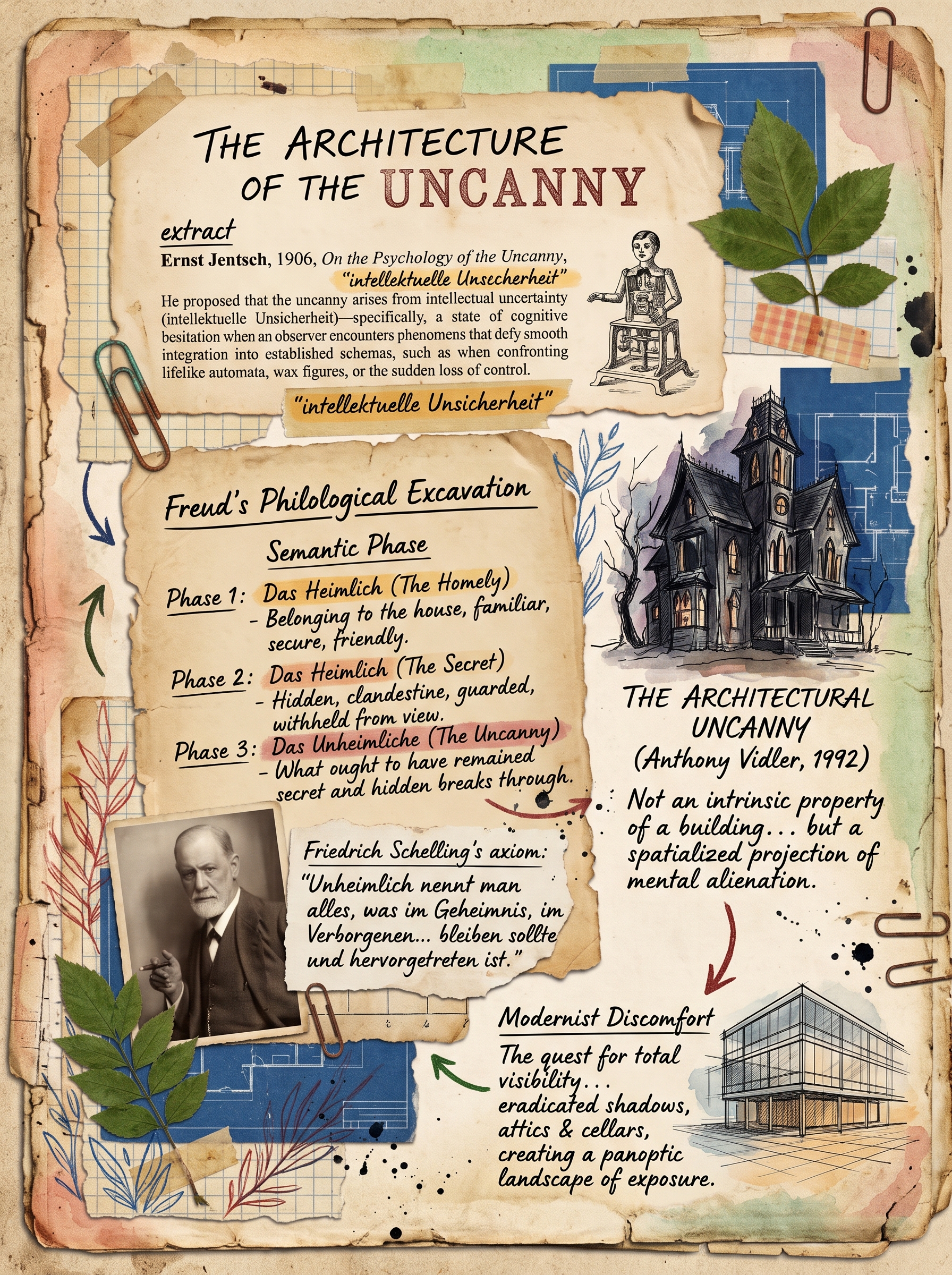
To situate Carl Jung's spatial dream theory within architectural discourse, one must first examine the concept of the uncanny as formalized across neuropsychiatry, psychoanalysis, and spatial theory by Ernst Jentsch, Sigmund Freud, and Anthony Vidler.
Philological Archaeology and Psychoanalytic Origins
In 1906, German psychiatrist Ernst Jentsch published the foundational investigation into the phenomenon, On the Psychology of the Uncanny (Zur Psychologie des Unheimlichen).[1] Jentsch defined the uncanny primarily through the lens of intellectual uncertainty (intellektuelle Unsicherheit)—specifically, a state of acute cognitive hesitation provoked when an observer encounters phenomena that defy smooth integration into established perceptual schemas.[1:1] This disorientation erupts most powerfully when the boundary between animate life and inanimate mechanical matter is destabilized, such as when confronting lifelike wax figures, automata, or epileptic seizures unmasking the biological machine.[1:2]
Thirteen years later, in his seminal 1919 treatise Das Unheimliche (The Uncanny), Sigmund Freud contested Jentsch's cognitive framework, shifting the phenomenon from conscious categorization failure to a profound psychosexual crisis of unconscious recognition.[2] Before analyzing clinical encounters or literature, Freud conducted an exhaustive philological investigation of the German adjective heimlich (homely, familiar, intimate) and its antonym unheimlich (unhomely, eerie, strange).[3]
| Semantic Phase | Lexical Focus | Conceptual Definition & Manifestation |
|---|---|---|
| Phase 1: The Homely | Das Heimlich (Domestic Enclosure) | Belonging to the house (Heim); familiar, intimate, comfortable, friendly, and securely protected against external chaos.[2:1] |
| Phase 2: The Secret | Das Heimlich (Concealment) | Withdrawn from the knowledge of others; kept hidden from view, clandestine, withheld from daylight, and guarded.[2:2] |
| Phase 3: Dialectical Inversion | Das Unheimliche (The Unhomely / Uncanny) | The concealed secret breaks through its domestic enclosure into the open; what ought to have remained hidden is terrifyingly exposed.[2:3][3:1] |
Freud observed a profound linguistic paradox: at its secondary level of meaning, heimlich also denotes that which is concealed, clandestine, kept from sight, or withheld from others.[3:2] Consequently, heimlich develops along an ambivalent trajectory until it merges directly with its opposite, unheimlich.[1:3] Adopting philosopher Friedrich Schelling's formulation, Freud established the cornerstone axiom of psychoanalytic aesthetics:
"Unheimlich nennt man alles, was im Geheimnis, im Verborgenen... bleiben sollte und hervorgetreten ist."
("Uncanny is the name for everything that ought to have remained secret and hidden, and yet has come to light.") — Friedrich Schelling[2:4]
For Freud, uncanny dread does not stem from encountering something wholly alien or novel; rather, it marks the resurgence of something that was once intimately familiar (heimisch) to the psyche, but was subsequently alienated through psychological repression.[2:5] The negative prefix un- functions as the psychoanalytic token of repression (die Marke der Verdrängung). Freud categorized uncanny phenomena into two primary operational engines:[2:6][4]
- The Return of the Repressed: Infantile complexes—such as castration anxiety (symbolized by ocular trauma in E.T.A. Hoffmann's The Sandman), womb fantasies, or the defensive double (Doppelgänger) analyzed by Otto Rank—that have been driven from awareness suddenly resurface via an external sensory trigger.[4:1]
- Surmounted Primitive Beliefs: Archaic, animistic modes of thought—such as classical animism, the omnipotence of thoughts (Allmacht der Gedanken), or the return of the dead—that rational modern humanity believes it has intellectually surmounted suddenly appear to be confirmed by empirical reality.[4:2]
Anthony Vidler and the Architectural Uncanny
In his landmark 1992 monograph The Architectural Uncanny: Essays in the Modern Unhomely, architectural historian Anthony Vidler translated psychoanalytic estrangement directly into spatial and cultural criticism.[1:4][3:3] Vidler emphasized an essential epistemological distinction: the uncanny is not an intrinsic physical property of a building.[3:4] No specific proportion, material, or geometric configuration is inherently eerie in its masonry. Rather, the architectural uncanny is an aesthetic representation of a psychological projection—a spatialized manifestation of mental alienation, bodily dislocation, and historical trauma.[1:5]
Vidler demonstrates that architecture has served since the Romantic era as the privileged vessel for the uncanny precisely because the house is culturally tasked with providing ultimate ontological security (Heimlichkeit). When the domestic sanctuary becomes estranged, the boundary between self and environment collapses.
Vidler traced this spatial pathology from the haunted Romantic dwellings of E. T. A. Hoffmann, Edgar Allan Poe (The Fall of the House of Usher), and Victor Hugo through to twentieth-century modernism.[3:5] High modernist architecture—exemplified by The Bauhaus School and Le Corbusier's concept of the dwelling as a "machine for living in" (machine à habiter)—attempted to exorcise the shadowy, neurotic recesses of nineteenth-century bourgeois interiors through radical transparency, hygienic geometry, and glass curtain walls.[1:6]
Paradoxically, this quest for total rational visibility generated a distinctly modern unhomeliness. By systematically eradicating shadows, attics, and cellars, modernist architecture eliminated the protective folds of domestic intimacy, creating a panoptic landscape characterized by relentless surveillance, spatial exposure, scale alienation, and the erasure of psychological refuge.[1:7]
2. The Jungian Divergence: From Repression to Individuation
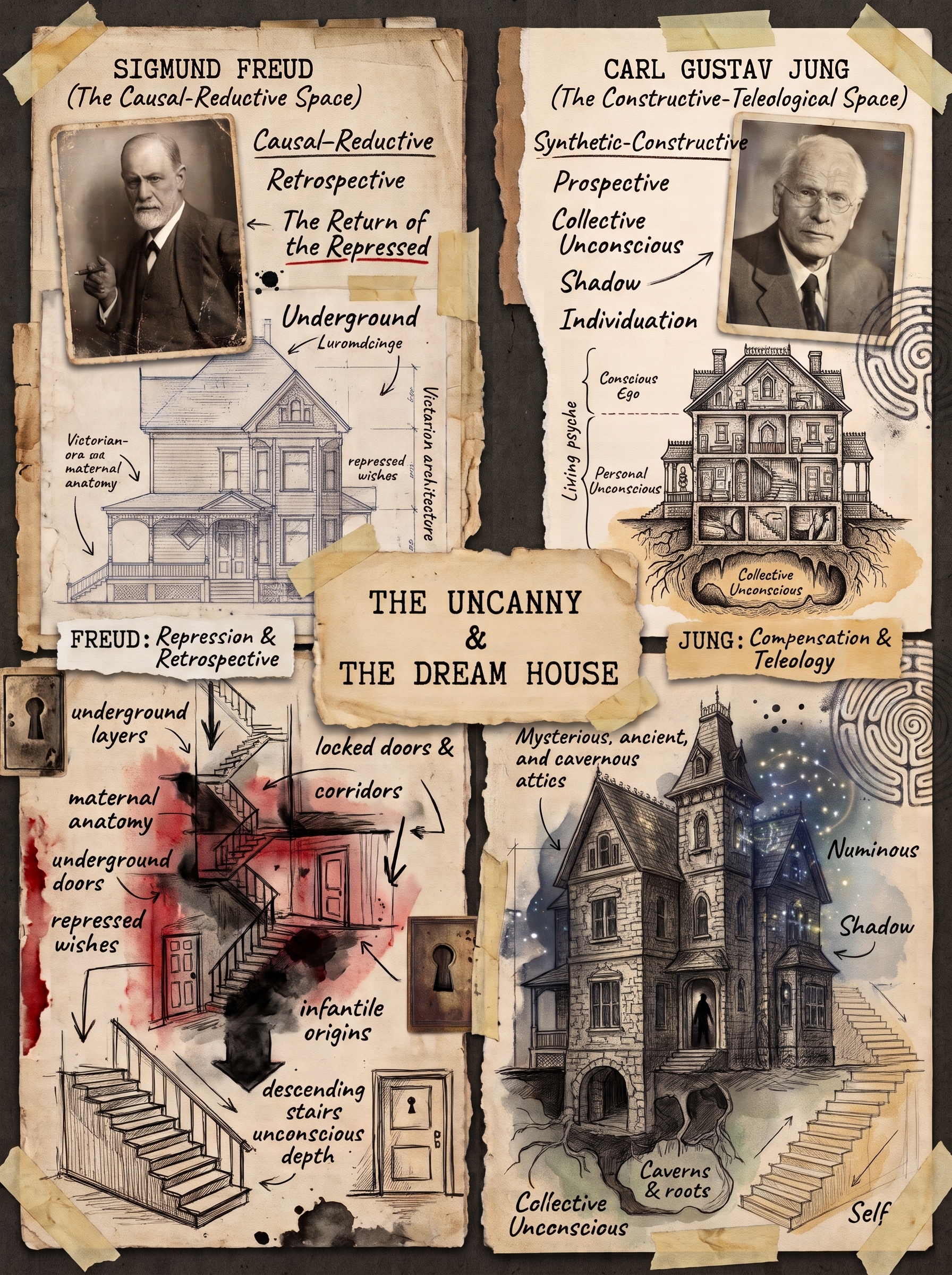
While Sigmund Freud and Carl Gustav Jung both recognized the potent affective charge of uncanny spaces and haunting dreams, their theoretical break fundamentally transformed how spatial oneirism is interpreted in analytical depth psychology.[5]
| Hermeneutic Dimension | Sigmund Freud (Causal-Reductive Oneirism) | Carl Gustav Jung (Constructive-Teleological Oneirism) |
|---|---|---|
| Directional Orientation | Retrospective: Traces dream motifs backward to infantile origins and historical trauma.[5:1] | Prospective: Interprets dream motifs forward as symbolic vectors toward future integration.[6] |
| Interpretive Mechanics | Causal-Reductive: Decodes manifest architectural imagery into latent biological drives and repressed wishes.[5:2] | Synthetic-Constructive: Amplifies architectural symbols as self-representations of psychic structure.[6:1] |
| Spatial Conception of the House | A defensive camouflage disguising forbidden incestuous wishes or maternal anatomy.[5:3] | An objective, living structural diagram of the conscious ego, personal unconscious, and collective unconscious.[5:4] |
| Diagnostic Meaning of Anomalies | Symptoms of neurosis, unresolved fixation, or threatening return of the repressed.[4:3] | Compensatory summons to confront the Shadow, withdraw projections, and expand ego boundaries.[7] |
| Ultimate Teleological Goal | Taming instinctual drives; transmuting neurotic misery into common unhappiness.[5:5] | Individuation: Harmonizing conscious ego identity with the total archetypal Self.[7:1] |
Reductive vs. Constructive Hermeneutics
Freud's interpretive model is predominantly retrospective and causal-reductive: an uncanny dream house disguises repressed infantile complexes or somatic memories, frequently reducing rooms, staircases, and corridors to maternal anatomy or sexual intercourse.[5:6] For Freud, the dream's manifest content is a deceptive distortion orchestrated by the psychic censor to protect sleep from taboo wishes.[5:7]
Conversely, Jung developed a synthetic, constructive, and teleological approach to the psyche.[6:2] While acknowledging the personal unconscious and its repressed complexes, Jung established that beneath biographical memory lies the collective unconscious—an evolutionary, transpersonal substrate populated by inherited structural blueprints known as archetypes.[5:8]
In Jungian oneirism, dreams are not deceptive facades requiring reductive decoding; they are candid, unvarnished self-portrayals of the actual state of the total psyche.[6:3] Consequently, an uncanny architectural dream is not a static symptom of past neurotic injury, but a compensatory blueprint: a dynamic spatial representation designed to counterbalance the one-sided attitudes of the conscious ego and point toward future development.[6:4]
Shadow Projection and Numinosity
In analytical psychology, the experiential sensation of das Unheimliche corresponds directly to an encounter with the Shadow or the numinous.[7:2]
- The Shadow: Comprising all personal traits, instinctual drives, and creative potentials disowned by the conscious ego to maintain its social mask (the Persona), the Shadow carries an autonomous energetic charge.[7:3] When disowned, this psychic material is projected onto external environments, causing familiar domestic spaces to appear oppressive, watched, or haunted.[8]
- Autonomous Complexes: Jung demonstrated through his Word Association experiments that feeling-toned complexes behave like autonomous splinter psyches operating outside conscious control.[9] In dreams and waking fantasies, unintegrated complexes frequently personify as poltergeists, phantom intruders, or eerie architectural distortions within a dwelling.[9:1]
- Teleological Dread and the Numinous: Whereas Freud interpreted the uncanny as an unwelcome return of what should remain buried, Jung recognized that the dread accompanying an uncanny space often masks an encounter with the numinous—what Rudolf Otto’s The Idea of the Holy|Rudolf Otto designated as the mysterium tremendum et fascinans.[7:4] The uncanny disruption of the ego's domestic comfort functions as a necessary crisis, summoning the individual toward individuation—the lifelong psychological integration of conscious and unconscious contents into the wholeness of the Self.[7:5]
3. Jung's Architectural Oneirism: Key Case Studies
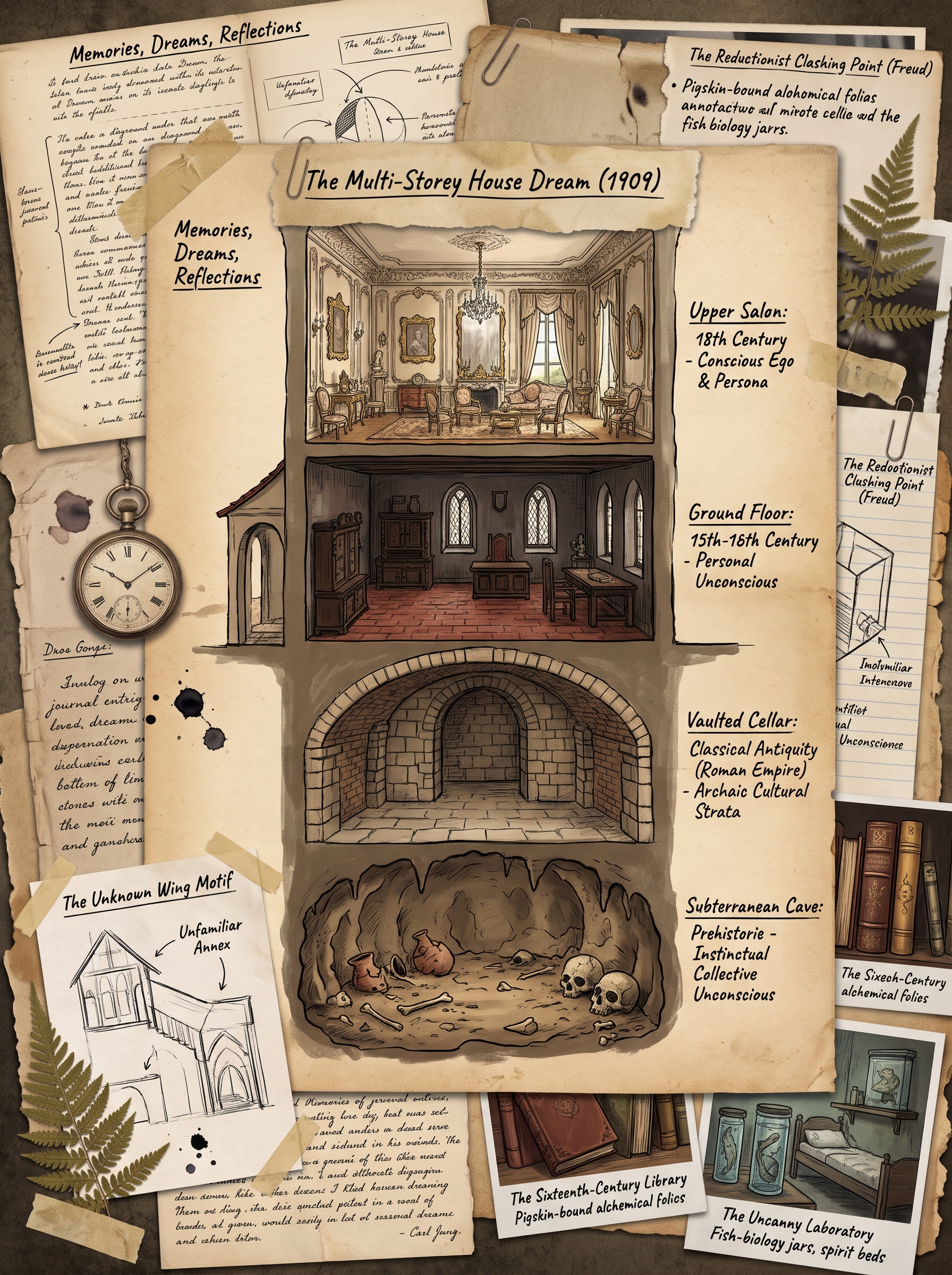
Jung's autobiographical reflections in Memories, Dreams, Reflections demonstrate how architectural dreams functioned as the primary empirical catalyst for his structural formulation of the collective unconscious.[5:9]
| Storey / Level | Historical & Architectural Epoch | Psychological Stratum | Material & Phenomenological Markers | Diagnostic & Archetypal Function |
|---|---|---|---|---|
| Upper Salon | Eighteenth-Century (Rococo Style) | Conscious Ego & Persona | Inhabited salon, precious paintings, refined antique furnishings.[5:10] | The curated, civilized identity presented to society; daylight awareness detached from biological roots. |
| Ground Floor | Fifteenth–Sixteenth Century (Medieval) | Personal Unconscious | Dark chambers, red brick floors, heavy medieval furnishings.[5:11] | Historical and biographical memories; cultural heritage directly adjoining conscious awareness. |
| Vaulted Cellar | Classical Antiquity (Roman Empire) | Archaic Cultural Strata | Heavy door, stone stairways, masonry of stone blocks with brick-chip mortar.[5:12] | Collective cultural foundations; foundational Western socio-historical roots underlying personal identity. |
| Subterranean Cave | Prehistoric / Paleolithic Epoch | Instinctual Collective Unconscious | Ringed stone slab, rock-cut cavern, thick dust, scattered bones, broken pottery, two ancient skulls.[5:13] | Primordial phylogenetic substrate; universal animal and evolutionary matrix common to all humanity. |
The Multi-Storey House Dream (1909)
During his 1909 voyage to Clark University in the United States alongside Sigmund Freud, Jung experienced a watershed architectural dream that precipitated their theoretical split and provided the foundational model for analytical psychology.[5:14]
In the dream, Jung found himself inside an unfamiliar two-storey house that he recognized intuitively as "my house."[5:15] His exploration proceeded along a strict vertical descent through historical epochs:
- The Upper Salon (Conscious Persona/Ego): Jung began on the upper floor in an inhabited salon furnished with refined eighteenth-century Rococo pieces and precious paintings.[5:16]
- The Ground Floor (Personal Unconscious): Realizing he did not know what the lower level looked like, he descended to a dark ground floor dating to the fifteenth or sixteenth century, outfitted with medieval furnishings and red brick floors.[5:17]
- The Vaulted Cellar (Archaic Cultural Strata): Opening a heavy door, he descended a stone stairway into an ancient vaulted room whose masonry—stone blocks mixed with brick chips in the mortar—dated back to Roman antiquity.[5:18]
- The Subterranean Cave (Instinctual Collective Unconscious): Lifting a ringed stone slab in the cellar floor, Jung descended narrow stone steps into a low, rock-cut prehistoric cave containing thick dust, scattered animal bones, broken pottery, and two half-disintegrated human skulls.[5:19]
When Jung recounted this dream to Freud, Freud focused exclusively on the final image, pressing Jung repeatedly to identify whose death he secretly wished for in connection with the two skulls.[5:20] Freud insisted on reducing the dream to a repressed personal death-wish. Recognizing the inadequacy of reducing prehistoric stratigraphy to a petty personal hostility, Jung realized that the house constituted a structural cross-section of the human mind—descending from contemporary conscious identity through historical cultural strata into the universal, instinctual foundations of evolutionary biology.[5:21]
The Unknown Wing Motif
A second major architectural motif recurred throughout Jung's life, most notably preceding his multi-decade investigation of Western alchemy.[9:2] Jung repeatedly dreamed of discovering an unfamiliar, ancient wing or annex attached directly to his familiar house.[6:5] In each dream, he marveled at how this extensive structure could have existed without his knowledge, even though it had evidently stood there for centuries.[6:6]
- The Sixteenth-Century Library: In a pivotal dream from the mid-1920s, Jung entered the unknown wing and discovered an immense library filled with sixteenth- and seventeenth-century folios bound in pigskin, containing cryptic alchemical engravings.[10] Fifteen years later, after amassing historical alchemical treatises to decipher his patients' dreams, Jung realized he had assembled in waking life the exact library prefigured in his oneiric blueprint.[9:3]
- The Uncanny Laboratory and Maternal Room: In another variation, Jung opened double doors in the unvisited wing to find his deceased father's laboratory for fish-biology alongside a billowing curtain leading to his mother's empty room.[9:4] Jung explicitly described the room's atmosphere as uncanny, noting rows of suspended pavilion-like chests containing beds for visiting spirits.[9:5]
In Jungian hermeneutics, the "unknown wing" exemplifies the prospective uncanny: the psyche (house) is revealed to be far more expansive than its conscious proprietor assumes.[11] The undiscovered rooms house latent intellectual, creative, or spiritual capacities that feel alien (unheimlich) solely because consciousness has not yet inhabited and integrated them.[11:1]
4. Phenomenological Synthesis: Gaston Bachelard's Topoanalysis
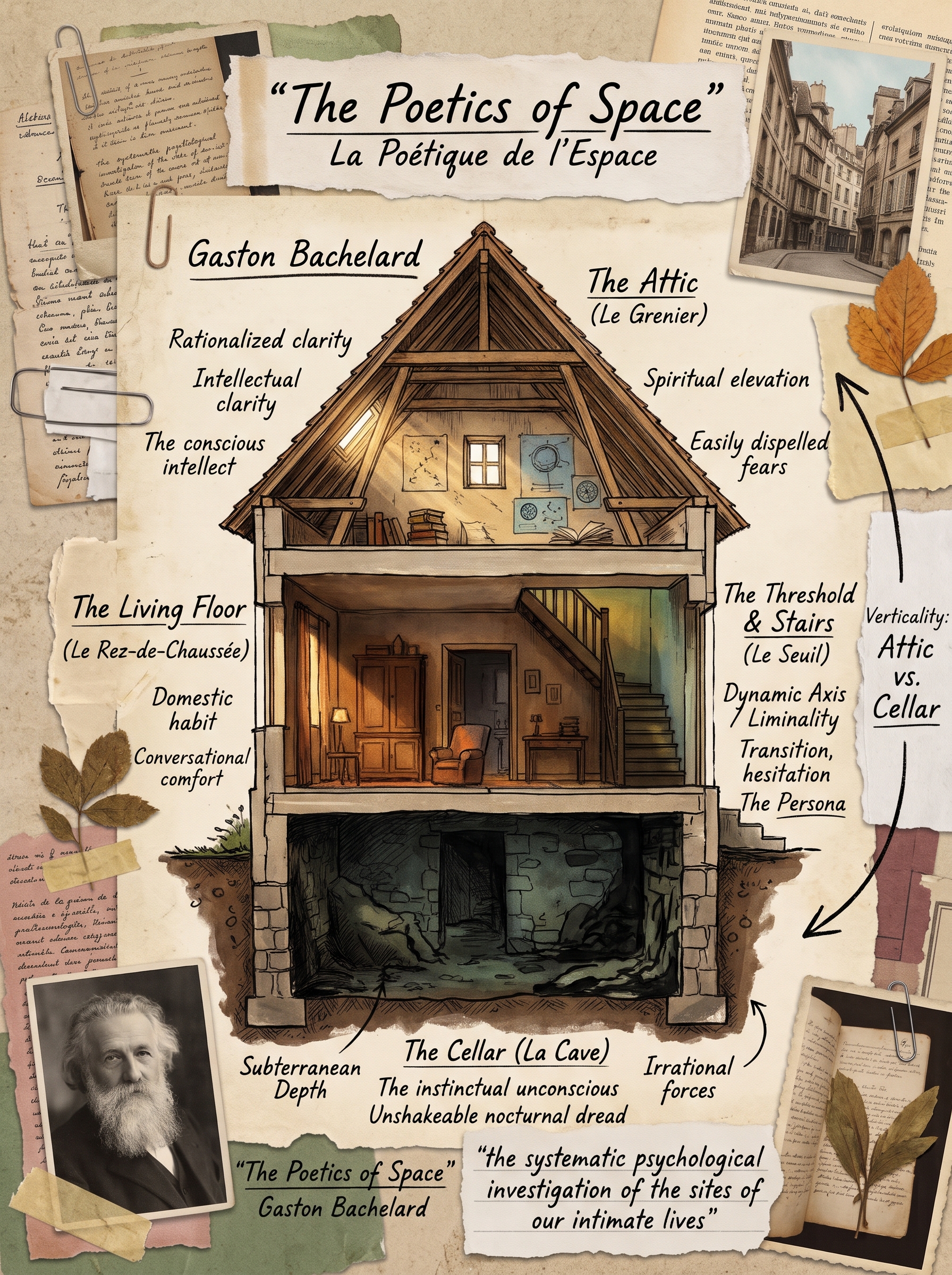
The conceptual bridge connecting Jungian depth psychology with architectural theory was cemented by French philosopher Gaston Bachelard in his 1958 masterwork The Poetics of Space (La Poétique de l'Espace).[12] Bachelard formulated topoanalysis—defined as the systematic psychological investigation of the sites of our intimate lives—explicitly favoring Jung's archetypal imagination over Freudian clinical reductionism.[12:1]
| Topoanalytical Zone | Vertical Axis | Phenomenological Feeling-Tone | Dominant Psychic Agency | Manifestation of the Uncanny |
|---|---|---|---|---|
| The Attic (Le Grenier) | Apex / Vertical Elevation | Rationalized clarity, sunny sublimation, structured intelligibility.[13] | Conscious intellect, spiritual elevation, cognitive Edification.[14] | Easily dispelled fears; daylight effortlessly banishes phantom night terrors.[13:1] |
| The Living Floor (Le Rez-de-Chaussée) | Center / Horizon | Domestic habit, functional sociability, conversational comfort.[12:2] | Persona and waking conscious ego navigation.[5:22] | Sudden defamiliarization when domestic routines rupture unexpectedly.[3:6] |
| The Threshold & Stairs (Le Seuil) | Dynamic Axis / Liminality | Transition, hesitation, vertigo of passage.[8:1] | Liminal mediation between ego boundaries and unconscious depths.[8:2] | Dread of the locked door or the unseen watcher ascending from below.[7:6] |
| The Cellar (La Cave) | Base / Subterranean Depth | Heavy, impenetrable terrestrial dread, irrational forces.[13:2] | The instinctual unconscious, shadow complexes, biological drives.[13:3] | Unshakeable nocturnal dread; perpetual darkness impervious to rational daylight.[13:4] |
Verticality and Polarity: Attic vs. Cellar
Drawing directly on Jung's structural analogy of the psyche to an ancient building, Bachelard argued that inhabited domestic space transcends Cartesian geometric coordinates, organizing human consciousness along a polarized vertical axis:[13:5]
- The Attic (Rationalized Sublimation): Up beneath the roof, structural framing is visible, solid, and intelligible.[13:6] Even if irrational fears intrude at night, daylight banishes attic terrors effortlessly; the attic represents intellectual clarity, conscious contemplation, and spiritual sublimation.[14:1]
- The Cellar (Irrational Subterranean Dread): For Bachelard, the cellar is the dark entity of the house, partaking directly of subterranean terrestrial forces.[13:7] Unlike the attic, cellar fears cannot be reasoned away because darkness prevails there day and night, surrounded by buried earth walls that enclose infinite, unseen depths.[13:8]
In The Poetics of Space, Bachelard cites Jung to illustrate how modern consciousness behaves when confronted by unconscious panic: the prudent citizen hearing a suspicious noise in the cellar sprints up into the sunlit attic to verify there are no burglars—preferring rationalized self-deception in the light over descending into the uncanny reality of the subterranean depths.[13:9]
5. Diagnostic Taxonomy of Dream Architecture
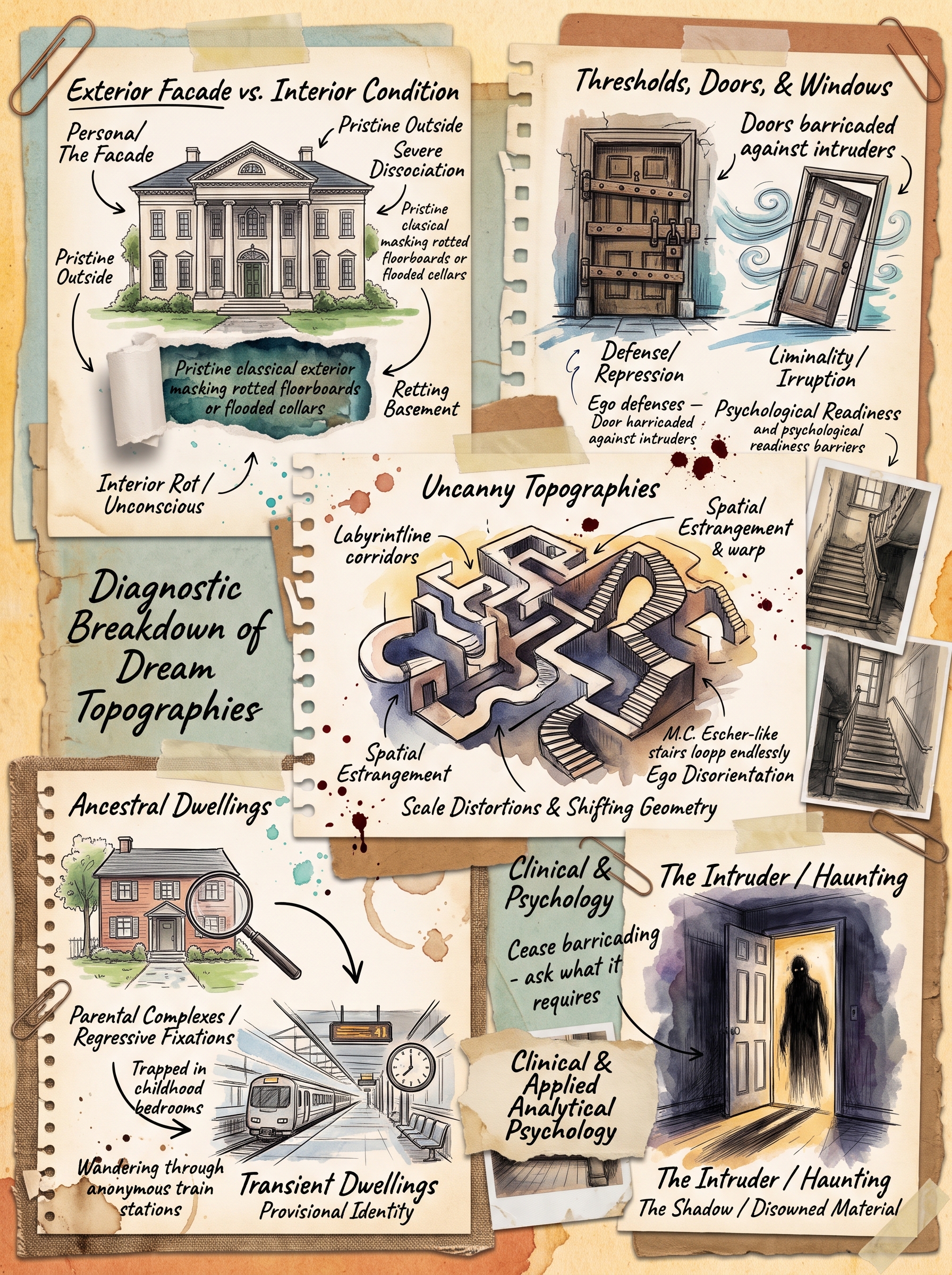
In clinical and applied analytical psychology, architectural structures are never decoded via rigid, dogmatic "dream dictionaries." Rather, analysts employ amplification—synthesizing the dreamer's personal associations with universal mythological and architectural motifs—to diagnose the state of psychic equilibrium.[10:1]
| Dream Architectural Motif | Structural Variable | Analytical Psychology Referent | Clinical Presentation / Symptom | Therapeutic & Individuation Task |
|---|---|---|---|---|
| Exterior Facade vs. Interior Rot | Boundary Integrity | The Persona vs. unacknowledged internal reality.[5:23] | Pristine classical exterior masking rotted floorboards or flooded cellars; acute dissociation. | Dismantle rigid persona over-identification; confront neglected internal decay. |
| Locked Doors & Thresholds | Liminal Permeability | Ego defenses, repressions, and psychological readiness barriers.[8:3] | Doors barricaded against intruders or doors blown off hinges by unseen winds. | Transition from defensive resistance to dialogue with autonomous unconscious contents. |
| Warped Geometry & Endless Halls | Spatial Metric | Ego disorientation during developmental crises or trauma.[1:8] | Non-Euclidean corridors, shifting floors, rooms with shrinking ceilings. | Stabilize the conscious center; ground the ego amidst transitional identity dissolution. |
| Childhood Home vs. Transit Hubs | Temporal Permanence | Archaic parental complexes (imago) vs. provisional identity states.[14:2] | Trapped in childhood bedrooms or wandering through anonymous airports and train stations. | Liquidate regressive childhood fixations; commit to an authentic adult psychological dwelling. |
| Subterranean Water Infiltration | Fluid Dynamics | Flooding of consciousness by chaotic archetypal affect.[5:24] | Rising black water in basements, burst pipes, subterranean sea caverns. | Establish robust ego-boundaries; channel volcanic affective energies into creative form. |
| The Uncanny Intruder / Poltergeist | Agentic Presence | Disowned Shadow material demanding conscious integration.[7:7] | Spectral figures lurking in hallways, door-rattling intruders, poltergeists. | Cease barricading the threshold; actively inquire what the disowned figure demands. |
Diagnostic Breakdown of Dream Topographies
When analyzing uncanny architectural dreams, Jungian clinicians evaluate several spatial variables to assess the health of the ego-Self axis:[5:25][8:4]
- Exterior Facade vs. Interior Condition: The exterior facade reflects the Persona—the polished public identity presented to collective society.[5:26] A pristine neoclassical facade masking rotting timber, cracked foundation masonry, or flooded basements indicates a severe dissociation between external adaptation and inward psychological reality, warning that conscious life is built on sand.
- Thresholds, Doors, and Windows: Thresholds signify liminality—zones of transition between conscious ego-territory and the unconscious ocean.[8:5] Locked doors indicate defensive repression or psychological unreadiness, whereas doors blown open by atmospheric forces signal an imminent irruption of autonomous unconscious material that the conscious mind cannot forestall.
- Scale Distortions and Shifting Geometry: Corridors that stretch into infinity, ceilings that sink, or stairs that loop like M.C. Escher prints mirror what Vidler terms spatial estrangement.[1:9] Psychologically, geometric instability reveals ego disorientation during profound life transitions, trauma, or identity disintegration.[8:6]
- Ancestral vs. Transient Dwellings: Returning repeatedly in dreams to a childhood home typically points to active parental complexes (imago) or regressive developmental arrests.[14:3] Conversely, wandering through hotels, motels, and train stations indicates provisional psychological attitudes—transitional identities the individual is passing through rather than permanently inhabiting.
- The Intruder or Haunting Presence: Uncanny apparitions attempting to breach the dwelling almost invariably personify rejected Shadow material.[7:8] In Jungian practice, the decisive therapeutic breakthrough occurs when the dreamer stops barricading the doors and asks the intruder what it requires from consciousness.[7:9]
6. Materializing the Oneiric Blueprint: The Bollingen Tower
Unlike theoreticians whose engagement with architectural space remained purely discursive, Carl Jung physically translated his oneiric blueprints into stone through the construction of the Bollingen Tower (Turm zu Bollingen) on the upper shore of Lake Zürich.[15]
| Phase / Year | Structural Addition | Psychological & Individuation Milestone | Archetypal Meaning | Oneiric Prefiguration |
|---|---|---|---|---|
| Phase 1 (1923) | Circular Two-Storey Stone Tower | Death of Jung's mother; need for maternal containment and primordial psychic root.[15:1] | Maternal womb, archetypal Heim, primitive hearth, autonomous sanctuary.[11:2] | Reaction against modern functionalism; search for ancestral grounding. |
| Phase 2 (1927) | Central Annex with Hearth | Expansion of conscious ego capabilities; growing integration of family and professional life.[15:2] | The tower extends laterally, establishing a bridge between inner depth and outward reality. | Structural elaboration of the dwelling beyond isolated primitive containment. |
| Phase 3 (1931) | Tower-Like Extension & Private Sanctorum | In-depth immersion in Western alchemy; need for complete solitude during active imagination.[11:3] | Spiritual retreat dedicated to meditation, inaccessible to family or guests.[11:4] | Direct waking manifestation of the Unknown Wing and alchemical library dreams.[9:6] |
| Phase 4 (1935) | Courtyard and Lake-Facing Loggia | Maturation of the individuation journey; completion of the four-part mandala structure.[11:5] | Architectural Quaternio: Four discrete sections opening outward to earth, water, and sky.[11:6] | The Self manifesting as a balanced geometric mandala in physical space. |
| Phase 5 (1955) | Upper Storey Raised Over Central Section | Death of his wife, Emma Jung; confronting final solitary completeness in old age.[11:7] | Full conscious realization of the ego-Self axis; total self-responsibility before mortality.[11:8] | Conscious completion of the upper salon, integrated with subterranean roots. |
Stone as Psychic Individuation
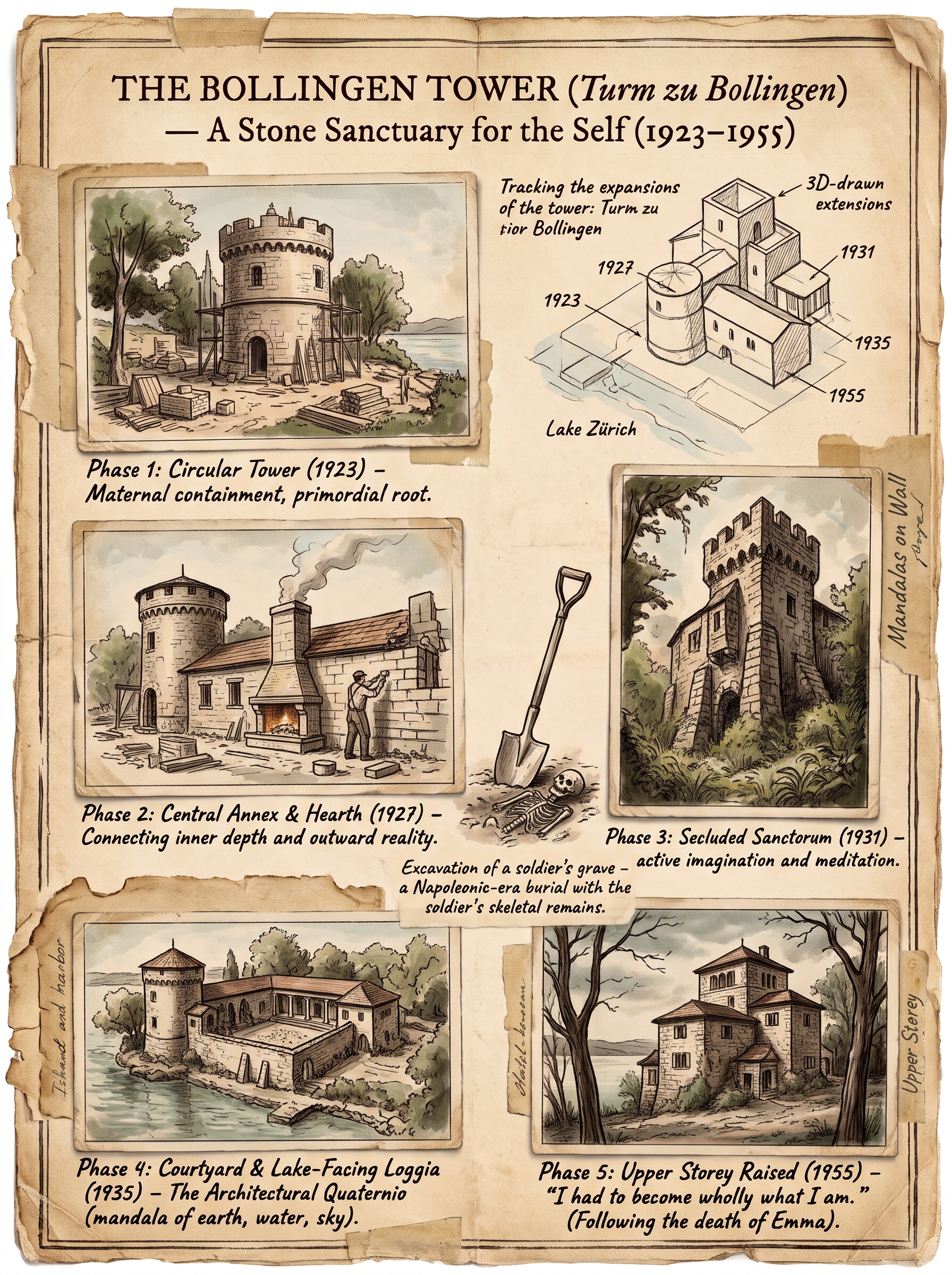
Beginning in 1923—shortly after the death of his mother—Jung purchased land at Bollingen without an architect or master blueprint.[15:3] Deliberately rejecting twentieth-century functionalism, Jung built without electricity, running water, or central heating, relying on oil lamps, an open hearth, and water pumped from a well.[11:9] Jung initially planned a primitive circular African hut, but realized such a form was too archaic for a modern European, opting instead for a two-storey medieval stone tower.[11:10]
Over thirty-two years, Jung expanded the edifice in five distinct phases corresponding directly to his unfolding individuation process:[15:4]
- In 1931, Jung erected a tower-like annex containing a secluded private room dedicated exclusively to meditation and active imagination—a room where no one else was permitted to enter, physically materializing the unknown wing of his dreams.[11:11]
- In 1935, he added an enclosed courtyard and lakeside loggia, completing an architectural quaternio (a fourfold mandala of psychic wholeness uniting earth, water, and sky).[11:12]
- In 1955, following the death of his wife Emma Jung, he raised an upper storey over the central section, representing the conscious extension of his ego-personality in old age: "I had to achieve an inner consolidation of what I was... I had to become wholly what I am."[11:13]
Even the subterranean uncanny of his 1909 dream manifested literally at Bollingen: during excavation for the tower's foundations, workmen uncovered a skeletal grave dating to the Napoleonic wars.[11:14] Jung buried the soldier with military honors, physically rooting his stone sanctuary atop ancestral bones just as his 1909 dream house rested upon the two ancient skulls.[11:15]
At Bollingen, Jung demonstrated the ultimate resolution of the architectural uncanny: by consciously carving stone, painting frescoes, and building alongside the primordial forces of the unconscious, the terrifying unheimlich dread of the unknown was transmuted into an enduring, sacred home (Heim) for the Self.[11:16]
🎴 Interactive Web Practice (Comprehension Check)
Question 1 (Hermeneutic Divergence: Freud vs. Jung on Dream Houses): How does Carl Jung's prospective and constructive interpretation of architectural dreams diverge from Sigmund Freud's causal-reductive approach, and what does this difference imply for understanding spatial anomalies?
Answer: Sigmund Freud's oneiric hermeneutics is strictly causal-reductive and retrospective. For Freud, a dream house functions as a defensive disguise orchestrated by the psychic censor to conceal repressed infantile wishes, somatic tensions, or maternal anatomy. Uncanny anomalies within a house—such as locked chambers, haunted hallways, or intrusive monsters—are interpreted backward as pathological symptoms of unresolved childhood trauma or the return of repressed psychosexual drives.
In contrast, Carl Jung developed a prospective and constructive hermeneutics. Rather than treating dreams as deceptive camouflages, Jung viewed them as candid, unvarnished self-representations of the actual state of the total psyche. Domestic architecture in dreams operates as an objective, structural blueprint of the dreamer's psychic organism, moving vertically from the conscious ego and persona on the upper storeys down to the personal and collective unconscious in the subterranean foundations. For Jung, uncanny architectural anomalies (such as undiscovered wings, secret basements, or poltergeists) are not merely signs of past pathology; they are compensatory, teleological summons pointing toward individuation. They alert the conscious ego that it has become too one-sided, presenting unintegrated psychological potentials (the Shadow or the archetypal Self) that must be consciously explored and assimilated.
Question 2 (Phylogenetic Stratigraphy in Jung's 1909 Multi-Storey House Dream): How did Jung's 1909 dream of the multi-storey house precipitate his theoretical break with Freud, and what do its four vertical strata reveal about the architecture of the mind?
Answer: During their 1909 journey to Clark University, Jung experienced a dream of descending through a historical, multi-storey house that revealed the structural stratigraphy of the human psyche. The dream progressed downward through four distinct epochs:
1. The Upper Salon (Eighteenth-Century Rococo): Represented conscious ego awareness and the cultivated social Persona.
2. The Ground Floor (Fifteenth–Sixteenth Century Medieval): Represented the personal unconscious, housing historical and personal biographical memories adjoining consciousness.
3. The Vaulted Cellar (Roman Classical Antiquity): Represented the archaic cultural foundations and historical traditions underpinning Western identity.
4. The Subterranean Cave (Prehistoric Paleolithic Cavern): Contained animal bones, broken pottery, and two ancient human skulls, representing the deep, phylogenetic collective unconscious—the universal, evolutionary biological bedrock shared by all humanity.
The decisive rupture with Freud occurred when Jung recounted the dream: Freud repeatedly pressed Jung to identify whose death he secretly wished for in connection with the two skulls, attempting to reduce ancient phylogenetic stratigraphy to a personal, repressed death-wish. Jung recognized that Freud's personalistic drive theory was fundamentally inadequate to explain the archaic, myth-forming depths of the human mind, leading directly to Jung's independent formulation of the collective unconscious.
Question 3 (Bachelard's Topoanalysis: The Polarity of Attic and Cellar): How does Gaston Bachelard's topoanalysis in The Poetics of Space formalize the vertical polarity between the attic and the cellar, and why does modern consciousness fear the subterranean depth?
Answer: In The Poetics of Space (1958), Gaston Bachelard introduced topoanalysis as the systematic psychological study of the intimate sites of human life, explicitly aligning with Jungian archetypal oneirism over Freudian drive reductionism. Bachelard established that inhabited domestic space is structured along an asymmetric vertical axis:
• The Attic (Le Grenier): Represents rational sublimation, conscious clarity, and intellectual Edification. Beneath the roof, the architectural framing is visible, ordered, and intelligible. Because daylight easily penetrates the attic, nocturnal phantoms and irrational fears can be effortlessly rationalized and dispelled.
• The Cellar (La Cave): Represents the dark, irrational entity of the house, rooted directly in subterranean terrestrial forces and the instinctual unconscious. Unlike the attic, the cellar's darkness is permanent, day and night, enclosed by buried earth walls that partake of infinite depth. Rational arguments cannot dispel cellar dread because the cellar embodies primordial, subterranean forces.
Modern consciousness fears the cellar because it confronts the ego with its instinctual, uncontrollable foundations. Citing Jung, Bachelard observes that when modern individuals hear a frightening noise in the cellar, they reflexively sprint up into the sunlit attic to verify there are no intruders—choosing rationalized self-deception in the light rather than descending into the uncanny reality of their own unconscious depths.
Question 4 (Bollingen Tower & The Materialization of Individuation): In what ways does Jung's thirty-two-year construction of the Bollingen Tower physicalize his concept of individuation and provide a tangible resolution to the architectural uncanny?
Answer: Carl Jung's construction of the Bollingen Tower on Lake Zürich (1923–1955) represents the physical translation of his oneiric blueprints into stone masonry. Built without electricity, running water, or central heat, the tower was an intentional rejection of modern hygienic functionalism in favor of ancestral containment and psychological grounding. Over thirty-two years, the tower evolved through five distinct architectural phases that mirrored Jung's unfolding individuation:
1. 1923: The original circular tower provided maternal containment and refuge following the death of his mother.
2. 1927: The addition of a central annex established a bridge between inner contemplative depth and outward family/professional adaptation.
3. 1931: A private tower-like annex containing a secluded meditation sanctorum materialized the \"unknown wing\" and alchemical library of his recurring dreams.
4. 1935: The addition of a courtyard and lake-facing loggia completed the fourfold architectural quaternio—a physical mandala of psychic wholeness.
5. 1955: Following the death of his wife Emma, Jung raised an upper storey over the central section, representing the full conscious realization of the ego-Self axis in old age.
The Bollingen Tower resolves the architectural uncanny by refusing to suppress or flee the archaic, unhomely depths. When excavation uncovered the skeleton of a Napoleonic soldier, Jung buried him with full honors, directly rooting his sanctuary atop the subterranean remains that mirrored his 1909 dream skulls. By actively building, carving, and dwelling alongside the autonomous forces of the unconscious, Jung transmuted unheimlich dread into a durable, sacred home (Heim) for the Self.
Resonant Notes
The following notes in the vault share direct thematic, psychological, and spatial connections with the architectural uncanny and depth psychology:
🔴 Analytical Psychology, Individuation & Depth Hermeneutics
- Carl Gustav Jung — The vault's core intellectual biography of Jung; details his clinical break from Freud, the formulation of the collective unconscious, structural archetypes, the alchemy of individuation, and the construction of Bollingen Tower.
- Sigmund Freud — Foundational biography tracing Freud's psychoanalytic revolution; provides the causal-reductive baseline for dream interpretation, castration anxiety, and the unconscious mechanisms governing cultural affects.
- Theories of the Uncanny (Freud & Vidler) — Direct sister monograph examining Freud's 1919 philological and psychosexual analysis of das Unheimliche alongside Anthony Vidler's 1992 spatialization of the modern unhomely across domesticity, bodies, and metropolitan spaces.
- On the Psychology of the Uncanny (Zur Psychologie des Unheimlichen) — Ernst Jentsch's 1906 neuropsychiatric treatise; establishes intellectual uncertainty, categorical ambiguity, and the animate-inanimate boundary as the cognitive precursor to Freudian and Jungian aesthetics.
- The Numinous — Rudolf Otto's formulation of the mysterium tremendum et fascinans; provides the phenomenological category for the overwhelming, awe-inspiring affective charge encountered in uncanny architectural spaces and archetypal dreams.
- Jacques Lacan — Lacan's psychoanalytic concept of extimité (intimate exteriority) and the fragmented body (corps morcelé) expands upon the architectural uncanny, analyzing what occurs when spatial enclosures fail to contain the unassimilable Real.
- Otto Rank — Rank's landmark study The Double (Der Doppelgänger, 1914) investigates how shadow projections, spectral doubles, and mirror reflections evolve from narcissistic defenses against death into terrifying omens of psychic fragmentation.
- Jokes and Their Relation to the Unconscious — Freud's 1905 aesthetic companion treatise; while jokes provide pleasurable energetic release through the temporary bypass of psychic repression, the uncanny marks the distressing, involuntary collapse of ego defenses.
🟡 Spatial Phenomenology, Architectural Theory & Defamiliarization
- The Bauhaus School — The historical pioneer of architectural functionalism and transparent glass curtain walls; Vidler identifies the Bauhaus's utopian crusade to eliminate shadows as the catalyst for the modern panoptic uncanny and spatial alienation.
- The Metropolis and Mental Life & Georg Simmel (1858-1918) — Simmel's sociology of the metropolitan sensorium, the blasé attitude, and objective cultural hypertrophy; provides the urban backdrop for Vidler's analysis of metropolitan agoraphobia and spatial neuroses.
- Walter Benjamin (1892–1940) & The flâneur — Benjamin's exploration of Parisian arcades, domestic interiors, and urban labyrinths; illustrates how nineteenth-century bourgeois interiors functioned as cushioned memory cases before modernity shattered domestic containment.
- Jacques Derrida — Derrida's hauntology and deconstruction inform the Deconstructivist architectural movement (Eisenman, Tschumi, Libeskind); provides the post-structural methodology for sabotaging domestic functionalism and exposing structural voids.
- Louis Sass - Phenomenological Psychopathology and the Self — Sass's phenomenological analysis of schizophrenia illuminates how hyperreflexivity estranges the tacit domestic background into an alien, staged spectacle, providing a clinical parallel to uncanny spatial disorientation.
🟢 Cognitive Architecture, Predictive Processing & Literary Oneirism
- Default Mode Network (DMN) — The neuroanatomical network orchestrating autobiographical memory, spontaneous oneiric narrative generation, and self-referential mental models; serves as the biological substrate for architectural dream mapping.
- The Uncanny Valley (不気味の谷現象) & The Auditory Uncanny Valley (Voice & AI Assistants) — Masahiro Mori's cybernetic curve and its acoustic counterpart modernizing Jentsch and Freud; examines how near-human androids and synthetic voices plunge into revulsion when subtle anomalies breach biological expectations.
- Bayesian Brain Hypothesis & Glitches in The Bayesian Brain — Karl Friston's predictive coding model; demonstrates that the uncanny is a severe prediction error generated when bottom-up sensory anomalies violently clash with top-down generative models of domestic safety.
- Cognitive Dissonance & Cognitive Schemas — Analyze how the brain constructs internal models of the world, explaining why phenomena that simultaneously belong to contradictory categories (homely and unhomely) generate acute processing friction.
- Animism, Apophenia & Pareidolia — Explore the innate human tendency to project consciousness, agency, and living faces onto inert matter, explaining why haunted houses and disowned spaces readily acquire an uncanny, watchful atmosphere.
- Edgar Allan Poe (1809-1849) — Poe's Gothic fiction (The Fall of the House of Usher, The Black Cat) exemplifies literary architectural oneirism, depicting decaying domestic mansions whose fissures and subterranean tombs literalize the collapse of the psyche.
- Franz Kafka (1883-1924) — Kafka's nightmarish bureaucratic mazes (The Castle, The Trial) portray spatial estrangement taken to an extreme, wherein domestic security is dissolved into an unnavigable, authoritarian architectural labyrinth.
- The Nightmare — Henry Fuseli's iconic painting physically dramatizes the uncanny threshold between domestic sleep and waking terror, depicting the incubus as an externalized, predatory shadow crushing the dreamer's chest.
- Travis Bickle — Scorsese and Schrader's alienated protagonist in Taxi Driver; converts his nocturnal taxi into a mobile, claustrophobic isolation chamber, dramatizing the urban uncanny and the violent eruption of an unintegrated Shadow.
References
For a clinical breakdown by Jungian analysts on how dream residences map psychic structure and shadow elements, watch House Dreams: Schematics of Your Psychological Functioning.
Ernst Jentsch / On the Psychology of the Uncanny (Zur Psychologie des Unheimlichen) (1906) / Translated by Roy Sellars / Angelaki: Journal of the Theoretical Humanities, 2(1), 1997, pp. 7–16 / Taylor & Francis ↩︎ ↩︎ ↩︎ ↩︎ ↩︎ ↩︎ ↩︎ ↩︎ ↩︎ ↩︎
Sigmund Freud / The Uncanny (Das Unheimliche) (1919) / In The Standard Edition of the Complete Psychological Works of Sigmund Freud, Volume XVII / Translated by James Strachey / MIT Press Archive ↩︎ ↩︎ ↩︎ ↩︎ ↩︎ ↩︎ ↩︎
Anthony Vidler / The Architectural Uncanny: Essays in the Modern Unhomely / MIT Press (1992) / MIT Press ↩︎ ↩︎ ↩︎ ↩︎ ↩︎ ↩︎ ↩︎
Nicholas Royle / The Uncanny / Routledge (2003) / Routledge ↩︎ ↩︎ ↩︎ ↩︎
Carl Gustav Jung / Memories, Dreams, Reflections / Recorded and edited by Aniela Jaffé / Translated by Richard and Clara Winston / Vintage Books (1989) / Penguin Random House ↩︎ ↩︎ ↩︎ ↩︎ ↩︎ ↩︎ ↩︎ ↩︎ ↩︎ ↩︎ ↩︎ ↩︎ ↩︎ ↩︎ ↩︎ ↩︎ ↩︎ ↩︎ ↩︎ ↩︎ ↩︎ ↩︎ ↩︎ ↩︎ ↩︎ ↩︎ ↩︎
Carl Gustav Jung / The Archetypes and the Collective Unconscious (Collected Works Vol. 9/1) / Translated by R. F. C. Hull / Princeton University Press / Bollingen Series (1969) / Princeton University Press ↩︎ ↩︎ ↩︎ ↩︎ ↩︎ ↩︎ ↩︎
The Jungian Vault / The Shadow: Jung's Most Important Discovery / The Jungian Vault ↩︎ ↩︎ ↩︎ ↩︎ ↩︎ ↩︎ ↩︎ ↩︎ ↩︎ ↩︎
Ian Hawksford / When the Familiar Becomes Unfamiliar: A Personal Encounter with Freud's Uncanny / Medium ↩︎ ↩︎ ↩︎ ↩︎ ↩︎ ↩︎ ↩︎
Carl Gustav Jung / Psychology and Alchemy (Collected Works Vol. 12) / Translated by R. F. C. Hull / Princeton University Press / Bollingen Series (1968) / Princeton University Press ↩︎ ↩︎ ↩︎ ↩︎ ↩︎ ↩︎ ↩︎
Oniri / Dreaming About a Library: Jung and Freud / Oniri Journal ↩︎ ↩︎
Scribd Research Archive / Jung's Alchemical Tower at Bollingen / Scribd ↩︎ ↩︎ ↩︎ ↩︎ ↩︎ ↩︎ ↩︎ ↩︎ ↩︎ ↩︎ ↩︎ ↩︎ ↩︎ ↩︎ ↩︎ ↩︎ ↩︎
Gaston Bachelard / The Poetics of Space (La Poétique de l'Espace) (1958) / Translated by Maria Jolas / Beacon Press (1994) / Beacon Press ↩︎ ↩︎ ↩︎
On Art and Aesthetics / The Poetics of Space by Gaston Bachelard / On Art and Aesthetics ↩︎ ↩︎ ↩︎ ↩︎ ↩︎ ↩︎ ↩︎ ↩︎ ↩︎ ↩︎
Edward S. Casey / Getting Back into Place: Toward a Renewed Understanding of the Place-World / Indiana University Press (1993) / Indiana University Press ↩︎ ↩︎ ↩︎ ↩︎
Wikipedia Contributors / Bollingen Tower / Wikipedia ↩︎ ↩︎ ↩︎ ↩︎ ↩︎