Secular Buddhism and Naturalized Dharma - Batchelor, Flanagan, Wright, and Harris
🗂️ Interactive Notebook: Open Study Companion (Video Summary, Flashcards, Mind Map) ↗
This comparative study operates under the master taxonomic umbrella of Traditional vs. Secular Buddhist vs. General Spiritual Teachers, specifically elaborating the Secular Buddhist paradigm across its four primary philosophical vectors: existential-hermeneutic, analytic-neurophilosophical, evolutionary-adaptationist, and neuroscientific-contemplative.
The contemporary project of Secular Buddhism and Naturalized Dharma represents one of the most radical philosophical recalibrations in modern intellectual history.[^1][^2] Across the works of Stephen Batchelor, Owen Flanagan, Robert Wright, and Sam Harris, an ancient, world-renouncing Eastern monastic religion is systematically deconstructed and reconstructed as an empirical, this-worldly philosophy of mind, ethics, and human flourishing.[^1][^2][^3][^4]
While these four thinkers arrive from disparate intellectual lineages—monastic hermeneutics, analytic philosophy of mind, evolutionary psychology, and cognitive neuroscience—they share an unyielding baseline commitment to methodological naturalism.[^1][^2][^3][^4] They uniformly excise what Flanagan terms "hocus pocus": literal post-mortem rebirth, trans-generational retributive karma, supernatural cosmological planes (hells, hungry ghosts, devas), and disembodied consciousness.[^1][^2]
In place of supernatural dogma, they demonstrate that early Buddhism's core diagnostic insights—radical impermanence (anicca), the pervasive friction of existence (dukkha), the deconstruction of the substantial ego (anattā), and universal causal interdependence (pratītyasamutpāda)—not only survive naturalization, but provide twenty-first-century science with its most sophisticated phenomenological map of consciousness and psychological liberation.[^1][^2][^3][^4]
1. Taxonomic Architecture: The Four Naturalizing Engines
To understand how Buddhism is naturalized in contemporary philosophy, we must distinguish among the four distinct epistemological engines driving the project. Rather than representing a monolithic doctrine, Secular Buddhism constitutes a multi-pronged convergence of existential hermeneutics, analytic neurophilosophy, evolutionary biology, and contemplative cognitive neuroscience.[^1][^2][^3][^4]
| Analytical Dimension | Stephen Batchelor | Owen Flanagan | Robert Wright | Sam Harris |
|---|---|---|---|---|
| Primary Work | After Buddhism: Rethinking the Dharma for a Secular Age (2015)[^1] | The Bodhisattva's Brain: Buddhism Naturalized (2011)[^2] | Why Buddhism is True: The Science and Philosophy of Meditation and Enlightenment (2017)[^3] | Waking Up: A Guide to Spirituality Without Religion (2014)[^4] |
| Native Discipline | Monastic Training (Gelugpa & Korean Sŏn) & Historical Hermeneutics | Analytic Philosophy of Mind, Moral Psychology & Sellarsian Naturalism | Evolutionary Psychology, Adaptationist Biology & Science Journalism | Cognitive Neuroscience, Philosophy of Mind & Analytic Philosophy |
| Epistemic Engine | Historical-critical textual recovery of early Pāli Nikāyas; deep agnosticism | Sellarsian reconciliation of the "manifest" and "scientific" images; physicalism | Darwinian natural selection; modular mind theory; cognitive behavioral science | fMRI neuroimaging; analytic philosophy; first-person Dzogchen phenomenology |
| Model of the Self (Anattā) | Contingent narrative construct; dynamic self-fashioning without essence | Distributed modular computation; absence of a Cartesian soul or homunculus | Competitive sub-modules lacking an executive CEO; "interpreter" press secretary | Verifiable first-person illusion; centerless, open field of awareness |
| View of Contemplation | Existential practice of the Four Tasks (ELSA) in secular culture | Systematic phenomenological mind-training for eudaimonic flourishing | Cognitive self-regulation decoupling affective craving from action (RAIN) | Non-dual pointing-out of primordial awareness (rigpa); looking for the looker |
| Ethical Grounding | Relational vulnerability, care ethics, and historical contingency | Naturalized Bodhisattva ideal; prosocial eudaimonism; enlightened self-interest | Dissolution of tribal affective tags; nonzero-sum cooperative game theory | Objective secular well-being; universal human flourishing; non-dual compassion |
| Philosophical Counterpart | Socrates & Pyrrho; Camus; Sartre | Wilfrid Sellars; Gilbert Ryle; Darwin | Donald Hoffman; Michael Gazzaniga; Robert Kurzban | David Chalmers; Tulku Urgyen Rinpoche; Karl Popper |
| Soteriological Telos | Immanent, this-worldly flourishing within a single biological lifetime | Empirical eudaimonia; equilibrium of the manifest and scientific images | Freedom from evolutionary conditioning and cognitive delusions | Direct experiential realization of self-transcendence and mental freedom |
2. Epistemological Engines: How Each Thinker Demarcates the Dharma
The four thinkers diverge sharply in their starting premises, methodology, and primary dialogue partners, illustrating the intellectual breadth of the secular Buddhist movement.
Stephen Batchelor: The Historical-Critical and Existential Recovery
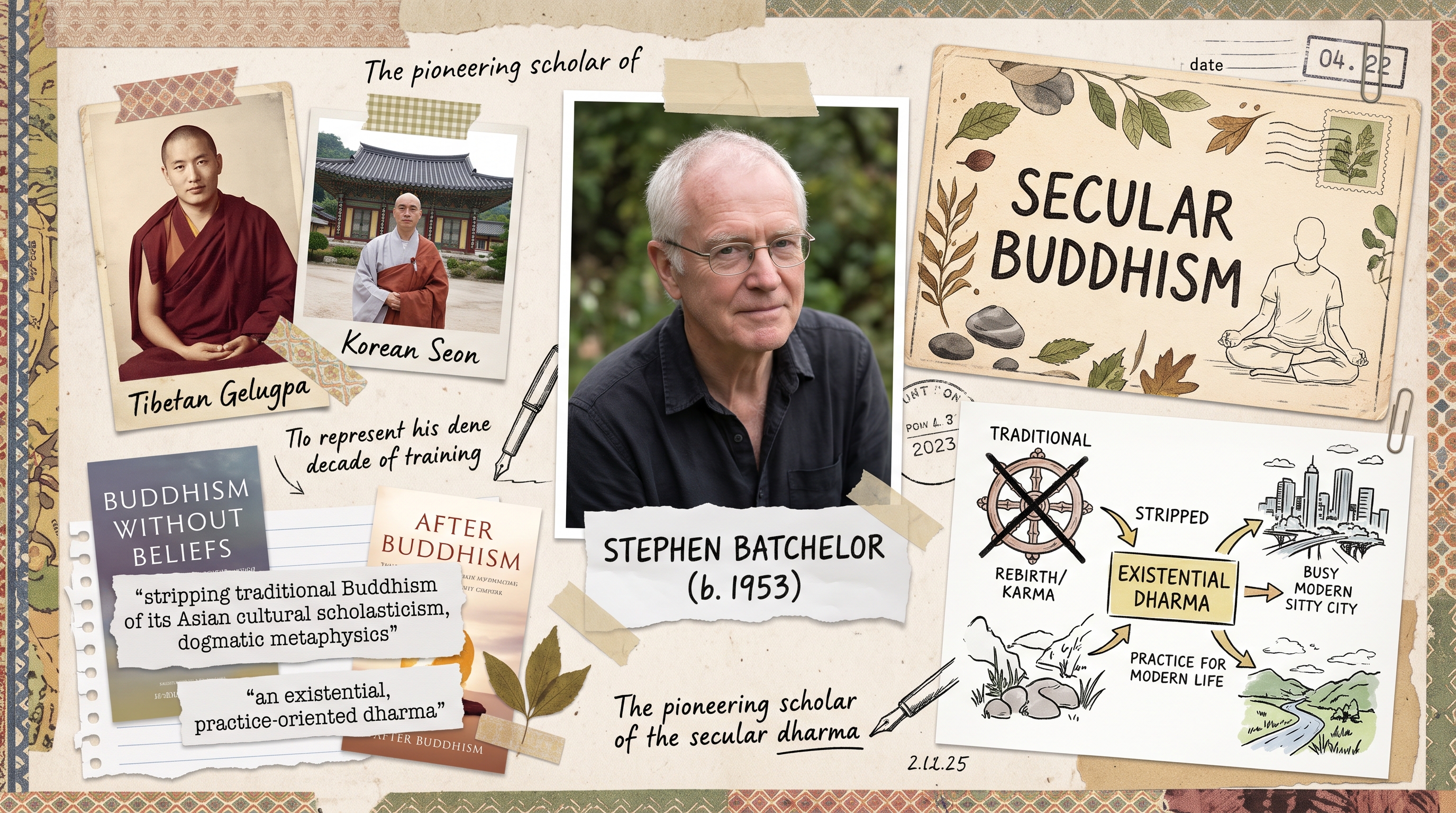
Stephen Batchelor approaches naturalization from inside the Buddhist lineage.[^1] Having spent over a decade as an ordained Buddhist monk—first in the Tibetan Gelugpa tradition in Dharamshala under Geshe Rabten, and subsequently in the Korean Sŏn (Zen) monastic community at Songgwangsa under Kusan Sunim—Batchelor experienced the full weight of Asian monastic scholasticism before disrobing in 1985.[^1][^5]
Batchelor's primary contribution is historical-critical hermeneutics.[^1] He argues that the canonical Pāli Nikāyas preserve two contradictory worldviews:
- The Emergent Dharma: An original, radical, non-dogmatic therapeutic orthopraxy articulated by the historical wandering mendicant Siddhartha Gautama in the rapidly urbanizing Gangetic plains of 5th-century BCE India.[^1]
- Ancient Indian Cosmology: A secondary, culturally conditioned mythological matrix—consisting of Brahmanical karma, trans-generational rebirth, supernatural realms, and ascetic world-renunciation—that gradually infiltrated and ossified the tradition into an institutional religion.[^1][^6]
Batchelor deploys what he terms "profound agnosticism"—an ontological humility that rejects religious dogmatism without collapsing into cynical reductionism.[^1] He connects early Buddhist thought directly with Hellenistic philosophy, demonstrating that Gautama operated analogously to Socrates (questioning societal orthodoxies regarding ethics and virtue) and Pyrrho of Elis (suspending metaphysical judgment, epochē, to achieve mental equanimity, ataraxia), a dynamic explored across From Mythos to Ataraxia - A Survey of Ancient Greek Philosophy and Dogma vs. Dharma.[^1][^7]
"I am not trying to say that the Buddha did not believe in rebirth... My point is that the Buddha’s distinctive contribution was to offer a practice that does not depend on rebirth for its validity."[^1]
Owen Flanagan: Analytic Neurophilosophy and Eudaimonics
Owen Flanagan, James B. Duke Professor Emeritus of Philosophy at Duke University, enters the conversation from the pinnacle of contemporary Analytic Philosophy and cognitive science.[^2] Flanagan explicitly confronts what philosopher Wilfrid Sellars identified as the defining philosophical dilemma of modernity: reconciling the "manifest image" (the human world of intentionality, values, agency, and meaning) with the "scientific image" (the material, causally closed cosmos revealed by physics, chemistry, and evolutionary biology).[^2][^8]
Flanagan formulates eudaimonics—an empirical-normative inquiry into the causes and conditions of human flourishing.[^2][^9] He approaches Buddhism because, among all global wisdom traditions, it presents the most systematically empirical, phenomenologically rigorous, and experimentally testable psychology of suffering and emotional regulation.[^2]
Flanagan’s methodological razor is uncompromising:
- Naturalism: Reality is physically closed; there are no disembodied minds, supernatural moral accountings, or post-mortem transmissions of identity.[^2]
- Excising the "Hocus Pocus": Flanagan strips away rebirth, cosmic retributive karma, and celestial realms as empirically indefensible mythological artifacts.[^2]
- Preserving the Metaphysical Core: Crucially, Flanagan insists that pratītyasamutpāda (dependent origination), anicca (impermanence), and anattā (non-self) are not supernatural dogmas; they are rigorous metaphysical and psychological principles that align completely with causal determinism, thermodynamics, and cognitive neuroscience.[^2]
Robert Wright: Evolutionary Psychology and Modular Adaptationism
Robert Wright, author of The Moral Animal and Why Buddhism is True, bridges early Buddhism with adaptationist evolutionary biology.[^3][^10] Wright’s core insight is that human cognitive suffering (dukkha) is neither an unfortunate accident nor the result of cosmic sins from a previous lifetime; rather, it is the direct, intended design of natural selection.[^3]
Natural selection operates under a solitary, ruthless criterion: maximizing the transmission of genetic material into subsequent generations.[^3] It is entirely indifferent to subjective happiness, sustained contentment, or objective truth.[^3] Whenever accurate perception conflicts with reproductive fitness, natural selection systematically favors adaptive delusions, a principle mathematically validated in The Interface Theory of Perception (ITP).[^3][^11]
Wright maps early Buddhist phenomenology onto contemporary cognitive science:
- The Hedonic Treadmill as Evolutionary Mechanism: The brain is biologically engineered so that the pleasure derived from food, sex, and social status rapidly evaporates. If satisfaction were durable, our ancestors would have stopped foraging, mating, and competing.[^3]
- The Forecasting Fallacy: The mind systematically overestimates the duration and intensity of future satisfaction ("If I only get that job, promotion, or partner, I will be happy forever"), compelling perpetual craving (taṇhā).[^3]
- The Modular Mind: Integrating Michael Gazzaniga’s split-brain research and Robert Kurzban’s modular mind theory, Wright demonstrates that there is no centralized executive "CEO" inside the brain; instead, semi-autonomous cognitive modules compete for behavioral control based on environmental cues, with consciousness acting merely as a post-hoc press secretary.[^3][^12][^13]
Sam Harris: Cognitive Neuroscience and Dzogchen Non-Duality
Sam Harris, holding a doctorate in cognitive neuroscience from UCLA and an undergraduate degree in philosophy from Stanford University, approaches naturalized contemplation through the twin lenses of laboratory neuroimaging and first-person non-dual investigation.[^4][^14]
In Waking Up: A Guide to Spirituality Without Religion, Harris executes a strict demarcation between dogmatic religion and empirical contemplation:[^4]
- Demarcation Problem: In accordance with Science vs. Pseudoscience - The Demarcation Problem, Harris separates verifiable subjective states of self-transcendence from mythological cosmologies, asserting that one can investigate consciousness with scientific rigor without affirming iron-age dogmas.[^4]
- The Limits of Gradual Vipassana: While acknowledging the attentional benefits of Theravāda vipassanā (mindfulness of breath, sensations, and thoughts), Harris argues that dualistic mindfulness maintains a subtle illusion: it establishes an "inner witness" looking at mental objects, which covertly reifies a subtle sense of self as an observer located behind the eyes.[^4]
- The Dzogchen Breakthrough: Harris elevates the Tibetan non-dual tradition of Dzogchen (the Great Perfection), which he studied under Tulku Urgyen Rinpoche and Nyoshul Khenpo.[^4][^15] By turning awareness back upon itself—executing The Core Instruction - Turning the Gaze Inward—the practitioner looks directly for the observer and discovers that no localized center exists. Consciousness is an open, seamless, unconditioned space in which thoughts, feelings, and the entire external world appear.[^4]
3. The Deconstruction of the Self (Anattā): Four Distinct Angles of Attack
The conceptual centerpiece of Buddhist philosophy is the doctrine of anattā (non-self): the radical claim that nowhere within phenomenal experience can there be found an unchanging, independent, permanent entity or soul (ātman).[^1][^2][^3][^4] Across the four secular thinkers, this doctrine is rescued from esoteric mysticism and grounded in rigorous modern frameworks.
| Thinker | Conceptual Vehicle | Primary Mechanism of Deconstruction | Theoretical / Empirical Validation |
|---|---|---|---|
| Stephen Batchelor | Existential Hermeneutics & Dynamic Self-Fashioning | Replaces the static soul with a dynamic, historically contingent biographical process; treats the self as a verb rather than a noun.[^1] | Early Pāli suttas (Anattalakkhana Sutta); existential phenomenology of Sartre ("existence precedes essence").[^1] |
| Owen Flanagan | Analytic Philosophy of Mind & Modular Neurobiology | Rejects Cartesian substance dualism; the self is an evolved, distributed set of neuro-computational functions without a central homunculus.[^2] | Gilbert Ryle's critique of the "Ghost in the Machine"; functionalist cognitive science; neural plasticity.[^2][^8] |
| Robert Wright | Modular Mind Theory & Evolutionary Biology | Deconstructs the "CEO self"; the brain consists of competing evolutionary modules; the conscious ego is merely a post-hoc "press secretary."[^3] | Gazzaniga's split-brain "interpreter" module; Kurzban's evolutionary modularity; cognitive dissonance experiments.[^3][^12][^13] |
| Sam Harris | Cognitive Neuroscience & Non-Dual Dzogchen | First-person introspection reveals that looking for the "thinker" yields nothing; the subject-object dichotomy collapses into centerless awareness.[^4] | fMRI suppression of the Default Mode Network (DMN) (PCC and mPFC); first-person pointing-out instructions in Dzogchen.[^4][^16] |
1. Batchelor: The Self as a Contingent Task
For Batchelor, anattā is not an abstract metaphysical claim that "I do not exist," which he views as a nihilistic misunderstanding.[^1] Drawing on the early discourses, Batchelor explains that the Buddha analyzed experience into the five impermanent aggregates (khandhas): physical form, feeling tone, perception, mental formations, and consciousness.[^1][^17]
Because every aggregate is contingent, relational, and constantly changing, none of them can be identified as a permanent self. Batchelor translates this into an existential imperative: the self is not a static substance to be discovered or negated, but an ongoing, dynamic process of ethical self-creation.[^1] This insight directly bridges Buddhist psychology with Sartre's dictum that existence precedes essence—we are not pre-formed essences; we are our intentional choices in the world.[^1]
2. Flanagan: The De-homuncularized Brain
Flanagan attacks the Cartesian legacy that continues to haunt Western philosophy: the assumption of an indwelling, unified, immaterial soul or central observer seated in the "Cartesian Theater."[^2][^18] Deconstructing this illusion using Gilbert Ryle's famous category mistake—the Ghost in the Machine—Flanagan argues that the brain is a decentralized biological network.[^2]
There is no central processing unit where consciousness converges. The feeling of being a unified "I" is an evolved, useful phenomenological narrative constructed by the brain to track bodily integrity and social obligations.[^2] When this narrative is reified into an immutable identity that must be defended at all costs, it generates neurotic suffering, anxiety, and moral callousness.[^2]
3. Wright: The Modular Mind and the Press Secretary
Robert Wright provides the most granular cognitive-biological architecture for anattā.[^3] Drawing on evolutionary psychology, Wright argues that the human brain evolved as a confederation of semi-autonomous modules—specialized neural programs that evolved to handle specific adaptive challenges: mate selection, mate retention, predator avoidance, status striving, kin care, and coalition building.[^3][^13]
- The Illusion of Executive Control: When a person decides to abandon a diet and eat a chocolate pastry, it is not an executive "self" changing its mind. It is a foraging module temporarily overwhelming a long-term reputation module based on sensory cues (sugar, fat).[^3]
- The "Interpreter" Module: Citing the classic split-brain experiments of Michael Gazzaniga, Wright highlights the left hemisphere's "interpreter." When the right brain is secretly instructed to perform an action (e.g., standing up), and the left brain is asked why the person stood up, the left brain does not admit ignorance; it instantaneously invents a plausible post-hoc lie: "I wanted to get a soda."[^3][^12]
- Consciousness as Public Relations: The conscious ego did not evolve to be the CEO of the organism; it evolved to be the press secretary—an agent whose job is to rationalize, justify, and spin the actions of underlying modules to other human beings in order to maintain tribal belonging, a mechanism underlying Identity Protective Cognition.[^3]
4. Harris: The Centerless Field and DMN Suppression
Sam Harris approaches anattā by uniting third-person neuroimaging with first-person non-dual phenomenology.[^4]
At the third-person level, neuroscientists have mapped the neural correlates of ego-referential thinking to the Default Mode Network (DMN), particularly the medial prefrontal cortex (mPFC) and the posterior cingulate cortex (PCC).[^4][^16] The DMN is the engine of mental time travel, rumination, autobiographical memory, and social comparison—the neurological substrate of what Becker called character armor and what the Buddha called papañca (conceptual proliferation), as examined in Terror Management Theory, Becker's Denial of Death, and Buddhist Contemplation.[^4][^16]
At the first-person level, Harris demonstrates that the feeling of being an ego inside the head is an introspective illusion that vanishes under rigorous inspection.[^4] In his guided inquiries, Harris instructs the meditator to look for the thinker of thoughts:[^4]
- When one looks closely for the thinker, no thinker can be found; thoughts simply arise spontaneously in awareness.[^4]
- When one looks for the observer of sights and sounds, the observer is recognized as merely another sensation or visual appearance.[^4]
- The subject-object dichotomy collapses into a unified, centerless experiential field where appearances arise within consciousness without a central controller, realizing the core premise of Constructs of the Mind-Unmasking Consciousness in East and West.[^4]
4. The Soteriological Shift: From Samsaric Escape to Eudaimonic Flourishing
In traditional Asian Buddhism, the ultimate problem of existence is saṃsāra: the horrific, unending cycle of death, decay, and rebirth across cosmic epochs (kalpas) in hellish, animal, human, and heavenly realms, as depicted iconographically in the Tibetan Wheel of Life.[^1][^2][^6] The traditional soteriological goal is nirvāṇa: the complete cessation of the causes of rebirth, escaping the phenomenal universe once and for all.[^1][^6]
When Secular Buddhism excises rebirth and trans-generational karma, the entire soteriological engine undergoes a tectonic shift.
| Dimension | Traditional Monastic Buddhism | Secular / Naturalized Buddhism |
|---|---|---|
| The Primary Crisis | Involuntary rebirth across cosmic eons (saṃsāra); suffering in hell/animal realms.[^6] | Existential friction, cognitive delusion, and unnecessary suffering in this life alone.[^1][^2] |
| Cosmological Horizon | Thirty-one planes of existence; cyclical cosmic epochs (kalpas).[^6] | Finite biological existence bounded strictly by physical conception and somatic death.[^1][^2][^3] |
| The Four Noble Truths | Metaphysical, propositional dogmas requiring belief and intellectual assent.[^1] | Practical phenomenological challenges to be enacted in daily life (Batchelor's ELSA).[^1] |
| Operational Definition of Karma | Cosmic moral ledger tracking merit (puñña) across multiple physical lifetimes.[^6] | Observable psychological habituation (saṅkhāras) and immediate social-relational consequences.[^1][^2] |
| The Bodhisattva Ideal | Vow to delay final individual release to reincarnate across infinite cosmic realms.[^6] | Naturalized commitment to systemic social justice, universal compassion, and ethical flourishing.[^2] |
| Soteriological Endpoint | Extinction of rebirth; transcendental liberation beyond the physical cosmos.[^6] | Eudaimonia; emotional equanimity; cognitive clarity; ethical flourishing within human limits.[^2][^9] |
Batchelor's ELSA: From Dogmatic Truths to Actionable Tasks
Stephen Batchelor’s most influential philosophical contribution is his reformulation of the Four Noble Truths.[^1] Historically, translating cattāri ariyasaccāni as "Four Noble Truths" framed them as metaphysical propositions that require cognitive belief (e.g., "Life is suffering," "Craving is the cause").[^1]
Batchelor argues that early Pāli discourses frame them not as propositional claims, but as four pragmatic tasks—summarized by the acronym ELSA:[^1]
- Embrace (Pariññā): Embrace the full, contingent reality of dukkha—the vulnerability, sickness, aging, and finitude of biological existence—without fleeing into metaphysical fantasies of post-mortem immortality or supernatural salvation.[^1]
- Let Go (Pahāna): Relinquish reactive craving (taṇhā), defensive clutching, and ideological dogmatism as they arise in real time.[^1]
- See (Sacchikiriya): Behold and dwell in the cessation of reactivity (nirodha)—experiencing the unburdened, cool, and peaceful spaces of awareness when craving temporarily abates.[^1]
- Act / Actualize (Bhāvanā): Cultivate and live an integrated, eightfold path of ethical, mindful, and compassionate action in the secular world through The Noble Eightfold Path and Sīla - Buddhist Ethics.[^1]
Confronting Finitude: Naturalism and Terror Management
This soteriological shift forces Secular Buddhism into direct dialogue with existential thanatology, as analyzed in Terror Management Theory, Becker's Denial of Death, and Buddhist Contemplation.[^1][^2]
Traditional Buddhism often provided its followers with what Ernest Becker termed an immortality project: the comforting belief that conscious awareness survives biological death, that moral merit will be rewarded in a pleasant future rebirth or Pure Land, and that the ultimate self can achieve eternal transcendence.[^1][^6]
By stripping away the doctrine of rebirth, Secular Buddhism strips away this metaphysical character armor.[^1][^2] The secular practitioner confronts what Heidegger termed being-towards-death (Sein-zum-Tode) without supernatural consolation.[^1] Death is real, absolute, and final. Consequently, contemplative practice ceases to be an otherworldly escape from the body; it becomes an urgent, compassionate embracing of the fragile, bittersweet present moment.[^1][^3]
---\n\n## 5. Comparative Matrix: The Four Thinkers Across Core Dimensions\n\nThe following detailed matrix maps the specific structural alignments and theoretical divergences among Batchelor, Flanagan, Wright, and Harris.\n\n| Philosophical Axis | Stephen Batchelor | Owen Flanagan | Robert Wright | Sam Harris |\n| :--- | :--- | :--- | :--- | :--- |\n| Ontological Baseline | Agnostic Phenomenalism & Existentialism | Strict Physicalism & Non-Reductive Materialism | Adaptationist Biology & Natural Selection | Empirical Naturalism & Analytic Idealism Dialogue |\n| Hermeneutical Method | Historical-Critical Pāli Sutta Deconstruction | Analytic Philosophy of Mind & Conceptual Analysis | Reverse-Engineering Evolutionary Adaptations | First-Person Contemplative Introspection & fMRI |\n| Core Diagnosis of Suffering (Dukkha) | Existential reactivity to impermanence and finitude | Destructive mental states (kleśas) disrupting eudaimonia | Evolutionary design: the hedonic treadmill and forecasting fallacy | Identification with the automatic stream of self-referential thought |\n| Treatment of Karma | Reinterpreted as psychological habit and ethical intentionality | Naturalized as social-relational causation and habit energy | Understood as behavioral feedback loops and evolutionary game theory | Stripped of cosmic retribution; framed as neuro-psychological consequence |\n| Contemplative Modality | Task-based mindfulness (ELSA) embedded in daily life | Phenomenological mind-training; attention and affect regulation | Vipassana insight practice; non-identification (RAIN method) | Direct non-dual pointing (Dzogchen); looking for the looker |\n| View of Enlightenment (Nirvāṇa) | Moments of non-reactivity and ethical presence in this world | Attainment of sustainable eudaimonia and affective equanimity | Freedom from the dictatorship of evolutionary cognitive modules | Experiential recognition of the illusion of self; unconditioned presence |\n| Stance on Traditional Monasticism | Critical of patriarchal hierarchies, clericalism, and dogmatism | Respectful of monastic psychology but rejects metaphysical claims | Secular lay perspective; focuses on retreat practice and modern life | Highly critical of religious sectarianism, dogma, and clerical authority |\n| Resolution to the "Is-Ought" Problem | Relational care ethics; shared human vulnerability and mortality | Empirical eudaimonism; prosociality produces optimal flourishing | Nonzero-sum game theory; expanding moral circle through clear sight | Rational utilitarianism; maximizing the well-being of conscious creatures |\n\n---\n\n## 6. Traditional and Academic Critiques of Naturalized Dharma\n\nWhile Secular Buddhism has achieved immense popularity across the modern Western world, it has encountered intense philosophical and methodological critique from traditional Buddhist monastics, academic Buddhologists, and secular philosophers.\n\n### 1. The Monastic Critique: Stripping the Engine of the Dhamma\n\nTraditional monastic scholars, epitomized by the venerable Theravāda elder Bhikkhu Bodhi, argue that karma and rebirth cannot be casually dismissed as "cultural baggage" without gutting the entire Buddhist philosophical edifice.[^6][^19]\n\n- The Integrity of Right View (Sammā-Diṭṭhi): In canonical texts like the Mahācattārīsaka Sutta (MN 117), the Buddha explicitly defines "mundane Right View" as affirming that actions have karmic consequences that extend beyond death into future rebirths.[^6][^19] To deny post-mortem retribution is historically categorized within the Pāli canon as micchā-diṭṭhi (wrong view), specifically the materialist nihilism of the Ucchedavāda school.[^6][^19]\n- The Moral Vacuum: Traditionalists contend that without the cosmic accountability of karma spanning multiple lifetimes, the moral architecture of Buddhism loses its ultimate normative foundation.[^6] If an unrepentant tyrant dies comfortably in old age, strict physicalism admits that justice is permanently denied. Traditional Buddhism insists that cosmic karmic momentum guarantees moral balance.[^6]\n\n### 2. The Academic Buddhology Critique: "Buddhist Modernism"\n\nHistorians of religion, including Donald S. Lopez Jr. and David L. McMahan, point out that Secular Buddhism is not the objective recovery of a pristine ancient philosophy, but the latest iteration of "Buddhist Modernism"—a reform movement that began in late 19th-century Asia as a defensive response to Western colonial imperialism, Christian missionary critiques, and Victorian scientific rationalism.[^5][^20]\n\n- Anachronistic Projection: Modern secular interpreters systematically project 18th-century European Enlightenment values, Western scientific empiricism, Protestant anti-clericalism, and 20th-century secular humanism onto ancient Iron-Age Asian texts.[^5][^20]\n- Selective Decontextualization: Ancient Indian Buddhists were deeply concerned with rituals, relics, celestial protectors, auspicious rebirths, and monastic Vinaya disciplines. Portraying Siddhartha Gautama as a modern rationalist scientist walking around with a notebook conducting empirical cognitive psychology is an ahistorical Western fantasy.[^5][^20]\n\n### 3. Evan Thompson’s Critique: "Buddhist Exceptionalism"\n\nIn Why I Am Not a Buddhist (2020), philosopher Evan Thompson unleashes a rigorous critique against what he terms "Buddhist exceptionalism"—the widely accepted belief that Buddhism is uniquely rational, empirical, and scientific compared to all other world religions.[^21]\n\n- The Neural Fallacy: Thompson critiques thinkers like Wright, Flanagan, and Harris for equating subjective contemplative states with objective brain activations (the "neuro-enchantment" of fMRI).[^21] Demonstrating that meditation alters Default Mode Network connectivity does not prove that Buddhist metaphysical claims about reality (śūnyatā or anattā) are "true."[^21]\n- The Flattening of Soteriology: Thompson argues that naturalizers reduce a radical, cosmic path of existential renunciation and world-transcending liberation into an individualized, bourgeois cognitive hygiene kit designed to help stressed professionals cope with modern late-capitalist workplace demands, a dynamic critiqued in The Digital Infrastructure of Delusion-A Buddhist Economic and Psychological Analysis of Corporate Culture.[^21]\n\n### 4. Hume’s Guillotine: The "Is-Ought" Problem\n\nA persistent meta-ethical vulnerability within naturalized Buddhism is David Hume’s famous "is-ought" problem: one cannot logically deduce normative moral obligations solely from descriptive facts about the physical universe.[^2]\n\n- The Limits of Naturalism: Even if cognitive science successfully proves that the "self" is a modular illusion (anattā), this descriptive biological fact does not logically compel someone to become a compassionate Bodhisattva.[^2]\n- The Nihilistic Hazard: A sociopath could accept that the self is an illusion and conclude that because there is no enduring self, their exploitation of others is morally inconsequential.[^2] \n- Flanagan's & Harris's Counter-Arguments: Flanagan responds by rooting ethics in empirical eudaimonism (compassion biologically generates the most stable human flourishing), while Harris argues in The Moral Landscape that morality can be treated as a science of well-being. However, critics note that both thinkers ultimately smuggle an unproven normative value (that conscious flourishing is intrinsically good) into their naturalistic frameworks.[^2][^4]\n\n---\n\n## 🎴 Interactive Web Practice (Comprehension Check)\n\n
Question 1 (Hermeneutic Recovery vs. Analytic Naturalization): Contrast Stephen Batchelor's historical-critical hermeneutic with Owen Flanagan's Sellarsian neurophilosophy. How do their respective methods arrive at the naturalization of the Dharma from opposite directions?
\n\nAnswer: Stephen Batchelor and Owen Flanagan arrive at Naturalized Dharma from opposing intellectual directions:\n
- \n
- Batchelor's Internal-Hermeneutic Method: Batchelor works from inside the Buddhist textual and monastic lineage. Utilizing modern historical-critical scholarship on the earliest strata of the Pāli canon, he peels away centuries of secondary commentarial scholasticism (Abhidharma) and cultural Asian cosmology (Brahmanical rebirth and karma). He argues that Siddhartha Gautama was an itinerant, non-dogmatic pragmatic thinker whose original diagnostic model was an actionable existential practice (ELSA) rather than a metaphysical religion. Batchelor naturalizes Buddhism by recovering what he believes was its original, pre-religious historical core. \n
- Flanagan's External-Analytic Method: Flanagan approaches Buddhism from the outside as an analytic philosopher of mind and moral psychologist. He is guided by Wilfrid Sellars' challenge of reconciling the human "manifest image" (meaning, purpose, morality) with the scientific "scientific image" (physicalist, causally closed nature). Flanagan does not claim to recover the historical Buddha's personal beliefs; instead, he takes the existing body of Buddhist philosophy, applies a rigorous physicalist filter, excises all supernatural "hocus pocus" (literal transmigration and cosmic justice accounting), and tests whether the remaining core concepts (anattā, pratītyasamutpāda, karuṇā) remain philosophically defensible and empirically viable within contemporary cognitive science and eudaimonics. \n
\n
\n\n
Question 2 (Evolutionary Biology vs. Cognitive Neuroscience on Anattā): How does Robert Wright's adaptationist modular mind theory differ from Sam Harris's neuroscientific non-dual analysis in deconstructing the illusion of the executive self?
\n\nAnswer: While both thinkers agree that the executive self is a cognitive illusion, they dismantle it through different conceptual frameworks and methodologies:\n
- \n
- Robert Wright (Evolutionary Adaptationism): Wright analyzes the self through evolutionary biology and third-person cognitive psychology (Gazzaniga's split-brain research and Kurzban's modular mind theory). He explains that natural selection engineered the brain as a decentralized confederation of competing modules designed to solve adaptive survival and reproductive problems (mate acquisition, status, self-protection). There is no "CEO" homunculus in the brain; the conscious ego is merely a post-hoc "press secretary" or public relations module that invents plausible stories to rationalize behavioral decisions initiated by subconscious sub-modules. Wright uses Vipassana meditation as a functional hacking tool to observe modules firing and prevent them from automatically hijacking behavior. \n
- Sam Harris (Neuroscience & First-Person Non-Duality): Harris deconstructs the self through the twin engines of third-person neuroimaging (Default Mode Network attenuation) and first-person Dzogchen phenomenology. While Wright focuses on evolutionary utility and modular competition, Harris focuses on the immediate, qualitative nature of consciousness itself. Harris argues that gradual mindfulness often preserves a subtle dualistic error: the feeling of an "inner witness" detached from experience. Through Dzogchen pointing-out instructions, Harris directs awareness to look for the entity that is looking. Experientially, the observer cannot be located; the center collapses, revealing consciousness as an intrinsically open, non-dual field in which thoughts and sensations appear without an inner owner. \n
\n
\n\n
Question 3 (The Soteriological Reconfiguration / Samsara vs. Finitude): How does the elimination of literal rebirth and multi-lifetime karma fundamentally alter the existential purpose of Buddhist practice, and what traditional Buddhist critique does this provoke?
\n\nAnswer: In traditional Buddhism, the entire purpose of practice is eschatological and world-transcending: to escape saṃsāra—the terrifying, multi-lifetime cycle of involuntary rebirth, agony, and death governed by karmic causality across cosmic epochs—by extinguishing the causes of rebirth in nirvāṇa.\n
\nWhen Secular Buddhism eliminates literal rebirth and cosmic karma:\n
- \n
- Shift to Immanent Flourishing: The existential crisis is no longer how to escape future lifetimes, but how to live with wisdom, courage, non-reactivity, and compassion within the boundary of this single biological lifetime. Practice shifts from world-denying cosmic escape to world-affirming psychological resilience, relational care, and eudaimonia in the present moment. \n
- Confrontation with Finitude: Practice directly encounters mortality without supernatural consolation. Impermanence (anicca) is radicalized: biological death is absolute, stripping away Beckerian immortality projects and requiring practitioners to find peace directly amid temporal vulnerability. \n
\nTraditional Critique: Traditionalists like Bhikkhu Bodhi argue that this secular pivot guts the moral and metaphysical integrity of Buddhism. They contend that:\n
- \n
- Denying post-mortem karma aligns Buddhism with the ancient materialist heresy of Ucchedavāda (annihilationism), explicitly condemned by the Buddha. \n
- Without trans-generational karmic accountability, there is no ultimate cosmic justice for unpunished evil or unrewarded virtue in this world. \n
- Flattening a radical path of cosmic liberation into a secular self-help and psychological stress-reduction technique trivializes the Dharma into a palliative therapeutic tool for modern comfort. \n
\n\n---\n\n## Resonant Notes\n\nThe following notes in the vault share direct thematic, sociological, and philosophical connections with Secular Buddhism and Naturalized Dharma:\n\n### 🔴 Core Thinkers, Biographies & Monographic Studies\n- Western Theravāda and American Vipassanā - Goldstein, Kornfield, Fronsdal, and the Ajahn Chah Lineage — Sibling comparative study establishing the traditional Theravāda and American Vipassanā pillar against which the secular naturalized project defines itself.\n- The Direct Path and Contemporary Non-Duality - Klein, Spira, Adyashanti, and Bodian — Sibling comparative study establishing the non-dual Direct Path pillar, contrasting immediate recognition with naturalized pragmatic tasks.\n- Stephen Batchelor — Primary biographical and philosophical profile detailing his monastic evolution, profound agnosticism, the ELSA task model, and his recovery of early Pāli texts.\n- Owen Flanagan — Foundational neurophilosophical companion analyzing The Bodhisattva's Brain, the Sellarsian challenge, the excision of "hocus pocus," and naturalized eudaimonics.\n- Robert Wright — Evolutionary psychological analysis detailing Why Buddhism is True, adaptationist biology, the modular mind, and the deconstruction of the "CEO self."\n- Sam Harris — Neuroscientific profile detailing Waking Up, the demarcation problem, Default Mode Network attenuation, and the transition from Vipassana to non-dual Dzogchen.\n- Traditional vs. Secular Buddhist vs. General Spiritual Teachers — The master taxonomic parent note that categorizes the Secular Buddhist paradigm alongside traditional monastic orthodoxy and eclectic non-dual spiritual teachers.\n\n### 🟡 Cognitive Neuroscience, The Modular Mind & The Default Mode Network\n- Default Mode Network (DMN) — Neuroimaging correlate of the narrative self; down-regulation of midline cortical structures (mPFC and PCC) during meditation provides the empirical substrate for the deconstruction of the ego (anattā).\n- Gilbert Ryle's-The Concept of Mind & Ghost in the Machine — Ryle's linguistic critique of Cartesian substance dualism supplies the Western analytic machinery utilized by Flanagan, Wright, and Harris to refute the illusion of an internal executive controller.\n- The Interface Theory of Perception (ITP) — Donald Hoffman’s evolutionary theorem proving that natural selection tunes perceptual systems for fitness payoffs rather than veridical truth, directly supporting Wright’s thesis on adaptive cognitive delusions.\n- Constructs of the Mind-Unmasking Consciousness in East and West — Cross-cultural philosophical exploration analyzing how Eastern contemplative phenomenology and Western cognitive models converge to deconstruct the reified ego.\n- Terror Management Theory, Becker's Denial of Death, and Buddhist Contemplation — Thanatological companion note; demonstrates how traditional Buddhist rebirth functions as a Beckerian immortality project, and how secular meditation de-automates defensive worldview inflation.\n- Identity Protective Cognition & Confirmation Bias — Cognitive mechanisms explaining how the modular brain reflexively weaponizes tribal belonging, providing the psychological basis for Wright's analysis of affective essence tagging.\n- Perception vs. Apperception — Demarcates bare sensory input from reflexive higher-order monitoring, illuminating Harris's and Batchelor's contemplative methodologies.\n\n### 🟢 Buddhist Philosophy, Hermeneutics & Western Thought\n- The Noble Eightfold Path & The Dhammapada — Foundational canonical texts that secular thinkers reconstruct from metaphysical dogmas into practical matrices of this-worldly psychological flourishing.\n- Sīla - Buddhist Ethics — Explores Buddhist moral architecture, highlighting the central meta-ethical debate over whether compassion and virtue retain binding authority when decoupled from cosmic karma.\n- Nāgārjuna — Madhyamaka dialectician whose deconstruction of intrinsic essence (svabhāva) is reinterpreted by Batchelor and Wright as a therapeutic dissolution of conceptual dogmatism.\n- Tibetan Wheel of Life — Visual representation of the classical Buddhist cosmology of six realms and literal rebirth that secular Buddhists de-mythologize into psychological metaphors for conditioned human states.\n- From Mythos to Ataraxia - A Survey of Ancient Greek Philosophy — Connects early Buddhist orthopraxy to Hellenistic traditions (Socrates' ethical inquiry and Pyrrho's skeptical suspension of judgment yielding ataraxia).\n- Albert Camus & Jean-Paul Sartre — Continental existentialists who provide the philosophical mirror for secular Buddhism: confronting an indifferent universe without metaphysical illusions, where existence precedes essence.\n- Martin Heidegger — Heidegger's analysis of Dasein as being-towards-death underpins the secular Buddhist insistence on confronting temporal finitude without fleeing into post-mortem fantasies.\n- Schopenhauerian Pessimism — Arthur Schopenhauer was the first major Western philosopher to articulate Buddhist dukkha; secular thinkers reframe Schopenhauer’s blind "Will" through the lens of Darwinian natural selection.\n- Jon Kabat-Zinn & Jon Kabat-Zinn-Full Catastrophe Living — Clinical pioneers who translated Buddhist contemplative mechanics into secular hospital-based medicine (MBSR), operationalizing naturalized dharma for modern healthcare.\n- Dogma vs. Dharma — Analytical counterpart investigating the boundary demarcating rigid propositional orthodoxy from empirical, experiential, and contextual contemplative praxis.\n- The Digital Infrastructure of Delusion-A Buddhist Economic and Psychological Analysis of Corporate Culture — Sociological analysis examining how stripped-down secular mindfulness risks co-optation into corporate "McMindfulness" when divorced from systemic ethical critique.\n\n---\n\n## References\n\n[^1]: Stephen Batchelor / After Buddhism: Rethinking the Dharma for a Secular Age / Yale University Press\n\n[^2]: Owen Flanagan / The Bodhisattva's Brain: Buddhism Naturalized / MIT Press\n\n[^3]: Robert Wright / Why Buddhism is True: The Science and Philosophy of Meditation and Enlightenment / Simon & Schuster\n\n[^4]: Sam Harris / Waking Up: A Guide to Spirituality Without Religion / Simon & Schuster\n\n[^5]: Stephen Batchelor / Confession of a Buddhist Atheist / Spiegel & Grau\n\n[^6]: Bhikkhu Bodhi / In the Buddha's Words: An Anthology of Discourses from the Pali Canon / Wisdom Publications\n\n[^7]: Stephen Batchelor / Buddha, Socrates, and Us: Ethical Living in Uncertain Times / Yale University Press\n\n[^8]: Wilfrid Sellars / Philosophy and the Scientific Image of Man / PhilPapers\n\n[^9]: Owen Flanagan / The Really Hard Problem: Meaning in a Material World / MIT Press\n\n[^10]: Robert Wright / The Moral Animal: Why We Are the Way We Are / Vintage Books\n\n[^11]: Donald D. Hoffman / The Case Against Reality: Why Evolution Hid the Truth from Our Eyes / W. W. Norton\n\n[^12]: Michael S. Gazzaniga / Who's in Charge? Free Will and the Science of the Brain / HarperCollins\n\n[^13]: Robert Kurzban / Why Everyone (Else) Is a Hypocrite: Evolution and the Modular Mind / Princeton University Press\n\n[^14]: Sam Harris, Sameer A. Sheth, & Mark S. Cohen / The Neural Correlates of Religious and Nonreligious Belief / PLOS ONE\n\n[^15]: Tulku Urgyen Rinpoche / As It Is, Vol. 1 / Rangjung Yeshe Publications\n\n[^16]: Judson A. Brewer et al. / Meditation experience is associated with differences in default mode network activity and connectivity / PNAS\n\n[^17]: Thanissaro Bhikkhu (Trans.) / Anattalakkhana Sutta: The Discourse on the Not-self Characteristic (SN 22.59) / Access to Insight\n\n[^18]: Daniel C. Dennett / Consciousness Explained / Little, Brown and Company\n\n[^19]: Bhikkhu Bodhi / The Noble Eightfold Path: Way to the End of Suffering / Pariyatti Publishing\n\n[^20]: David L. McMahan / The Making of Buddhist Modernism / Oxford University Press\n\n[^21]: Evan Thompson / Why I Am Not a Buddhist / Yale University Press\n