Western Theravāda and American Vipassanā - Goldstein, Kornfield, Fronsdal, and the Ajahn Chah Lineage
🗂️ Interactive Notebook: Open Study Companion (Video Summary, Flashcards, Mind Map) ↗
This comparative study operates under the master taxonomic umbrella of Traditional vs. Secular Buddhist vs. General Spiritual Teachers, establishing the definitive third pillar of the master contemplative taxonomy: the Traditional & Western Theravāda / American Vipassanā paradigm across its Southeast Asian monastic roots (the Burmese Vipassanā revival and the Thai Forest tradition), institutional lay adaptations (IMS, Spirit Rock, IMC), canonical textual recovery, psychotherapeutic integration, and Western monastic lineage preservation (Wat Nong Pah Pong, Amaravati, Abhayagiri, and Bodhinyana).
The transplantation of Theravāda Buddhism to the West represents one of the most consequential cultural and contemplative migrations of the modern era.[1][2] Unlike the radical demythologization of Secular Buddhism or the immediate, non-progressive realization articulated in Contemporary Non-Duality, Western Theravāda and American Vipassanā preserve an unyielding devotion to early canonical Pāli source texts, the Four Noble Truths, the Noble Eightfold Path, and the progressive development of mindfulness (sati), concentration (samādhi), and liberating wisdom (paññā).[1:1][2:1][3][4]
This movement was catalyzed by two distinct Southeast Asian lineages:
- The Burmese Vipassanā Revival: Pioneered by Mahāsi Sayādaw, Anagarika Munindra, and Sayadaw U Pandita, which extracted systematic mental noting, bare attention, and intensive silent meditation from cloistered monastic enclaves and offered them to householders as a reliable technology of dry insight (śukhavipassanā).[1:2][5]
- The Thai Forest Tradition (Kammaṭṭhāna): Epitomized by the forest master Ajahn Chah Subhaddo at Wat Nong Pah Pong and Wat Pa Nanachat, which anchored contemplation in strict monastic discipline (Vinaya), radical ascetic renunciation (dhutaṅga), choiceless awareness, deep meditative absorption (jhāna), and intuitive resting in the natural unconditioned mind (citta).[6][7]
Across the work of Joseph Goldstein, Jack Kornfield, Gil Fronsdal, and the Western monastic successors of Ajahn Chah (Ajahn Sumedho, Ajahn Brahm, and Ajahn Amaro), this inheritance divided into four robust, complementary currents:[1:3][2:2][3:1][6:1]
- Goldstein: The canonical Pāli anchor, dedicated to strict Satipaṭṭhāna commentary, Burmese noting mechanics, intensive retreat discipline, and an ecumenical One Dharma synthesis.[1:4]
- Kornfield: The psychospiritual pioneer, bridging Theravāda insight with clinical psychology (Ph.D.), confronting spiritual bypassing, elevating the heart practices (brahmavihāras), and articulating an embodied householder Dharma.[2:3]
- Fronsdal: The scholar-practitioner, recovering the archaic pre-sectarian poetry of the Aṭṭhakavagga, synthesizing Sōtō Zen presence with Vipassanā investigation, and establishing a radical lay gift economy (dāna).[3:2]
- The Ajahn Chah Lineage Monastics: The guardians of living monastic orthopraxy, establishing ordained forest monasteries across the Western hemisphere, while navigating profound internal dialectics between deep absorption (jhāna) and open awareness, as well as institutional hierarchy versus female monastic ordination (bhikkhunī).[6:2][7:1]
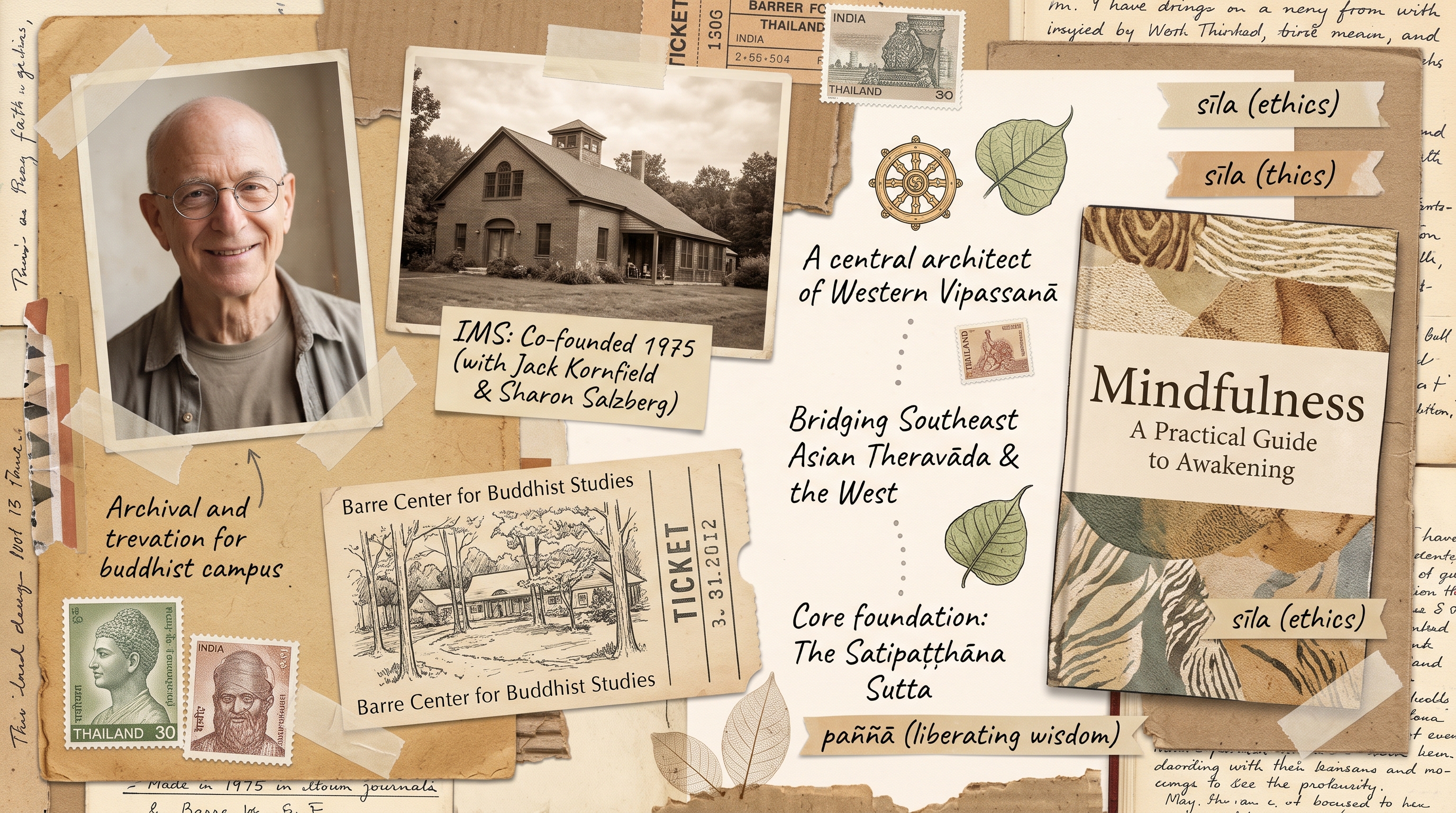
1. Lineage Genealogy: The Dual Asian Roots of Western Dharma
Western Theravāda and American Vipassanā did not emerge in a vacuum; they represent the convergence of two distinct socio-religious reform movements that revitalized Southeast Asian Buddhism in the late 19th and mid-20th centuries.[4:1][5:1] When young Western travelers, Peace Corps volunteers, and seekers encountered these traditions in the late 1960s and early 1970s, they absorbed two distinct contemplative paradigms: the Burmese Analytical Method and the Thai Forest Contemplative Ethos.[1:5][2:4][6:3]
The Dual Asian Foundations
| Lineage Axis | The Burmese Vipassanā Revival | The Thai Forest Tradition (Kammaṭṭhāna) |
|---|---|---|
| Geographic Core | Lower & Upper Burma (Yangon, Mandalay, Bodh Gaya) | Isan / Northeast Thailand (Ubon Ratchathani, Wat Nong Pah Pong) |
| Foundational Ancestors | Ledi Sayādaw (1846–1923), Mingun Sayādaw (1868–1955), Mahāsi Sayādaw (1904–1982) | Phra Ajahn Sao Kantasīlo (1861–1941), Phra Ajahn Mun Bhūridatto (1870–1949), Ajahn Chah (1918–1992) |
| Primary Root Teachers of Westerners | Anagarika Munindra, Sayadaw U Pandita, S.N. Goenka, Dīpā Mā | Ajahn Chah Subhaddo, Ajahn Tate, Ajahn Maha Bua |
| Core Contemplative Technology | Structured mental noting (labeling), continuous satipaṭṭhāna, dry insight (śukhavipassanā), momentary concentration (khaṇika-samādhi) | Choiceless awareness, direct investigation of impermanence (anicca), ascetic forest training, deep jhāna absorption, resting in citta |
| Epistemic Centerpiece | Abhidhamma matrices; Visuddhimagga commentarial progress of insight (vipassanā-ñāṇa) | Early Pāli Nikāyas; austere living Vinaya monastic discipline; experiential surrender |
| Attitude Toward Monasticism | Highly adaptable to intensive lay practice; democratized meditation for civil servants and householders | Strictly monastic-centric; spiritual realization cultivated through mendicancy, poverty, and forest solitude |
| Western Heirs & Translators | Joseph Goldstein, Sharon Salzberg, Ruth Denison, Jacqueline Schwartz | Jack Kornfield, Ajahn Sumedho, Ajahn Brahm, Ajahn Amaro, Ajahn Pasanno |
Lineage Transmission and Western Institutional Realization
The historical transplantation of these two streams unfolded through a remarkable process of institutional architecture, pedagogical translation, and monastic foundation:
| Contemplative Vector | Primary Western Teachers | Institutional Grounding | Core Lineage Transmission |
|---|---|---|---|
| Canonical Satipaṭṭhāna & Burmese Vipassanā | Joseph Goldstein, Sharon Salzberg | Insight Meditation Society (IMS) (Barre, MA, 1975); Barre Center for Buddhist Studies (BCBS) (1991); The Forest Refuge (1998/2003) | Direct transmission from Anagarika Munindra, S.N. Goenka, Dīpā Mā, and Sayadaw U Pandita. |
| Psychospiritual Integration & Householder Dharma | Jack Kornfield, Sylvia Boorstein, Guy Armstrong | Spirit Rock Meditation Center (Woodacre, CA, 1987); Naropa Institute (1974) | Dual ordination/training under Ajahn Chah (Wat Nong Pah Pong) and Mahāsi Sayādaw; clinical psychology synthesis. |
| Early Pāli Naturalism & Zen Synthesis | Gil Fronsdal | Insight Meditation Center (IMC) (Redwood City, CA, 1990); Insight Retreat Center (IRC) (Santa Cruz, CA, 2012) | Theravāda monasticism under Sayadaw U Pandita; full Sōtō Zen transmission (shiho) from Sojun Mel Weitsman; Stanford Ph.D. in Buddhology. |
| Western Forest Monasticism (Wat Nong Pah Pong Network) | Ajahn Sumedho, Ajahn Brahm, Ajahn Amaro, Ajahn Pasanno | Cittaviveka (Chithurst, UK, 1979); Bodhinyana (Perth, Australia, 1983); Amaravati (Hertfordshire, UK, 1984); Abhayagiri (California, 1996) | Unbroken Vinaya ordination directly under Ajahn Chah at Wat Nong Pah Pong and Wat Pa Nanachat; ascetic forest monasticism. |
2. Master Comparative Taxonomy: The Four Vectors of Western Theravāda
To understand how Theravāda Buddhism functions in the modern Western world, we must distinguish among its four primary pedagogical and institutional expressions. Rather than presenting a monolithic orthodoxy, Western Theravāda represents an intricate ecosystem spanning scholastic canonical exegesis, psychological shadow integration, early textual naturalism, and strict ascetic monasticism.[1:6][2:5][3:3][6:4]
| Analytical Dimension | Joseph Goldstein | Jack Kornfield | Gil Fronsdal | The Ajahn Chah Monastic Lineage (Brahm & Amaro) |
|---|---|---|---|---|
| Primary Works | The Experience of Insight (1976); One Dharma (2002); Mindfulness: A Practical Guide to Awakening (2013)[1:7] | A Path with Heart (1993); After the Ecstasy, the Laundry (2000); The Wise Heart (2008)[2:6] | The Issue at Hand (2001); The Dhammapada (2005); The Buddha Before Buddhism (2016)[3:4] | Brahm: Mindfulness, Bliss, and Beyond (2006); Amaro: Small Boat, Great Mountain (2002); The Island (2009)[6:5][7:2] |
| Root Training & Lineage | Anagarika Munindra, S.N. Goenka, Dīpā Mā, Sayadaw U Pandita (Burmese Mahāsi Tradition) | Ajahn Chah (Wat Nong Pah Pong); Mahāsi Sayādaw (Burma); Ph.D. in Clinical Psychology | Sayadaw U Pandita (Burma); Sōtō Zen (shiho via Shunryu Suzuki lineage); Ph.D. in Religious Studies (Stanford) | Ordained disciples of Ven. Ajahn Chah Subhaddo (Wat Nong Pah Pong and Wat Pa Nanachat) |
| Epistemic Authority | Classical Pāli Nikāyas (specifically the Satipaṭṭhāna Sutta), Abhidhamma matrices, and seasoned retreat praxis | Pāli suttas synthesized with psychodynamic theory, Carl Jung's shadow, and somatic trauma therapy | Archaic pre-sectarian Pāli poetry (Aṭṭhakavagga), academic philology, and direct experiential phenomenology | Strict Pāli Vinaya (monastic code), living teacher-to-disciple transmission, and forest mendicancy |
| Meditation Mechanics | Precise mental noting (labeling), bare attention, moment-to-moment investigation of khandhas | Choiceless awareness, forgiveness rituals, grief work, somatic mindfulness, and mettā (loving-kindness) | Blending Sōtō Zen effortless presence (shikantaza) with granular Vipassanā noting and breath awareness | Brahm: Step-by-step calming leading to deep jhāna absorption; Amaro: Open awareness & the inner nāda sound |
| Model of the Self (Anattā) | Rigorous deconstruction of personal identity via the Five Aggregates (khandhas) and sense bases | "You have to be somebody before you can be nobody"; healthy ego development must precede self-transcendence | Phenomenological release of grasping; non-identification with views, dogmas, and fixed mental identities | Brahm: Ego extinguished through jhāna and anattā; Amaro: Resting in the unconditioned nature of mind (citta) |
| View of Monasticism vs. Lay Life | Adapted monastic silent retreats for lay householders; created long-term practice spaces (Forest Refuge) | Deliberate pivot away from celibate asceticism toward "Householder Dharma" embedded in family and work | Full integration of practice into lay domestic life, parenting, and career without requiring monastic withdrawal | Preserves orthodox monastic renunciation, mendicancy, and celibacy as the supreme counter-cultural vehicle |
| Stance on Rebirth & Metaphysics | Respectfully canonical; treats rebirth and karma as classical principles while focusing on present realization | Metaphorical and psychological; focuses on healing the wounds of this life rather than cosmic escape | Natural Buddhism: Explicitly brackets literal rebirth and cosmology, grounding liberation in the visible here-and-now | Upholds classical Theravāda cosmology, literal karmic retribution, and multi-lifetime samsaric escape |
| Institutional & Economic Model | Non-profit retreat centers (IMS/BCBS); standard retreat fees with financial aid; teacher dāna | Non-profit community retreat center (Spirit Rock); retreat fees, equity programs, and teacher support | Radical Dāna Economy: 100% free courses, workshops, and retreats; entirely sustained by voluntary gifts | Traditional mendicant economy: complete dependence on daily lay food offerings (piṇḍapāta) and donations |
| Soteriological Telos | Nibbāna: Unconditioned cessation of clinging, liberation from delusion, and ending suffering (dukkha) | Embodied psychospiritual wholeness, relational maturity, compassionate presence, and integrated freedom | Immanent peace (santi), emotional stability, ethical integrity, and freedom from ideological dispute | Extinction of the taints (āsavas), complete release from saṃsāra, and realization of the Unconditioned |
3. Epistemological Foundations & Contemplative Methodologies
The four vectors of Western Theravāda operationalize early Buddhist contemplative technology in profoundly different ways, reflecting divergent responses to modern secular culture, psychological science, and institutional organization.[1:8][2:7][3:5][6:6]
Vector 1: Joseph Goldstein — Canonical Satipaṭṭhāna, Bare Attention, and the One Dharma Synthesis
Joseph Goldstein's enduring historical contribution is his uncompromising grounding in the early Pāli discourses, particularly the Satipaṭṭhāna Sutta (Majjhima Nikāya 10).[1:9][8] While modern commercialized mindfulness frequently reduces contemplative practice to an individualized stress-reduction tool, Goldstein treats mindfulness (sati) as an indispensable limb of an integrated soteriological path leading directly to Nibbāna (unconditioned liberation), an ethical framework shared with The Noble Eightfold Path and Sīla - Buddhist Ethics.[1:10][8:1]
1. The Four Establishments of Mindfulness as Diagnostic Map
Goldstein structures contemplative investigation strictly across the four canonical foundations:[1:11]
- Mindfulness of the Body (Kāyānupassanā): Observing the breath (ānāpānasati), posture transitions (sampajañña), and the four physical elements (mahābhūta—earth, water, fire, wind) to dissolve the naive assumption of a solid, enduring physical form.
- Mindfulness of Feeling Tones (Vedanānupassanā): Isolating the immediate affective valence of experience: pleasant (sukha), unpleasant (dukkha), or neutral (adukkham-asukha). Goldstein identifies vedanā as the critical fulcrum of Dependent Origination (paṭiccasamuppāda): if bare attention registers a feeling tone without reactivity, the automated transition from feeling (vedanā) to craving (taṇhā) is severed, halting the entire cycle of suffering.[1:12]
- Mindfulness of Mind (Cittānupassanā): Dispassionately observing the states and qualities of consciousness (contracted, lustful, agitated, concentrated) without taking them personally, directly down-regulating autobiographical narrative processing in the Default Mode Network (DMN).[1:13]
- Mindfulness of Dhammas (Dhammānupassanā): Granular phenomenological tracking of the Five Hindrances (nīvaraṇa), the Five Aggregates (khandha), the Six Sense Bases (saḷāyatana), the Seven Factors of Awakening (bojjhaṅga), and the Four Noble Truths.[1:14]
2. The Mental Noting Technique
Inherited from the Burmese master Mahāsi Sayādaw via Anagarika Munindra, Goldstein emphasizes the practice of mental noting (labeling). By softly applying a silent, neutral verbal tag (e.g., "rising," "falling," "hearing," "thinking," "itching") to sensory objects as they arise, the practitioner prevents the discursive mind from spinning elaborate narratives (papañca). Mental noting establishes a critical psychological boundary between the observing consciousness and the observed phenomenon, allowing the practitioner to verify the Three Marks of Existence (tilakkhaṇa): that all phenomena are impermanent (anicca), unsatisfactory (dukkha), and devoid of an autonomous self (anattā).[1:15]
3. The One Dharma Synthesis
In his mature work One Dharma (2002), Goldstein addressed the sectarian friction emerging among Western converts encountering disparate Asian traditions.[1:16] After completing extensive training in Tibetan Dzogchen under Tulku Urgyen Rinpoche and Nyoshul Khenpo, Goldstein formulated an ecumenical framework that harmonizes three great Asian vehicles around the single axis of non-clinging:[1:17]
- Theravāda: Supplies the rigorous, analytical foundation of ethical conduct (sīla) and precise moment-to-moment deconstructive noting (vipassanā).
- Zen / Mahāyāna: Cultivates the radical realization of universal emptiness (śūnyatā), beginner's mind, and boundless compassion (bodhicitta).
- Dzogchen / Vajrayāna: Directs the mind to recognize its intrinsically open, luminous, non-dual ground of primordial awareness (rigpa), operationalizing The Core Instruction - Turning the Gaze Inward.
Vector 2: Jack Kornfield — Clinical Psychotherapy, Shadow Work, and the Householder Dharma
If Joseph Goldstein represents the monastic-minded scholar of American Vipassanā, Jack Kornfield represents its psychological and relational transformer.[2:8] Holding a Ph.D. in clinical psychology from the Saybrook Institute, Kornfield recognized early in his teaching career that intense meditation retreats often left Western students emotionally fractured, psychologically arrested, or interpersonally dysfunctional.[2:9][9]
1. Unmasking Spiritual Bypassing
Collaborating conceptually with transpersonal psychologist John Welwood, Kornfield became the foremost contemplative critic of spiritual bypassing—the widespread habit of using spiritual concepts, meditative detachment, or non-dual rhetoric to prematurely evade unhealed childhood trauma, emotional wounds, and relational deficits.[2:10][9:1] Kornfield demonstrated that years of austere, silent meditation could easily serve as an unconscious defense mechanism (what Ernest Becker termed character armor in Terror Management Theory, Becker's Denial of Death, and Buddhist Contemplation), allowing a practitioner to cultivate a cold, detached equanimity that masked profound relational terror.[2:11][9:2]
2. The Ego Paradox: "Somebody Before Nobody"
In A Path with Heart (1993), Kornfield articulated a psychological principle that challenged simplistic interpretations of Buddhist non-self (anattā):
"You have to be somebody before you can be nobody."[2:12]
Drawing on Western object relations theory and Jungian depth psychology, Kornfield argued that attempting to deconstruct personal identity (anattā) in an individual who possesses a fragile, fragmented, or traumatized ego structure leads not to spiritual awakening, but to psychological dissociation, severe depersonalization, or borderline collapse.[2:13][10] Contemplative practice must first help the student construct a healthy, cohesive, and resilient ego before that ego can be safely surrendered.[2:14]
3. Elevating the Heart Practices (Brahmavihāras)
In contrast to the dry-insight (śukhavipassanā) emphasis dominant in Burmese monasticism, Kornfield elevated the four divine abodes (brahmavihāras)—loving-kindness (mettā), compassion (karuṇā), sympathetic joy (muditā), and equanimity (upekkhā)—to absolute equality with insight practice.[2:15] He developed explicit somatic practices for healing grief, holding the wounded inner child, and performing formal forgiveness meditations, transforming American Vipassanā from an austere ascetic discipline into an emotionally literate, relational therapy.[2:16]
4. The Householder Dharma and Spirit Rock
In 1987, Kornfield co-founded the Spirit Rock Meditation Center in Woodacre, California, deliberately engineering an institutional alternative to monastic renunciation.[2:17] In After the Ecstasy, the Laundry (2000), Kornfield dismantled the myth of the "enlightened superhero," insisting that authentic spiritual realization must be integrated into the mundane realities of marriage, child-rearing, domestic conflict, financial stress, and environmental activism.[2:18]
Vector 3: Gil Fronsdal — Natural Buddhism, Early Pāli Antiquity, and the Aṭṭhakavagga
Gil Fronsdal occupies a unique scholarly and contemplative bridge within Western Buddhism, synthesizing monastic ordination in Burmese Vipassanā (under Sayadaw U Pandita), full Sōtō Zen priesthood and transmission (shiho in the Shunryu Suzuki lineage), and a Ph.D. in Religious Studies from Stanford University.[3:6][11]
1. The Formulation of "Natural Buddhism"
While thinkers like Stephen Batchelor embrace the label "Secular Buddhism," Fronsdal deliberately champions Natural Buddhism (or naturalistic Buddhism).[3:7][12] Fronsdal argues that "secular" defines itself in opposition to the religious institution, whereas "natural" roots spiritual practice directly in the observable biological, psychological, and relational realities of the human organism.[3:8][12:1] Natural Buddhism approaches the Dhamma as an observational, phenomenological craft that is:
- Sandiṭṭhiko: Immediately apparent here and now in sensory experience.[3:9]
- Ehipassiko: Inviting the practitioner to "come and see" rather than passively believe, echoing the radical empiricism analyzed in William James and the Landscape of Eastern Thought.[3:10]
- Akāliko: Timeless and immediately effective, focusing awareness on the moving present as explored in Time as Change and Internal Time-Consciousness and Buddhist Psychology.[3:11]
2. The Textual Revolution: The Buddha Before Buddhism
Fronsdal’s scholarship focuses on the Aṭṭhakavagga (the "Book of Eights") within the Sutta Nipāta, widely recognized as one of the oldest preserved strata of Buddhist literature.[3:12][13] In The Buddha Before Buddhism (2016), Fronsdal demonstrates that this archaic poetry contains virtually no references to complex cosmological planes, trans-temporal rebirth, monastic hierarchies, or Abhidhamma scholasticism.[3:13][13:1] Instead, the Aṭṭhakavagga advances a radical diagnostic critique centered on:
- Radical Non-Attachment to Views (Diṭṭhi): Revealing that human suffering and political conflict stem from grasping at philosophical theories, moral dogmas, and religious systems—including Buddhist dogmas, an insight central to Dogma vs. Dharma.[3:14]
- The Ideal of the Sage (Muni): The sage is not someone who possesses secret metaphysical knowledge of the afterlife, but someone who has abandoned disputation, who remains unperturbed by blame and praise, and who rests in immanent peace (santi).[3:15]
3. Sōtō Zen and Vipassanā Cross-Pollination
Fronsdal unites the non-striving, radiant awareness (shikantaza) of Sōtō Zen with the methodical, moment-to-moment investigation (vipassanā) of the Theravāda canon.[3:16] This prevents Vipassanā from degenerating into mechanical, hyper-intellectual labeling, while shielding Zen from quietist complacency or lack of developmental rigor.[3:17]
4. The Radical Dāna Economy (IMC & IRC)
At the Insight Meditation Center (IMC) in Redwood City and the Insight Retreat Center (IRC) in Santa Cruz, Fronsdal implemented an uncompromising economic model: every teaching, daylong workshop, and multi-day residential retreat is offered 100% free of charge.[3:18][14] Unlike standard American retreat centers that charge mandatory registration fees for food and lodging, IMC operates entirely on anonymous, voluntary donations (dāna), demonstrating a viable structural counterweight to the commercialized wellness dynamics critiqued in The Digital Infrastructure of Delusion-A Buddhist Economic and Psychological Analysis of Corporate Culture.[3:19][14:1]
Vector 4: The Ajahn Chah Lineage — Western Forest Monasticism, Jhāna, and Lineage Cohesion
While Goldstein, Kornfield, and Fronsdal adapted Theravāda for lay householders, the disciples of the venerable Ajahn Chah Subhaddo preserved the living heart of traditional Theravāda: unbroken monastic renunciation under the Pāli Vinaya.[6:7][7:3] Headquartered historically at Wat Nong Pah Pong and Wat Pa Nanachat in Thailand, this lineage expanded into the West through foundational monasteries: Cittaviveka and Amaravati in the United Kingdom, Abhayagiri in California, and Bodhinyana in Australia.[6:8][7:4]
1. Ascetic Monastic Orthopraxy (Vinaya and Dhutaṅga)
The Thai Forest disciples argue that Buddhist meditation cannot be divorced from radical lifestyle renunciation.[6:9] Western forest monastics observe the 227 rules of the Pāṭimokkha, maintain strict celibacy, eat only one meal a day out of an alms bowl, possess no personal money, and practice mendicancy (piṇḍapāta), embodying the pure moral discipline detailed in Sīla - Buddhist Ethics.[6:10] For Ajahn Chah, the monastic rules are not arbitrary legalisms; they are an ingenious psychological instrument designed to provoke, expose, and systematically dismantle the ego's subtle attachments.[6:11]
2. The Great Contemplative Divergence: Ajahn Brahm vs. Ajahn Amaro
Within the Western Thai Forest Sangha, two towering figures illustrate two distinct contemplative and pedagogical orientations:[6:12][7:5]
| Contemplative Axis | Ven. Ajahn Brahmavamso (Ajahn Brahm) | Ven. Ajahn Amaro (Ajahn Amaro) |
|---|---|---|
| Primary Monastic Seat | Bodhinyana Monastery (Western Australia); autonomous since 2009 | Amaravati Buddhist Monastery (UK); official branch of Wat Nong Pah Pong |
| Contemplative Focus | Deep Jhāna Absorption: Methodical, step-by-step calming of bodily and sensory processes leading to non-sensory absorption states.[6:13] | Open Spacious Awareness (Sati-Sampajañña): Cultivating intuitive presence and attending to the inner nāda sound ("Sound of Silence").[7:6] |
| Epistemic Emphasis | Rigorous early sutta exegesis; deep suspicion of later Abhidhamma and Visuddhimagga commentarial layers.[6:14] | Ecumenical bridge-building; reconciling Thai Forest teachings on citta with Tibetan Dzogchen non-duality.[7:7] |
| Nature of Liberation | Radical extinguishing of the illusion of self (anattā) achieved through the complete stillness of samādhi.[6:15] | Realization of unconditioned, non-manifestive consciousness (viññāṇaṃ anidassanaṃ) and primordial knowing.[7:8] |
| Ecclesiastical Stance | Prioritizes moral and Vinaya integrity over administrative harmony; enacted full Bhikkhunī ordination in 2009.[6:16] | Prioritizes global monastic harmony (Sangha-sāmaggi) and unbroken communion with the Thai Ecclesiastical Council.[7:9] |
- Ajahn Brahm's Jhāna Path: In Mindfulness, Bliss, and Beyond (2006), Brahm asserts that true liberating insight cannot occur without the foundational stillness of deep jhāna.[6:17] In deep jhāna, physical hearing, bodily sensation, and discursive thoughts (vitakka-vicāra) completely shut down, leaving a radiant, bliss-filled consciousness (pīti-sukha) that permanently shatters the illusion of an enduring ego.[6:18]
- Ajahn Amaro's Dzogchen Dialogue: In Small Boat, Great Mountain (2002) and The Island (2009, with Ajahn Pasanno), Amaro maps the Thai Forest teaching on the "unconditioned mind" (citta) against the Great Perfection (Dzogchen) of Tibetan Buddhism, demonstrating that resting in bare, unconditioned awareness is the universal core of Buddhist realization.[7:10]
4. The Great Pedagogical & Doctrinal Dialectics
The transplantation of Theravāda into Western culture generated profound philosophical, institutional, and ethical debates that continue to shape contemporary contemplative practice.[1:18][2:19][3:20][6:19]
Dialectic 1: Dry Insight (Śukhavipassanā) vs. Deep Jhāna Absorption
A central technical dispute within Western Theravāda concerns the necessity of meditative absorption states (jhāna):
- The Mahāsi / IMS Position (Dry Insight): Following Mahāsi Sayādaw, teachers like Joseph Goldstein teach that deep, non-sensory jhāna is not strictly necessary for awakening.[1:19] By cultivating momentary concentration (khaṇika-samādhi), the mind achieves sufficient stability to track the rapid arising and passing away of sensory phenomena, directly verifying anicca, dukkha, and anattā.[1:20]
- The Thai Forest / Ajahn Brahm Position: Ajahn Brahm sharply rejects dry insight as an uncanonical commentarial shortcut.[6:20] Citing the Sutta Piṭaka, Brahm demonstrates that the Buddha universally defined Right Concentration (sammā-samādhi) as the four jhānas. Without the profound sensory cessation and stillness of jhāna, the mind remains too weak and agitated to overcome deep-seated defilements (āsavas).[6:21]
Dialectic 2: Monastic Asceticism (Vinaya) vs. The Householder Dharma
- The Monastic Critique of Lay Practice: Forest monastics warn that when meditation is extracted from its traditional context of celibacy, poverty, and moral renunciation, it risks being trivialized into a lifestyle hobby or a palliative self-care therapy designed to make worldly householders more comfortable inside capitalism.[6:22][15]
- The Householder Response: Kornfield and Fronsdal counter that confining spiritual awakening to celibate monastic enclaves reinforces an elitist, patriarchal, and dualistic view of spirituality.[2:20][3:21] Deep wisdom must be forged within the furnace of everyday life—navigating intimate relationships, sexual ethics, child-rearing, and economic justice.[2:21][3:22]
Dialectic 3: Trans-Temporal Rebirth vs. Immanent Psychological Causality
- Traditional Monasticism: Ajahn Brahm and Ajahn Amaro insist that karma and post-mortem rebirth are non-negotiable pillars of Right View (sammā-diṭṭhi). Without rebirth, the Buddha's teachings on saṃsāra lose their cosmic coherence and moral urgency.[6:23][7:11]
- Natural & Householder Vipassanā: Gil Fronsdal, Jack Kornfield, and Joseph Goldstein adopt a practical, phenomenological stance. While Goldstein respects canonical rebirth, he emphasizes that the Dhamma must be verified in the present moment.[1:21] Fronsdal goes further, demonstrating through the Aṭṭhakavagga that the Buddha’s original teaching was an immanent, observational craft that did not require speculative assent to post-mortem reincarnation.[3:23]
Dialectic 4: The Commercial Retreat Model vs. The Radical Gift Economy (Dāna)
- The Market Dilemma: To maintain massive physical campuses and feed retreatants, centers like IMS and Spirit Rock charge registration fees (often $100–$250 per night), while providing scholarships for low-income practitioners.[1:22][2:22] Critics argue that this commodifies the Dhamma, creating economic barriers that disproportionately exclude marginalized groups.[14:2][15:1]
- The Dāna Solution: Gil Fronsdal at IMC/IRC and the traditional forest monastics at Bodhinyana and Amaravati prove that an alternative exists: operating with zero mandatory fees, sustaining all physical facilities and monastic communities entirely through voluntary, open-hearted generosity (dāna).[3:24][6:24][14:3]
Dialectic 5: The Gender Equality Crisis & The 2009 Bhikkhunī Schism
The most intense institutional crisis in modern Theravāda occurred on October 22, 2009, when Ajahn Brahm participated in the full ordination (upasampadā) of four female monastics at Bodhinyana Monastery in Australia, reinstating the extinct Bhikkhunī lineage.[6:25]
- Ajahn Brahm's Stand: Brahm argued that the Buddha explicitly founded the Fourfold Assembly (bhikkhu, bhikkhunī, upāsaka, upāsikā) and that denying women full monastic ordination was both uncanonical and an unacceptable violation of fundamental human rights.[6:26]
- The Wat Nong Pah Pong Resolution: Senior Thai disciples, citing a 1928 Thai Sangha decree and the necessity of international harmony (Sangha-sāmaggi), demanded that Brahm renounce the ordinations. When Brahm refused, Bodhinyana Monastery was formally expelled from the Ajahn Chah lineage.[6:27]
- Ajahn Amaro's Position: Amaro and the UK monasteries retained the Sīladhārā 10-precept order, arguing that unilateral institutional action fractured global monastic unity and damaged the delicate relationship with the Thai Sangha hierarchy.[6:28][7:12]
5. Comparative Matrix: The Three Master Contemplative Pillars
To contextualize Western Theravāda within the vault’s overarching taxonomy, we must map its structural boundaries against its two sibling paradigms: Secular Buddhism and Contemporary Non-Duality.[1:23][16][17]
| Analytical Vector | Pillar 1: Traditional & Western Theravāda / American Vipassanā | Pillar 2: Secular Buddhism & Naturalized Dharma | Pillar 3: Contemporary Non-Duality & The Direct Path |
|---|---|---|---|
| Exemplar Teachers | Joseph Goldstein, Jack Kornfield, Gil Fronsdal, Ajahn Brahm, Ajahn Amaro | Stephen Batchelor, Owen Flanagan, Robert Wright, Sam Harris | Jean Klein, Rupert Spira, Adyashanti (born Steven Gray, 1962), Stephen Bodian |
| Context File Anchors | This Comparative Monograph | Secular Buddhism and Naturalized Dharma - Batchelor, Flanagan, Wright, and Harris | The Direct Path and Contemporary Non-Duality - Klein, Spira, Adyashanti, and Bodian |
| Epistemic Baseline | Early Pāli Canon (Nikāyas, Vinaya), Abhidhamma, and lineage transmission | Methodological naturalism, historical-critical deconstruction, and cognitive neuroscience | First-person phenomenological inquiry, Advaita Vedānta, and Kashmiri Tantra |
| Pedagogical Dynamic | Gradual Cultivation: Systematic development of sīla, samādhi, and paññā over time | Pragmatic Modernization: Reinterpreting ancient doctrines into modern psychological tools | Direct Recognition: Immediate resting in ever-present, unconditioned awareness Now |
| Model of the Self (Anattā) | Empirical process composed of Five Aggregates (khandhas); deconstructed via noting | Evolved neuro-computational fiction; modular brain lacking a central CEO homunculus | The separate self is an episodic phantom; true identity is boundless Pure Awareness |
| Model of Consciousness | Transient series of cognitive events (viññāṇa) arising at the six sense doors | Emergent biological function generated by the physical brain | The sole, irreducible, infinite fabric and container of all phenomenal experience |
| Treatment of Cosmology | Respected canonically (Forest Monastics) or bracketed phenomenologically (Fronsdal) | Explicitly rejected; rebirth, karma, and cosmology dismissed as ancient "hocus pocus" | Agnostic or non-dogmatic; metaphysical cosmology viewed as irrelevant to pure presence |
| Somatic Orientation | Bare attention to breath, body elements, and posture transitions (kāyānupassanā) | Somatic awareness linked to down-regulating Default Mode Network rumination | Kashmiri "body approach"; dissolving muscular defense armor into open vibration |
| Psychotherapy Stance | Embraced by Kornfield (shadow work); respected as a complementary relative tool | Naturalized eudaimonism; cognitive-behavioral affect regulation (RAIN) | Psychotherapeutic shadow integration required to prevent spiritual bypassing (Bodian) |
| Soteriological Endpoint | Nibbāna: Unconditioned cessation of craving, ending samsaric cyclic suffering | Eudaimonic flourishing, non-reactivity, and psychological resilience in this life | Spontaneous, fearless embodiment of non-dual awareness in ordinary human life |
🎴 Interactive Web Practice (Comprehension Check)
Question 1 (Lineage Mechanics & Contemplative Methodology): Contrast the contemplative mechanics of the Burmese Mahāsi Sayādaw tradition (as transmitted by Joseph Goldstein) with the Thai Forest Tradition of Ajahn Chah (as practiced by Jack Kornfield and the Western monastics). How do their respective approaches to concentration, noting, and awareness differ?
Answer: The Burmese Mahāsi tradition and the Thai Forest tradition represent two distinct operational methodologies within Theravāda meditation:
- The Burmese Mahāsi Tradition (Joseph Goldstein):
- Method: Structured, active, moment-to-moment mental noting (labeling). The practitioner anchors attention on the rising and falling of the abdomen and applies a precise, neutral mental label (e.g., "rising," "falling," "thinking," "hearing") to every sensory object that enters awareness.
- Concentration: Relies on momentary concentration (khaṇika-samādhi) and the path of dry insight (śukhavipassanā). The meditator does not require deep, unmoving absorption (jhāna); instead, mental stability is developed by noting the rapid succession of changing phenomena.
- Epistemic Focus: Highly analytical, granular, and systematic deconstruction of the Five Aggregates (khandhas), tracking the sequential stages of the progress of insight (vipassanā-ñāṇa).
- The Thai Forest Tradition of Ajahn Chah (Jack Kornfield, Ajahn Brahm, Ajahn Amaro):
- Method: Emphasizes choiceless awareness, open observation, and radical surrender. Rather than actively applying mental labels, the practitioner allows phenomena to arise and cease naturally, observing them with non-interfering presence.
- Concentration: Prioritizes deep stillness and absorption states (jhānas) (championed emphatically by Ajahn Brahm), arguing that the mind must be profoundly quieted and energized by samādhi before liberating insight can penetrate the root of delusion.
- Epistemic Focus: Intuitive, holistic, and nature-attuned. Practitioners are instructed to turn awareness back upon the knowing mind itself (resting in citta or "the one who knows"), directly confronting aversion and attachment through living monastic discipline or embodied householder presence.
Question 2 (Psychospiritual Integration & The Ego Paradox): Why did Jack Kornfield insist that "you have to be somebody before you can be nobody," and how does his psychotherapeutic integration challenge traditional monastic assumptions regarding spiritual bypassing?
Answer: Jack Kornfield formulated the principle that "you have to be somebody before you can be nobody" to resolve an acute psychological crisis he observed in Western seekers:
- The Danger of Premature Transcendence: Traditional monastic Buddhism assumes an individual entering the monastery possesses a relatively cohesive, culturally stable ego structure. In the modern West, however, many practitioners come to meditation carrying severe developmental trauma, narcissistic injuries, attachment deficits, and unconscious self-hatred. If these individuals are immediately pushed into austere anattā (non-self) practices, they use the concept of "no self" to dissociate from their emotional pain, leading to depersonalization or spiritual inflation rather than liberation.
- Countering Spiritual Bypassing: In collaboration with John Welwood, Kornfield demonstrated that intensive meditation can coexist with severe neurosis. Practitioners often use meditative equanimity as a psychological defense mechanism (spiritual bypassing) to ignore grief, rage, or relational accountability. Meditation quiets the conscious mind, but it leaves the unconscious shadow (repressed complexes and childhood wounds) completely intact.
- The Integrated Developmental Solution: Kornfield argued that a healthy, resilient, and loving ego identity must be constructed before the self can be safely surrendered. Western Dharma practitioners must integrate Western psychotherapy, Carl Jung's shadow work, and somatic emotional release alongside mindfulness. By elevating the heart practices (brahmavihāras), grief rituals, and explicit forgiveness work, Kornfield transformed Vipassanā from an austere monastic tool of ascetic renunciation into a relational path of embodied psychospiritual wholeness.
Question 3 (The Monastic-Lay Dialectic & Institutional Economics): Compare the institutional and economic models of the Insight Meditation Society (IMS), Gil Fronsdal's Insight Meditation Center (IMC), and the traditional Thai Forest monasteries (Bodhinyana/Amaravati). What are the strengths and structural vulnerabilities of each approach?
Answer: The three institutional models represent different strategies for sustaining Dharma practice in modern society:
- 1. Insight Meditation Society (IMS / Spirit Rock) — The Non-Profit Retreat Model:
- Structure: Large residential retreat centers sustained through a hybrid economic model: mandatory registration fees for room and board (often $100–$250/day), supplemented by institutional donations, scholarship funds, and voluntary teacher dāna.
- Strengths: World-class retreat infrastructure; professional culinary and administrative support; financial stability; long-term retreat options (The Forest Refuge).
- Vulnerabilities: Commercialization risk; mandatory fees create financial barriers that alienate low-income or marginalized practitioners; commodification pressures that edge toward the wellness industry.
- 2. Insight Meditation Center (IMC / IRC) — Gil Fronsdal's Radical Dāna Economy:
- Structure: Community and retreat centers operated on an absolute 100% gift economy. All classes, workshops, and residential silent retreats are offered completely free of charge, with zero registration fees or mandatory room-and-board costs. All operating budgets and teacher stipends derive purely from anonymous voluntary donations.
- Strengths: Complete de-commodification of the Dharma; total accessibility across all socioeconomic strata; builds profound community gratitude, trust, and communal ownership; avoids corporate "McMindfulness" co-optation.
- Vulnerabilities: Requires high donor commitment and volunteer labor; vulnerable to economic recessions; scaling capacity is strictly bounded by local community generosity.
- 3. Western Forest Monasteries (Bodhinyana & Amaravati) — Orthodox Monastic Mendicancy:
- Structure: Traditional monastic communities operating under strict Pāli Vinaya rules. Monastics are prohibited from handling money, growing food, or cooking. The entire community is sustained by daily lay offerings of cooked food (piṇḍapāta) and voluntary donations of requisites.
- Strengths: Living counter-cultural embodiment of radical renunciation and mendicancy; deep spiritual purity that inspires immense devotion; completely detached from market capitalism.
- Vulnerabilities: Total dependence on the proximity of a devout lay supporter base; vulnerable to institutional ecclesiastical disputes and hierarchical rigidity (as evidenced by the 2009 Bhikkhunī ordination schism); demands lifetime ascetic celibacy accessible to only a small minority.
Resonant Notes
The following notes in the vault share direct thematic, monastic, and philosophical connections with Western Theravāda and American Vipassanā:
🔴 Core Lineage Masters, Thinkers & Monographic Studies
- Joseph Goldstein — Primary biographical and philosophical profile detailing his monastic training under Munindra and U Pandita, co-founding of IMS, classical Satipaṭṭhāna exegesis, and his ecumenical One Dharma vision.
- Jack Kornfield — Primary profile examining his ordination under Ajahn Chah, co-founding of IMS and Spirit Rock, clinical psychological synthesis, unmasking of spiritual bypassing, and formulation of the Householder Dharma.
- Gil Fronsdal — Primary scholar-practitioner profile detailing his Sōtō Zen shiho transmission, early Pāli scholarship on the Aṭṭhakavagga, the formulation of Natural Buddhism, and the 100% dāna economy at IMC.
- Ajahn Brahm and Ajahn Amaro — Western monastic companion profile analyzing their shared discipleship under Ajahn Chah, contrasting Brahm's deep jhāna absorption and the 2009 Bhikkhunī schism with Amaro's open awareness and Dzogchen dialogue.
- Traditional vs. Secular Buddhist vs. General Spiritual Teachers — The master taxonomic parent note classifying Western Theravāda alongside Secular Buddhism and General Non-Dual Spirituality.
🟡 Early Buddhist Canon, Epistemology & Canonical Orthopraxy
- The Noble Eightfold Path — The foundational matrix of Dharmic orthopraxy; provides the canonical structure uniting ethical conduct (sīla), concentration (samādhi), and liberating wisdom (paññā) across all four Theravāda vectors.
- The Dhammapada — Core early canonical text translated by Gil Fronsdal; serves as the common ethical and psychological touchstone for early Buddhist mental cultivation and sense restraint.
- Sīla - Buddhist Ethics — Foundational orthopraxy; illuminates the non-negotiable moral bedrock underpinning monastic Vinaya discipline, lay householder ethics, and authentic contemplative concentration.
- Dogma vs. Dharma — Epistemological companion; examines the profound institutional tension between rigid religious dogmatism (ecclesiastical edicts) and living experiential insight, exemplified by the 2009 Perth Bhikkhunī ordination controversy.
- Constructs of the Mind-Unmasking Consciousness in East and West — Cross-cultural study of ego-construction; parallels Goldstein's and Fronsdal's granular deconstruction of personal identity via the Five Aggregates (khandhas).
- The Core Instruction - Turning the Gaze Inward — Contemplative mechanics; explores the phenomenological movement of reversing attention back onto the witnessing consciousness, central to both Burmese bare attention and Ajahn Amaro's resting in citta.
- Tibetan Wheel of Life — Iconographic and philosophical map of Saṃsāra and Dependent Origination; illustrates the traditional cosmological framework that Forest monastics uphold and Natural Buddhists demythologize.
- Time as Change & Internal Time-Consciousness and Buddhist Psychology — Phenomenological companion notes; analyze the moment-to-moment flux of sensory experience that underpins the Burmese technique of noting the arising and passing away of phenomena (udayabbaya-ñāṇa).
🟢 Modern Contemplative Lineages, Psychology & Cognitive Science
- Secular Buddhism and Naturalized Dharma - Batchelor, Flanagan, Wright, and Harris — The second pillar of the contemplative taxonomy; provides the naturalized, post-traditional philosophical counterpart to Western Theravāda's canonical and monastic orientations.
- The Direct Path and Contemporary Non-Duality - Klein, Spira, Adyashanti, and Bodian — The third pillar of the contemplative taxonomy; provides the non-progressive, immediate recognition counterpart to Theravāda's gradual developmental path.
- Stephen Batchelor — Secular Buddhist author and former monk; shares Fronsdal's commitment to returning to early Pāli texts, while Batchelor advocates an agnostic existential task framework (ELSA) compared to Goldstein's canonical Theravāda soteriology.
- Jon Kabat-Zinn & Jon Kabat-Zinn-Full Catastrophe Living — Creator of Mindfulness-Based Stress Reduction (MBSR); studied at IMS with Goldstein and Kornfield, translating classical Vipassanā mechanics into secular healthcare.
- Sam Harris — Prominent neuroscientist and contemplative who completed early intensive Vipassanā retreats under Goldstein and U Pandita, later synthesizing Theravāda noting with Dzogchen non-duality in Waking Up.
- Robert Wright — Evolutionary psychologist; developed the empirical arguments of Why Buddhism is True directly from silent Vipassanā retreats at IMS, confirming the cognitive mechanisms underlying craving and non-self.
- Stephen Bodian — Contemporary teacher and psychotherapist; shares Kornfield's clinical integration of shadow work and trauma healing, while practicing the Direct Approach of Advaita and Zen.
- Carl Gustav Jung — Depth psychology foundation; supplies the theoretical architecture for Kornfield's shadow work and integration of unconscious emotional complexes into contemplative practice.
- Terror Management Theory, Becker's Denial of Death, and Buddhist Contemplation — Thanatological companion; illustrates how traditional Buddhist rebirth functions as an immortality project, and how somatic meditation de-automates defensive character armor.
- Default Mode Network (DMN) — Neurobiological correlate of self-referential cognition; provides empirical cognitive verification for how Vipassanā mental noting down-regulates rumination and autobiographical ego processing.
- The Digital Infrastructure of Delusion-A Buddhist Economic and Psychological Analysis of Corporate Culture — Institutional critique; contrasts the radical renunciation, communal mendicancy, and dāna economies of Fronsdal and the Forest Monastics with corporate "McMindfulness."
- William James & William James and the Landscape of Eastern Thought — Jamesian radical empiricism and pragmatism directly mirror Fronsdal's empirical "come-and-see" (ehipassiko) framing of early Buddhist contemplation.
References
Joseph Goldstein / Mindfulness: A Practical Guide to Awakening / Sounds True ↩︎ ↩︎ ↩︎ ↩︎ ↩︎ ↩︎ ↩︎ ↩︎ ↩︎ ↩︎ ↩︎ ↩︎ ↩︎ ↩︎ ↩︎ ↩︎ ↩︎ ↩︎ ↩︎ ↩︎ ↩︎ ↩︎ ↩︎ ↩︎
Jack Kornfield / A Path with Heart: A Guide Through the Perils and Promises of Spiritual Life / Bantam Books ↩︎ ↩︎ ↩︎ ↩︎ ↩︎ ↩︎ ↩︎ ↩︎ ↩︎ ↩︎ ↩︎ ↩︎ ↩︎ ↩︎ ↩︎ ↩︎ ↩︎ ↩︎ ↩︎ ↩︎ ↩︎ ↩︎ ↩︎
Gil Fronsdal / The Buddha Before Buddhism: Wisdom from the Early Teachings / Shambhala Publications ↩︎ ↩︎ ↩︎ ↩︎ ↩︎ ↩︎ ↩︎ ↩︎ ↩︎ ↩︎ ↩︎ ↩︎ ↩︎ ↩︎ ↩︎ ↩︎ ↩︎ ↩︎ ↩︎ ↩︎ ↩︎ ↩︎ ↩︎ ↩︎ ↩︎
David L. McMahan / The Making of Buddhist Modernism / Oxford University Press ↩︎ ↩︎
Erik Braun / The Birth of Insight: Meditation, Modern Buddhism, and the Burmese Monk Ledi Sayadaw / University of Chicago Press ↩︎ ↩︎
Ajahn Brahm / Mindfulness, Bliss, and Beyond: A Meditator's Handbook / Wisdom Publications ↩︎ ↩︎ ↩︎ ↩︎ ↩︎ ↩︎ ↩︎ ↩︎ ↩︎ ↩︎ ↩︎ ↩︎ ↩︎ ↩︎ ↩︎ ↩︎ ↩︎ ↩︎ ↩︎ ↩︎ ↩︎ ↩︎ ↩︎ ↩︎ ↩︎ ↩︎ ↩︎ ↩︎ ↩︎
Ajahn Amaro / Small Boat, Great Mountain: Theravādin Reflections on the Natural Great Perfection / Amaravati Publications ↩︎ ↩︎ ↩︎ ↩︎ ↩︎ ↩︎ ↩︎ ↩︎ ↩︎ ↩︎ ↩︎ ↩︎ ↩︎
Bhikkhu Anālayo / Satipaṭṭhāna: The Direct Path to Realization / Windhorse Publications ↩︎ ↩︎
John Welwood / Toward a Psychology of Awakening: Buddhism, Psychotherapy, and the Path of Personal and Spiritual Transformation / Shambhala Publications ↩︎ ↩︎ ↩︎
Jack Kornfield / After the Ecstasy, the Laundry: How the Heart Grows Wise on the Spiritual Path / Bantam Books ↩︎
Insight Meditation Center / Teachers: Gil Fronsdal / insightmeditationcenter.org ↩︎
Gil Fronsdal / Natural Buddhism / Insight Meditation Center ↩︎ ↩︎
Gil Fronsdal / The Dhammapada: A New Translation of the Buddhist Classic with Annotations / Shambhala Publications ↩︎ ↩︎
Insight Meditation Center / The Practice of Generosity & IMC's Financial Model / insightmeditationcenter.org ↩︎ ↩︎ ↩︎ ↩︎
Ann Gleig / American Dharma: Buddhism Beyond Modernity / Yale University Press ↩︎ ↩︎
Stephen Batchelor / After Buddhism: Rethinking the Dharma for a Secular Age / Yale University Press ↩︎
Rupert Spira / The Transparency of Things: Contemplating the Nature of Experience / Non-Duality Press ↩︎