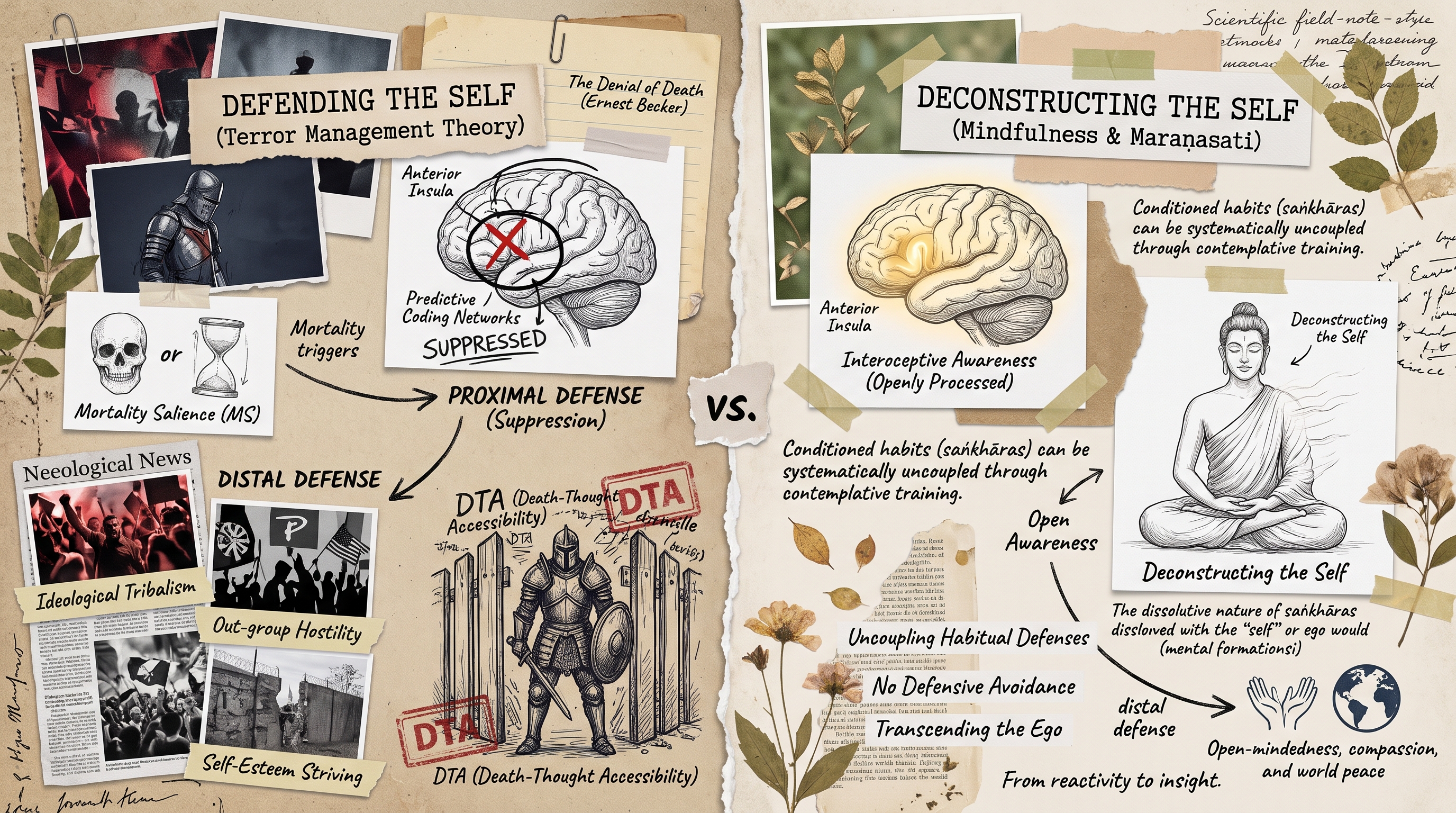
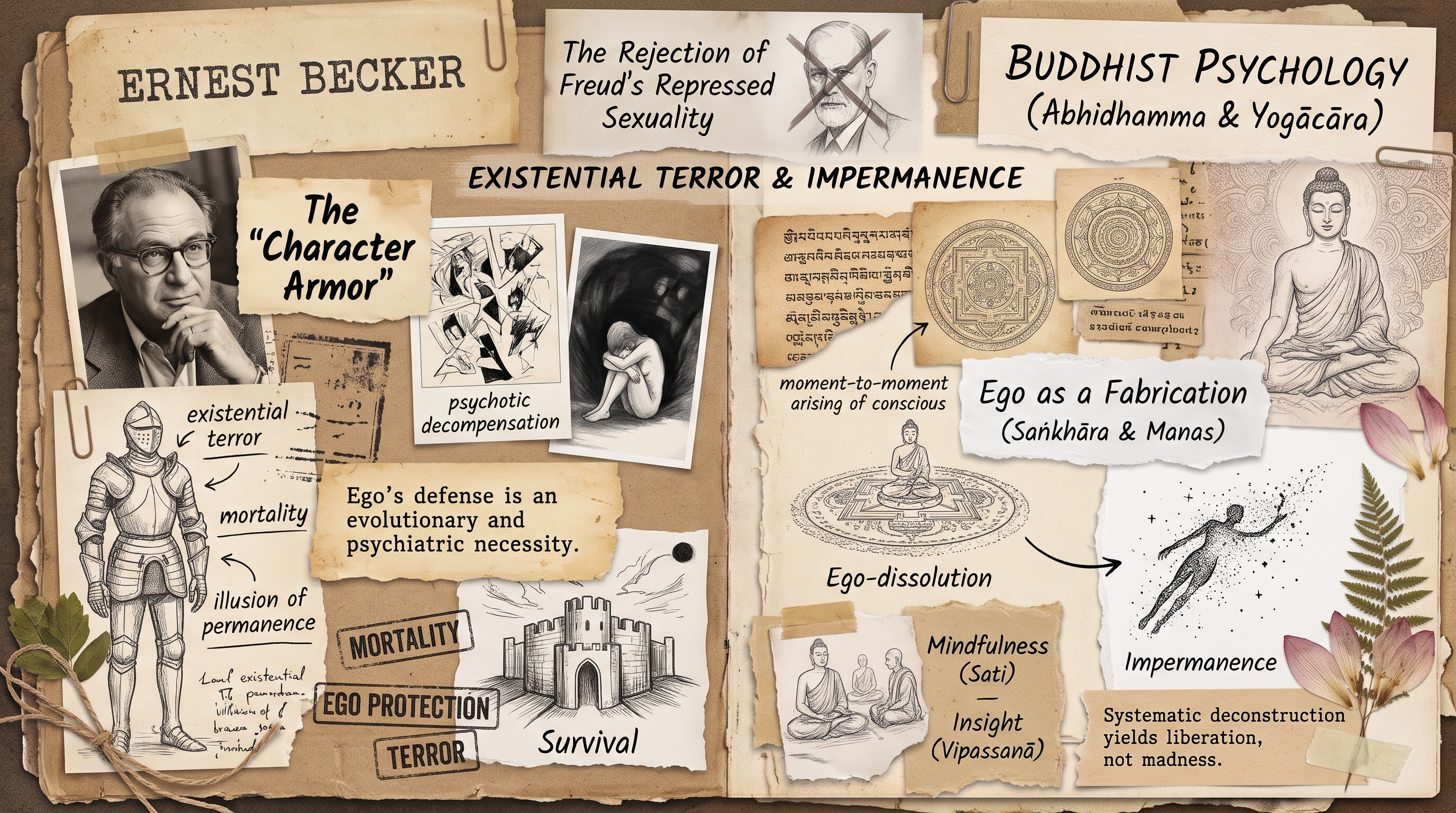
Ernest Becker’s 1973 Pulitzer Prize-winning treatise, The Denial of Death, represents a landmark synthesis of existential psychology, Kierkegaardian philosophy, and post-Freudian psychoanalysis.[^1] In the late 1980s, social psychologists Sheldon Solomon, Jeff Greenberg, and Tom Pyszczynski operationalized Becker’s thesis into Terror Management Theory (TMT), establishing an empirical laboratory framework for measuring how the human mind defends itself against awareness of its own finitude.[^2][^3] When this Western thanatological lineage is placed in dialogue with existential neuroscience and Buddhist psychology—specifically the phenomenological models of the early Pali Nikāyas, the Abhidhamma (Buddhist metapsychology), Yogācāra depth psychology, and clinical trials on mindfulness and death contemplation (maraṇasati)—a transformative cross-disciplinary synthesis emerges.[^4][^5][^6][^7] The defensive cognitive strategies documented by Becker and TMT are not immutable human instincts, but conditioned mental formations (saṅkhāras) that can be systematically deconstructed, uncoupled, and liberated through contemplative practice.[^6][^7][^8]
Executive Summary: Defending the Ego vs. Deconstructing the Self
In standard TMT laboratory paradigms, exposing individuals to Mortality Salience (MS) triggers an automated dual-process defensive cascade: immediate cognitive suppression (proximal defense) followed by unconscious Death-Thought Accessibility (DTA) that compels aggressive ideological tribalism, out-group hostility, and self-esteem striving (distal defense).[^2][^3][^4] Neuroimaging reveals that the untrained brain shields itself from mortality by suppressing interoceptive awareness in the anterior insula and shutting down prediction errors in the ventromedial prefrontal cortex (vmPFC), refusing to bind the concept of death to the neural representation of the self.[^9][^10] Becker argued that this "character armor" is a vital lie and psychological necessity without which human consciousness would collapse into psychotic panic or clinical depression.[^1]
Conversely, Buddhist psychology (Abhidhamma and Yogācāra) maps the ego not as a fragile entity requiring protective illusions, but as an ongoing cognitive fabrication (saṅkhāra and manas) driven by primal ignorance (avijjā) and latent mental taints (āsava).[^7][^8][^11] Clinical and experimental trials on trait mindfulness and Buddhist meditators demonstrate that contemplative training fundamentally alters the brain's trajectory.[^6][^7] Rather than suppressing mortality cues, meditators engage death awareness openly without defensive avoidance, preventing delayed unconscious DTA rebounds and eliminating downstream worldview defense.[^6][^7] At the neural level, contemplative training quiets the narrative Default Mode Network (DMN) while amplifying insular somatic presence, achieving psychological liberation (nirvāṇa) through direct insight into non-self (anattā) rather than psychiatric collapse.[^12][^13]
Foundations of Becker’s Existential Psychology
To evaluate The Denial of Death through empirical psychology and contemplative science, we must first examine how Becker reformulated Western psychoanalysis around the problem of mortality.
The Rejection of Freudian Instinct Theory
Becker’s primary psychological intervention was shifting psychoanalysis away from Sigmund Freud’s biological and sexual determinism.[^1] For Becker, human neurosis is not fundamentally driven by repressed sexual libido (eros) or the Oedipus complex, but by the terrifying cognitive awareness of physical finitude and cosmic vulnerability.[^1]
Becker termed this the paradox of the "ambiguous animal": human beings possess an advanced symbolic neocortex capable of conceptualizing infinity, eternity, and transcendent values, yet this god-like consciousness is trapped inside a vulnerable, defecating, decaying mammalian body doomed to rot and die.[^1]
Repression as an Existential Defense Mechanism
Drawing heavily on post-Freudian psychoanalyst Otto Rank and somatic theorist Wilhelm Reich, Becker redefined the nature of psychological repression.[^1][^5] In Becker’s architecture, repression is not merely an auxiliary defense against taboo instinctual impulses; it is the primary cognitive mechanism that filters out the overwhelming terror of existence so the human organism can function without being paralyzed by dread.[^1]
Character Armor and the Causa Sui Project
To manage this existential terror, the developing child constructs character armor—an automated, calcified suit of behavioral patterns, psychological defenses, and social roles.[^1][^5] Becker famously designated character as a "vital lie."[^1]
This armor is operationalized through the causa sui (self-creation) or immortality project, wherein the individual anchors their self-esteem to a culturally validated hero-system (wealth, professional status, national identity, religion, art, or science) to achieve symbolic permanence over biological death.[^1][^2]
Ernest Becker on Character as a Neurotic Defense
"Character is a face that man puts on to meet the world... It is a vital lie that takes the place of natural animal instincts, a defensive armor that hides our helplessness and keeps us from going mad."[^1]
The Empirical Architecture of Terror Management Theory (TMT)
Developed in the late 1980s by Sheldon Solomon, Jeff Greenberg, and Tom Pyszczynski, Terror Management Theory translates Becker’s existential insights into testable social-cognitive hypotheses.[^2] Across more than 1,000 peer-reviewed experiments, researchers have demonstrated that reminding individuals of their mortality activates predictable defense mechanisms—a dynamic known as the Mortality Salience (MS) Hypothesis.[^2][^3]
The Dual-Process Model of Defense
According to the dual-process model formulated by Pyszczynski, Greenberg, and Solomon, the human cognitive architecture processes conscious and unconscious death awareness through two distinct temporal and operational phases:[^3][^4]
Defensive Dimension
Proximal Defenses (Conscious / Immediate)
Distal Defenses (Unconscious / Delayed)
Cognitive Trigger
Focal, conscious attention on physical death, lethal illness, or bodily finitude.[^3][^4]
Immediate; active during and directly following explicit mortality exposure.[^4]
Delayed; manifests after a 5–15 minute cognitive distraction or latency interval.[^3][^4]
Cognitive Strategy
Rationalization, distraction, active thought suppression, or pseudo-rational health denial (e.g., "I am young, healthy, and take vitamins").[^4]
Symbolic inflation of cultural worldviews, moral righteousness, and self-esteem buffers.[^2][^3]
Underlying Function
Pushing the explicit existential threat out of working memory and focal consciousness.[^4]
Suppressing subterranean DTA spikes to protect against existential terror and cosmic insignificance.[^2][^3]
Behavioral Manifestations
Threat minimization, cognitive avoidance, or declared intentions for lifestyle modifications.[^4]
In-group favoritism, out-group derogation, harsher moral judgment, and compulsive status striving.[^2][^3]
Classic Mortality Salience Findings
When unconscious Death-Thought Accessibility (DTA) is elevated following a brief delay, laboratory participants exhibit predictable behavioral shifts that directly mirror Buddhist descriptions of upādāna (clinging) and papañca (conceptual proliferation):[^2][^3]
Empirical Domain
Landmark Experiment
Findings Under Mortality Salience (MS)
Cognitive & Behavioral Significance
Judicial & Moral Punitiveness
Rosenblatt et al. (1989) municipal court judge trial.[^2]
Judges primed with MS recommended an average bail bond of $455 for an alleged prostitute, compared to $50 in the control group.[^2]
Demonstrates how unconscious mortal threat triggers aggressive enforcement of legal and moral norms to re-stabilize the cultural nomos.[^2]
Out-Group Hostility & Aggression
McGregor et al. (1998) hot sauce allocation paradigm.[^3]
Participants primed with MS administered significantly higher, painfully spicy doses of hot sauce to an essayist who attacked their political beliefs.[^3]
Validates that ideological defense under mortality salience manifests as visceral, physical aggression against ideological dissenters.[^3]
Status Striving & Materialism
Kasser & Sheldon (2000) resource distribution studies.[^2][^3]
Mortality salience significantly elevates greedy resource consumption, luxury brand acquisition, and intolerance toward physical disability or bodily decay.[^2][^3]
Proves that wealth and consumer commodities function as secular immortality symbols (causa sui armor) to obscure physical finitude.[^2]
Existential Neuroscience: Neural Correlates of the "Vital Lie"
Recent advances in functional neuroimaging (fMRI), electroencephalography (EEG), and magnetoencephalography (MEG) have isolated the exact neurobiological circuits responsible for Becker’s "vital lie."[^9][^10][^14]
1. Predictive Coding and the "Immortal Self" Illusion
In a landmark 2019 study published in NeuroImage, Yair Dor-Ziderman, Aviva Lutz, and Abraham Goldstein used magnetoencephalography (MEG) to test how the brain’s predictive coding architecture processes self-mortality.[^9] In accordance with the Bayesian Brain Hypothesis, the human cortex operates as an active inference engine, constantly generating top-down models of reality and firing a prediction-error signal—measured as mismatch negativity (MMN)—when sensory input violates expectations.[^9]
When participants viewed their own facial images repeatedly paired with death-related linguistic cues, their brains exhibited a dramatic collapse in the prediction-error signal across the ventromedial prefrontal cortex (vmPFC) and insular cortex compared to when death words were paired with strangers' faces.[^9]
Neural Mechanism of the "Vital Lie"
Dor-Ziderman et al. (2019) demonstrated that the human brain possesses an automated, bottom-up neural shielding mechanism: it shuts down its own prediction-updating system when confronted with self-mortality, refusing to link the concept of "death" with the neural representation of the "self."[^9] Consequently, the default neurobiological architecture categorizes death strictly as an external event that happens only to other people.[^9]
2. Neural Architecture: Baseline Untrained Brain vs. Contemplative Integration
Neural Structure / Network
Baseline Untrained Brain Under Mortality Salience
Functional Implication (The "Vital Lie")
Contemplative Brain Under Death Contemplation (Maraṇasati)
Anterior Insular Cortex
Marked deactivation and blunted blood-oxygen-level-dependent (BOLD) response.[^10]
Attenuated amygdalar reactivity and elimination of habitual defense scripts through contemplative equanimity (upekkhā).[^7][^14]
Dorsal Anterior Cingulate Cortex (dACC)
Sustained conflict registration and alarm signaling.[^10]
Alarm & Incongruence: Registration of existential prediction error, cognitive dissonance, and ontological dread.[^10]
Down-regulated conflict distress; non-reactive witnessing of sensory and existential phenomena.[^6][^12]
Comparative Psychological Architecture: Becker, TMT, and Buddhist Metapsychology
When mapping Becker’s psychoanalytic concepts and TMT laboratory mechanisms onto the taxonomy of Buddhist psychology (Abhidhamma and Yogācāra), a striking translation of mental dynamics emerges:[^7][^8][^11]
Psychological Mechanism
Ernest Becker / Terror Management Theory
Buddhist Psychology (Abhidhamma & Yogācāra)
Core Unconscious Drive
Mortality terror; the dread of physical annihilation and cosmic insignificance.[^1][^2]
Avijjā (fundamental cognitive ignorance) and āsava (deep-seated mental outflows/taints).[^8][^11]
Ego Formation
Character Armor: A defensive "vital lie" built in childhood to repress vulnerability and death anxiety.[^1]
The Five Aggregates (Khandhas): Specifically saṅkhāra (volitional mental formations) and manas (the self-cherishing ego-consciousness).[^8][^11]
Compulsive Motivation
Immortality Projects (Causa Sui): Striving for symbolic permanence and heroic self-esteem within culture.[^1][^2]
Taṇhā (Craving) & Upādāna (Clinging): Specifically bhava-taṇhā (craving for egoic becoming/permanence) and asmimāna (the "I am" conceit).[^15]
Root of Psychopathology
Either too much reality (depression/schizophrenia from failed armor) or too much armor (neurotic rigidity and ideological violence).[^1]
Papañca (Conceptual Proliferation): The mind spinning defensive narratives driven by the Three Poisons: lobha (greed), dosa (aversion), and moha (delusion).[^16]
Therapeutic Endpoint
Tragic Integration: Recognizing one's neurosis and surrendering the ego's project to a transcendent, cosmic hero-system (Kierkegaardian faith).[^1]
De-conditioning (Visaṅkhāra): Dismantling egoic reactivity through vipassanā (insight), resulting in ceto-vimutti (liberation of heart/mind).[^7][^8]
1. The Ego as Process: Khandhas and Saṅkhāra vs. Character Armor
In Buddhist psychology, what Western psychology designates as the "ego" is not treated as a unified structural entity, but as an ongoing, high-speed cognitive process composed of five aggregates (pañca-khandha):[^8][^17]
Pāli Aggregate (Khandha)
Phenomenological Dimension
Cognitive & Somatic Function
Western / Beckerian Ego Parallel
Rūpa
Material form & somatic corporeality
Physiological sensory organs and physical body subject to aging, disease, and death.
The vulnerable "animal body" / mortal flesh that punctures human pretensions of godhood.[^1]
Vedanā
Affective feeling tone
Immediate, pre-reflective valence of contact: pleasant, unpleasant (dukkha), or neutral.
The somatic registering of existential threat and raw animal vulnerability.[^1]
Saññā
Perception & categorical recognition
Identification, labeling, and cognitive classification of incoming sensory impressions.
Semantic framing and cognitive categorization of the world into safe vs. threatening stimuli.[^8]
Saṅkhāra
Volitional formations & conditioned habits
Mental volitions, defense mechanisms, habitual reaction patterns, and karmic imprints.
Character Armor: The calcified suit of protective psychological habits and "vital lies."[^1][^5]
Viññāṇa
Bare sensory & cognitive consciousness
Moment-to-moment subjective awareness co-arising at the six sense doors.
The conscious observer that mistakenly identifies with the contents of awareness.[^11]
Becker’s concept of character armor maps directly onto the fourth aggregate, saṅkhāra.[^7][^8] In Buddhist psychology, saṅkhāras are conditioned, karmic habit patterns and defensive mental structures formed in response to past experiences of pain and fear.[^8] Just as Becker argues that character armor hardens around the child to block out existential helplessness, Buddhist psychology explains that saṅkhāras solidify into a rigid sense of personality that filters raw sensory data (viññāṇa and vedanā) to protect a fabricated sense of self.[^7][^8] Both systems agree: what we call "personality" is largely a calcified suit of psychological armor.
2. Unconscious Terror: Ālaya-vijñāna and Manas (Yogācāra Depth Psychology)
A frequent critique of early Buddhism by Western psychoanalysts is that it lacks a robust theory of the dynamic unconscious. However, the Mahāyāna Yogācāra (Mind-Only) school developed a sophisticated model of depth psychology involving eight consciousnesses.[^11]
Beneath the six sensory and thinking consciousnesses lies the seventh consciousness, kliṣṭa-manas (defiled/afflicted mentality), and the eighth consciousness, ālaya-vijñāna (storehouse consciousness):[^11]
The ālaya-vijñāna holds all subliminal karmic seeds (bīja) and latent tendencies (anusaya) below the threshold of conscious awareness.[^11]
The manas constantly looks inward at the ever-changing stream of the ālaya-vijñāna and mistakenly grasps it as a permanent, independent "I" or "Self" (ātman).[^11]
Through a Yogācāra lens, Becker’s "unconscious terror of death" is the continuous, subterranean anxiety generated by manas.[^7][^11] Because the ālaya-vijñāna is actually a fluctuating river of impermanent mental seeds rather than a solid entity, manas is locked in a perpetual state of existential panic, working overtime to fabricate a stable ego-identity out of moving water.[^7][^11] Becker’s "vital lie" is precisely the cognitive operation of kliṣṭa-manas.
3. Dependent Origination (Paṭiccasamuppāda) of the Immortality Project
Buddhist psychology explains the genesis of neurotic suffering through the twelve links of Dependent Origination (paṭiccasamuppāda).[^8] We can trace Becker’s "immortality project" directly through the critical middle links of this psychological chain:
Nidāna (Link of Dependent Origination)
Contemplative Psychological Function
Beckerian Immortality Mechanism
Cognitive & Behavioral Expression
1. Vedanā (Feeling Tone)
The organism experiences unpleasant affective tone (dukkha-vedanā).
Visceral confrontation with physical frailty, decay, and existential finitude.[^1]
Somatic dread, animal helplessness, and the horror of physical limitation.
2. Taṇhā (Craving)
Immediate reflex to escape pain through bhava-taṇhā or vibhava-taṇhā.
Craving for symbolic permanence, heroic self-aggrandizement, or numbness.[^1][^15]
The desperate urge to become something enduring, heroic, and cosmically significant.
3. Upādāna (Clinging / Fueling)
Craving crystallizes into four systematic modes of clinging (upādāna).[^18]
Investment of identity into cultural hero-systems to defeat biological death.[^1][^2]
Crystallization of a distinct, reified psychological identity.
Construction of the causa sui immortality project (career, nation, legacy, art).[^1]
Solidification of character armor; living within a socially validated "vital lie."
5. Jāti & Jarāmaraṇa (Birth & Decay)
Reified ego-state is born (jāti), guaranteeing inevitable death and grief (jarāmaraṇa).
The fragile symbolic identity is threatened, leading to neurotic collapse or ideological war.[^1][^7]
Clinical depression upon failure of the project; scapegoating, tribalism, and war when challenged.
4. Papañca (Conceptual Proliferation) and Terror Management
In the Madhupiṇḍika Sutta (MN 18), Buddhist psychology introduces the concept of papañca—often translated as "conceptual proliferation" or ego-driven mental elaboration.[^16] When an unawakened mind encounters a threatening stimulus, it does not simply register sensory data; it explodes into a defensive web of self-referential narratives ("I am threatened," "My legacy is at risk," "They are inferior to me").[^16]
In modern social psychology, TMT is the empirical measurement of papañca and diṭṭhupādāna triggered by the existential threat of anicca (impermanence).[^2][^7][^16] This defensive mental elaboration is mediated neurobiologically by the Default Mode Network (DMN) and sociopolitically by Identity Protective Cognition.
---\n\n## Contemplative Laboratory Interventions: De-automating the Beckerian Reflex\n\nIn the Pali Canon—specifically the Maranasati Sutta (AN 6.19) and the Satipatthana Sutta (MN 10)—the Buddha prescribes the exact operational opposite of proximal suppression.[^19][^20] Rather than pushing death out of awareness, the practitioner is instructed to bring mortality directly into focal consciousness with every breath ("Should I breathe in and not breathe out, or breathe out and not breathe in, I would die; therefore, let my mind be keen and attentive to the Dharma") and to systematically contemplate the dissolution of bodily components.[^19][^20]\n\nModern empirical psychology has tested how both secular mindfulness (sati) and traditional Buddhist meditation disrupt the TMT defensive cascade.\n\n### Summary of Laboratory Contemplative Interventions on Mortality Salience\n\n| Study & Authors | Participant Cohort | Experimental Protocol & Prime | Contemplative Mechanism | Empirical Laboratory Findings |\n| :--- | :--- | :--- | :--- | :--- |\n| Niemiec et al. (2010)[^6] | U.S. university undergraduates ( across 7 studies). | Standard Mortality Salience prompts (MAPS) vs. dental pain control; measured proximal vs. distal DTA. | Trait mindfulness (sati); non-defensive awareness of immediate experience. | High trait mindfulness abolished worldview defense and out-group hostility; high proximal DTA resolved without delayed unconscious rebound.[^6] |\n| Park & Pyszczynski (2019 - Study 1)[^7] | South Korean cohorts: non-Buddhists, meditation initiates, lay meditators, and ordained monks.[^7] | Mortality Salience prime followed by nationalistic and ideological worldview assessment. | Long-term monastic contemplation and sustained mindfulness practice. | While controls showed large spikes in nationalism, Buddhist monks and regular meditators exhibited zero defensive worldview inflation.[^7] |\n| Park & Pyszczynski (2019 - Study 2)[^7] | Randomized controlled trial at a Korean meditation center.[^7] | Pre- vs. post-meditation testing under Mortality Salience conditions. | Acute intensive mindfulness meditation session. | Meditators completely eliminated ideological defensiveness and exhibited a statistically significant rise in self-compassion under MS.[^7] |\n| Park & Pyszczynski (2019 - Study 3)[^7] | U.S. college undergraduates with no prior meditation background.[^7] | Single guided mindfulness session prior to MS prime and DTA measurement. | Elimination of proximal suppression during the initial mortality encounter. | Single brief mindfulness induction was sufficient to prevent proximal suppression, neutralizing the distal spike in DTA and out-group derogation.[^7] |\n| Farb et al. (2007) & Brewer et al. (2011)[^12][^13] | Novice meditators vs. experienced Buddhist meditators ( practice hours). | fMRI neural imaging during self-referential tasks and somatic awareness tasks. | Uncoupling of narrative DMN from somatic insular circuits. | Novices show rigid coupling of narrative ego to somatic threat; experienced meditators show quiet DMN alongside heightened insular engagement.[^12][^13] |\n\n### 1. Trait Mindfulness Eliminates Worldview Defense (Niemiec et al., 2010)\n\nIn a foundational seven-study investigation published in the Journal of Personality and Social Psychology, Christopher P. Niemiec, Kirk Warren Brown, Richard M. Ryan, and colleagues tested whether trait mindfulness buffers against mortality salience.[^6] Across multiple experiments, participants low in trait mindfulness exhibited the classic TMT reactions following mortality salience: harsher bail judgments against moral transgressors, anti-outgroup bias, and defensive self-esteem striving.[^6] However, participants scoring high in trait mindfulness showed zero worldview defense or out-group hostility following mortality salience.[^6]\n\nStudy 7 uncovered the exact cognitive mechanism by measuring Death-Thought Accessibility (DTA) across two distinct temporal intervals:[^6]\n- Immediately after Mortality Salience (Proximal Window): Highly mindful individuals showed significantly higher DTA than non-mindful individuals.[^6] Instead of suppressing thoughts of death, they allowed mortality awareness to remain fully present in conscious working memory.[^6]\n- After a Distraction Delay (Distal Window): Because mindful individuals fully processed the existential threat during the proximal phase without suppression, their unconscious DTA dropped back to baseline after the delay, completely eliminating the subterranean pressure that drives ideological bigotry, Identity Protective Cognition, and character-armor inflation.[^6]\n\n### 2. Monastic and Lay Buddhist Trials (Park & Pyszczynski, 2019)\n\nTo test whether formal Buddhist practice replicates and extends these findings, Young Chin Park and TMT co-founder Tom Pyszczynski (2019) conducted three empirical studies across South Korea and the United States:[^7]\n- Monastic Immunity (Study 1): Researchers exposed four South Korean cohorts to mortality salience: non-Buddhist controls, non-Buddhists immediately following introductory meditation, lay Buddhists with regular meditation practice, and ordained Buddhist monks with years of intensive contemplative training.[^7] While non-Buddhist controls exhibited a sharp spike in nationalistic worldview defense after MS, Buddhist monks, regular lay meditators, and recent initiates showed complete immunity to defensive worldview inflation.[^7]\n- Elevated Self-Compassion (Study 2): In a randomized experiment at a Korean meditation center, participants tested before meditation responded to mortality salience with classic ideological defensiveness.[^7] Participants randomized to complete an intensive meditation session prior to MS showed no worldview defense and instead demonstrated a statistically significant increase in self-compassion when reminded of death.[^7]\n- Mechanistic Mediation via Reduced Suppression (Study 3): Replicating the paradigm with American undergraduates, Park and Pyszczynski confirmed that a single guided mindfulness meditation eliminated proximal thought suppression after MS, which directly prevented the delayed unconscious DTA spike and neutralized out-group hostility.[^7]\n\n### 3. The "Deep Construal" Effect & Clinical Applications\n\nBeyond acute laboratory primes, longitudinal research on explicit death contemplation reveals profound clinical adaptations:\n- The "Deep Construal" Effect: Greenberg et al. (1994) and Lykins et al. (2007) found that while brief, shallow reminders of death trigger defensiveness, prolonged, deep contemplation of mortality shifts human motivation from extrinsic goals (wealth, status, image—Becker’s causa sui armor) toward intrinsic goals (community, authentic connection, and self-acceptance).[^3] Maraṇasati systematizes this deep construal into a daily contemplative discipline.[^19]\n- End-of-Life Clinical Protocols: Clinical interventions integrating Buddhist death contemplation—such as Roshi Joan Halifax’s Being with Dying protocol and Jon Kabat-Zinn’s clinical applications in Full Catastrophe Living—demonstrate that systematic exposure to mortality cues in palliative patients and clinicians significantly reduces existential distress, burnout, and death avoidance while increasing psychological resilience.[^21]\n\n### 4. Functional Neuroimaging: Uncoupling DMN and Insula\n\nNeuroimaging by Norman Farb et al. (2007) and Judson Brewer et al. (2011) provides the neural blueprint for why contemplative practitioners do not require TMT defenses.[^12][^13] In novices, the medial prefrontal cortex (mPFC) and posterior cingulate cortex (PCC)—the core hubs of the Default Mode Network (DMN) responsible for autobiographical narrative and "self-ing" (papañca)—are tightly coupled with the insula.[^12] In experienced Buddhist meditators, the DMN is functionally uncoupled from the insula alongside significantly reduced baseline DMN activity.[^12][^13]\n\n> [!quote] Neurobiological Synthesis: Reversing the Vital Lie\n> Whereas the unawakened brain responds to mortality by deactivating the insula (numbing bodily awareness) to protect the narrative Default Mode Network (DMN) (the symbolic ego),[^10] the trained contemplative brain does the exact inverse: it quiets the narrative Default Mode Network (anattā) while amplifying insular somatic presence (kāyagatāsati), allowing the organism to experience physical impermanence directly without triggering an egoic crisis.[^12][^13]\n\n\n\n---\n\n## Clinical & Epistemological Divergences\n\nWhile Becker and Buddhist psychology agree on how the defensive ego is constructed, they diverge fundamentally on psychopathology, the nature of existential anxiety, and what happens when character armor is removed.\n\n> [!important] Clinical Crux: Psychotic Decompensation vs. Meditative Insight\n> Ernest Becker believed that completely stripping away a person's character armor and symbolic illusions exposes them to raw cosmic terror, resulting in clinical depression or schizophrenia.[^1] Buddhist psychology, while acknowledging that rapid ego-deconstruction can trigger acute crisis, holds that systematically dismantling character armor through ethical stabilization (sīla), attentional regulation (samādhi), and insight (paññā) leads to psychological liberation (nirvāṇa) rather than psychosis.[^8][^22]\n\n### 1. Depression and Schizophrenia vs. The Dukkha-Ñāṇas\n\nBecker offers a striking existential theory of mental illness:\n- Schizophrenia is the state of having failed character armor—the individual cannot repress the terrifying, overwhelming totality of raw experience and physical vulnerability, leaving them flooded by cosmic dread.[^1]\n- Clinical Depression occurs when an individual’s immortality project collapses (e.g., loss of status, aging, failure of a relationship or career), exposing the futility of their symbolic heroism and leaving them paralyzed by guilt and insignificance.[^1]\n\nBuddhist psychology recognizes this exact psychological terrain but contextualizes it as a transitional crisis rather than a permanent terminal boundary. In the Visuddhimagga (Path of Purification) and Mahasi Sayadaw’s manual The Progress of Insight, advanced meditators who penetrate the illusion of permanence pass through the dukkha-ñāṇas (the Knowledges of Suffering):[^22]\n\n| Clinical / Contemplative Stage | Ernest Becker (Existential Psychoanalysis) | Theravāda Metapsychology (Dukkha-Ñāṇas) | Phenomenological Status & Resolution |\n| :--- | :--- | :--- | :--- |\n| Acute Mortality Confrontation | Schizophrenic Breakdown: Total collapse of repression; flooded by raw cosmic terror and somatic vulnerability.[^1] | Bhaya-ñāṇa (Knowledge of Terror): Direct perception of all physical and mental formations as inherently unstable and disintegrating.[^22] | Becker sees terminal psychiatric ruin requiring re-armoring; Buddhism sees an essential stage of seeing through the illusion of permanence. |\n| Collapse of Symbolic Heroism | Clinical Depression: The causa sui project shatters; paralysis, guilt, loss of self-worth, and existential emptiness.[^1] | Ādīnava-ñāṇa & Nibbidā-ñāṇa (Danger & Disenchantment): Realization that no conditioned worldly achievement can grant lasting refuge.[^22] | Becker diagnoses a pathological void; Buddhism navigates disenchantment as healthy disentanglement from neurotic hero-striving. |\n| Therapeutic Resolution | Tragic Kierkegaardian Faith: Submitting the broken ego to a transcendent, unknowable cosmic hero-system.[^1] | Saṅkhārupekkhā-ñāṇa & Nibbāna: Equanimity toward all formations; total release of grasping, yielding unarmored liberation.[^7][^22] | Becker requires a higher vital lie; Buddhism dismantles the need for armor through direct insight into non-self (anattā). |\n\nWhere Becker diagnoses a permanent psychiatric abyss requiring the reconstruction of a "healthy illusion," Buddhist psychology identifies a predictable stage of ego-dissolution.[^7][^22] By applying equanimity (upekkhā) and mindfulness (sati) rather than recoiling in panic, the practitioner passes through this terror into saṅkhārupekkhā-ñāṇa (equanimity toward all formations) and unarmored peace.[^22] This dynamic directly illuminates Louis Sass's analysis of hyperreflexivity and schizophrenia.\n\n### 2. David Loy’s Critique: Future Mortality vs. Present Groundlessness\n\nBuddhist philosopher and psychologist David R. Loy provides the sharpest critique of Becker’s psychoanalysis.[^7] Becker assumes that the ego is terrified because it is real now and will be annihilated in the future.[^1]\n\nLoy argues that Becker reverses the psychological causality.[^7] Drawing on the Buddhist doctrine of anattā (non-self), Loy posits that the self is an ungrounded mental construct (saṅkhāra) that has no independent reality in the present moment.[^7] Because the ego is a fabrication, it is haunted right now by a primordial "sense of lack"—an intuitive, subterranean dread that "I do not actually exist."[^7]\n\nBecause the conscious mind cannot comprehend or bear this present groundlessness, it temporalizes the anxiety, projecting it into the future as the fear of physical death.[^7] Therefore, Becker’s immortality projects are not attempts to keep a real self alive forever; they are desperate, neurotic attempts to make an illusory self feel real right now.[^7]\n\n### 3. Mark Epstein’s Synthesis: Narcissism and "Thoughts Without a Thinker"\n\nPsychiatrist and Buddhist author Mark Epstein, in Thoughts Without a Thinker (1995), bridges Western object-relations theory and Beckerian thanatology with Buddhist psychology.[^23]\n\nIn Becker’s view, primary narcissism—our childhood demand to be special, central, and immune to death—can never be eradicated; it can only be sublimated into higher cultural hero-systems.[^1] Epstein counters that Buddhist meditation directly targets the root of narcissism.[^23] Narcissism fluctuates between grandiosity (Becker’s heroic inflation) and depression/empty depletion (Becker’s collapsed hero-system).[^23]\n\nBuddhist mindfulness (sati) and insight (vipassanā) heal this split not by building a stronger, more heroic ego, but by teaching the mind to observe thoughts, feelings, and existential terror without identifying with a central thinker.[^23] When the mind stops defending the image of the self—as cultivated in The Core Instruction - Turning the Gaze Inward—the oscillation between heroic grandiosity and mortal terror subsides into what Epstein calls "the humbling of the ego"—a state of flexible, unarmored presence.[^23]\n\n---\n\n## Applied Synthesis: Spiritual Materialism and the Dissolution of Armor\n\nWhen we synthesize Ernest Becker’s existential depth psychology with Terror Management Theory and Buddhist metapsychology, two vital clinical and contemplative insights emerge:\n\n> [!warning] The Danger of Spiritual Immortality Projects\n> Ernest Becker’s framework serves as an indispensable diagnostic tool for identifying pathology within contemplative practice itself.[^1][^24] If a practitioner uses meditation, Buddhist philosophy, monastic robes, or the pursuit of nirvāṇa as a vehicle to feel superior to "unawakened" people, or to subconsciously secure personal permanence via rebirth or cosmic consciousness, Buddhism has been co-opted into a Beckerian immortality project.[^1][^7] The Tibetan meditation master Chögyam Trungpa diagnosed this exact psychological defense as Spiritual Materialism—the ego weaponizing the techniques of ego-dissolution to build more sophisticated, "enlightened" character armor.[^24]\n\n### Resolving the Dialectic: The Beckerian Reflex vs. Contemplative De-automation\n\nBringing empirical TMT research and contemplative neuroscience together resolves the tension between Western existential psychology and Buddhist metapsychology:\n\n| Dialectical Dimension | The Untrained Beckerian Reflex (TMT Cascade) | Contemplative De-automation (Maraṇasati / Vipassanā) |\n| :--- | :--- | :--- |\n| Cognitive Inception | Avijjā (existential ignorance) coupled with vibhava-taṇhā (aversion to mortality).[^6][^20] | Bare mindful presence (sati) observing sensory feeling tones (vedanā) without cognitive flight.[^6][^19] |\n| Proximal Encounter | Immediate repression and denial; numbing of somatic interoception in the insular cortex.[^4][^10] | Direct somatic contact (kāyagatāsati); acknowledging bodily finitude and decay without defense.[^19][^20] |\n| Subterranean Transition | Unconscious Death-Thought Accessibility (DTA) spikes, creating latent existential panic.[^3] | Unconscious integration; absence of delayed DTA rebound or subterranean panic.[^6][^7] |\n| Distal Expression | Aggressive worldview defense, ideological tribalism, moral punitiveness, and status acquisition.[^2][^3] | Cultivation of equanimity (upekkhā), universal compassion (karuṇā), and psychological freedom.[^7] |\n| Ontological Status of Ego | Defending a reified, fragile character armor against an indifferent universe.[^1][^9] | Experiencing the ego as an empty, impermanent cognitive fabrication (saṅkhāra / anattā).[^9][^12] |\n\n### Transcending Kierkegaard's Leap of Faith\n\nAt the conclusion of The Denial of Death, Becker is forced into a philosophical impasse: recognizing that psychoanalysis cannot cure the terror of death, he advocates for a Kierkegaardian "leap of faith"—surrendering one’s neurotic self-creation project to an unknowable, transcendent God.[^1]\n\nBuddhist psychology demonstrates that human beings do not need to choose between neurotic illusion, psychotic collapse, or blind theological surrender.[^7][^8][^23] By training the mind in somatic mindfulness (such as maraṇasati, the direct contemplative inspection of mortality) and deconstructing the cognitive aggregates (khandhas), the individual can safely metabolize existential terror, dissolving the need for character armor altogether.[^6][^7][^19] When the "full catastrophe" of existence is met with non-judgmental awareness, the breakdown of defensive illusions ceases to be a doorway to madness and becomes the threshold of genuine awakening.\n\n---\n\n## Resonant Notes\n\nThe following notes in the vault share direct thematic, contemplative, and cognitive connections with Terror Management Theory, Becker's Denial of Death, and Buddhist Contemplation:\n\n### 🔴 Thanatology, Existential Dread & Depth Psychology\n- Terror Management Theory (TMT) and Epistemological Defense — Definitive consolidated master monograph synthesizing Terror Management Theory, Beckerian thanatology, predictive processing, and epistemological defense systems.\n- Ernest Becker — Foundational biographical and theoretical note on the Thanatological Paradox ("gods with anuses"), character armor as a vital lie, and cultural immortality projects (causa sui).\n- Terror Management Theory (TMT) — Core mental model and social psychological guide detailing the Mortality Salience Hypothesis, Death-Thought Accessibility (DTA), and empirical worldview defense.\n- Otto Rank — Becker's primary psychoanalytic inspiration; formulated the vital lie (Lebenslüge) and will therapy, showing that the human mind requires protective illusions to avoid existential paralysis.\n- Sigmund Freud & Freud's The Uncanny (Das Unheimliche) — The psychoanalytic genesis of repression, defense mechanisms, and the death drive (Thanatos), which Becker and TMT reformulate around existential finitude.\n- On the Psychology of the Uncanny (Zur Psychologie des Unheimlichen) — Ernst Jentsch's cognitive analysis of intellectual uncertainty and somatic automatism, illustrating how mechanical doubles puncture the ego's vital lie.\n- Søren Kierkegaard — Delineates Angst as the objectless dread of finitude and possibility, providing the existential philosophical framework for Becker's character armor and the leap of faith.\n- Martin Heidegger — Analyzes Being-towards-death (Sein-zum-Tode) and the inauthentic flight of Dasein into the conformist "They" (das Man), directly paralleling TMT's distal worldview defenses.\n- Albert Camus — Formulates the Absurd as the collision between human longing for meaning and cosmic silence, rejecting protective illusions as forms of philosophical suicide.\n- Jean-Paul Sartre — Sartre's concept of bad faith (mauvaise foi) illustrates how individuals adopt reified social roles and determinist scripts to evade the vertigo of mortality and radical freedom.\n- Schopenhauerian Pessimism — Arthur Schopenhauer's metaphysical diagnosis of the insatiable Will to Live clashing against inevitable physical dissolution prefigures modern thanatology and Buddhist dukkha.\n- Jacques Lacan — Lacanian psychoanalysis maps the tension between the creaturely body (the unassimilable Real of decay) and cultural hero-systems (the Imaginary ego and Symbolic order designed to veil mortal lack).\n- Louis Sass - Phenomenological Psychopathology and the Self — Examines hyperreflexivity and schizophrenia, illustrating how ungrounded cognitive deconstruction can trigger psychiatric crisis if not anchored by contemplative stabilization.\n\n### 🟡 Contemplative Neuroscience, Buddhist Metapsychology & Cognitive Architecture\n- Default Mode Network (DMN) — The neuroanatomical substrate sustaining the narrative self, mental time travel, and autobiographical ego; down-regulated during deep meditation, eliminating the Beckerian need for symbolic armor.\n- Bayesian Brain Hypothesis & Glitches in The Bayesian Brain — Frames the cortex as an anticipatory inference engine where cultural worldviews operate as hyper-rigid, low-error priors shielding consciousness from the entropy of non-being.\n- Constructs of the Mind-Unmasking Consciousness in East and West — Synthesizes Eastern contemplative phenomenology with Western cognitive science, deconstructing the reified ego as a fabricated mental simulation.\n- Vasubandhu's-Triṃśikā-vijñaptimātratā — Masterwork of Yogācāra depth psychology analyzing how kliṣṭa-manas compulsively grasps the moving stream of the storehouse consciousness (ālaya-vijñāna) as an enduring self.\n- Internal Time-Consciousness and Buddhist Psychology — Investigates how the conscious mind fabricates linear time, projecting anxiety into future death rather than confronting the present groundlessness of anattā.\n- The Core Instruction - Turning the Gaze Inward — Contemplative mechanics of reflexive, choiceless awareness, providing the direct meditative methodology for observing thoughts without identifying with a central thinker.\n- Tibetan Wheel of Life — Iconographic and philosophical map of Saṃsāra and Dependent Origination, illustrating how sensory feeling tones (vedanā) solidify into reactive craving (taṇhā) and cultural clinging (upādāna).\n- Epistemology of Preference-Avijjā, Māna, and the Emptiness of Aesthetic Taste in Buddhist Philosophy — Analyzes how fundamental ignorance (avijjā) and ego conceit (māna) construct rigid preferences and ideological defenses against ontological void.\n- Spectrums can be Problematic in Buddhist Psychology — Examines cognitive reification and binary categorization as subtle ego defenses designed to stabilize a shifting reality.\n- Habit Energy (Vāsanā) and the Entropic Brain — Connects Yogācāra habit energy with predictive coding and neural canalization, detailing how contemplative practice restores cognitive entropy and flexibility.\n- Nāgārjuna — Foundational philosopher of Śūnyatā (Emptiness), demonstrating through dialectical critique that neither the external world nor the observing ego possesses inherent, enduring existence (svabhāva).\n- Jon Kabat-Zinn & Jon Kabat-Zinn-Full Catastrophe Living — Translates Buddhist vipassanā and somatic presence into clinical medicine, proving that non-judgmental exposure to pain and impermanence attenuates existential suffering.\n\n### 🟢 Sociological Nomos, Cultural Worldviews & Cognitive Defense\n- The Social Construction of Reality - A Treatise in the Sociology of Knowledge — Berger and Luckmann’s classic treatise demonstrating how human societies construct an institutionalized nomos (sacred canopy) to stave off anomic terror.\n- Alfred Schütz (1899–1959) — Explores the phenomenology of the "natural attitude," analyzing how social routines and typifications suspend existential doubt in daily life.\n- Identity Protective Cognition — Explores how analytical intelligence is weaponized to protect group belonging, providing the modern sociopolitical engine for distal worldview defense under mortality salience.\n- Cognitive Dissonance & Confirmation Bias (with Confirmation Bias Connections) — Core cognitive heuristics that filter incoming reality to preserve internal worldview equilibrium and shield the ego from destabilizing truths.\n- Transdisciplinary Analysis of Epistemological Illusion and Cognitive Defense — Direct analytical counterpart synthesizing Kierkegaardian existentialism, Terror Management Theory, predictive coding, and epistemic defense mechanisms.\n- Defining a Simulacrum — Jean Baudrillard’s hyperreality, illustrating how consumer cultures erect self-referential signs and media spectacles that shield consciousness from somatic reality.\n- Pulse (Kairo) — Existential Dread and Digital Alienation — Kiyoshi Kurosawa's cinematic masterpiece visually dramatizing how the collapse of cultural immortality shields into digital isolation triggers psychic surrender.\n- Don DeLillo Major Themes Analysis — Postmodern literary anatomy of consumerism, technology, and supermarket brand mantras in White Noise as secular American immortality rituals against death dread.\n- Woody Allen — Woody Allen’s tragicomic portrait of thanatological defense (epitomized by Annie Hall), dramatizing how intellectualization and romantic obsession serve as frantic shields against cosmic decay.\n- The Interface Theory of Perception (ITP) — Donald Hoffman’s evolutionary theorem proving that perceptual and cognitive systems evolved to maximize survival payoffs rather than to compute objective metaphysical truth.\n\n---\n\n## References\n\n[^1]: Ernest Becker / The Denial of Death / simonandschuster.com\n\n[^2]: Sheldon Solomon, Jeff Greenberg, & Tom Pyszczynski / The Worm at the Core: On the Role of Death in Life / penguinrandomhouse.com\n\n[^3]: Brian L. Burke, Andy Martens, & Erik H. Faucher / Two Decades of Terror Management Theory: A Meta-Analysis of Mortality Salience Research / pubmed.ncbi.nlm.nih.gov\n\n[^4]: Tom Pyszczynski, Jeff Greenberg, & Sheldon Solomon / A Dual-Process Model of Defense Against Conscious and Unconscious Death-Related Thoughts: An Extension of Terror Management Theory / psycnet.apa.org\n\n[^5]: Otto Rank / Will Therapy and Truth and Reality / ernestbecker.org\n\n[^6]: Christopher P. Niemiec, Kirk Warren Brown, Todd B. Kashdan, Philip J. Cozzolino, William E. Breen, Chantal Levesque-Bristol, & Richard M. Ryan / Being Present in the Face of Existential Threat: The Role of Trait Mindfulness in Reducing Defensive Responses to Mortality Salience / research.amanote.com\n\n[^7]: Young Chin Park & Tom Pyszczynski / Reducing Defensive Responses to Thoughts of Death: Meditation, Mindfulness, and Buddhism / researchgate.net\n\n[^8]: Bhikkhu Bodhi (Ed.) / A Comprehensive Manual of Abhidhamma: The Abhidhammattha Sangaha of Acariya Anuruddha / pariyatti.org\n\n[^9]: Yair Dor-Ziderman, Aviva Lutz, & Abraham Goldstein / Prediction-Based Neural Mechanisms for Shielding the Self from Existential Threat / pubmed.ncbi.nlm.nih.gov\n\n[^10]: Shihui Han, Lihua Qin, & Yina Ma / Neurocognitive Processes of Emotional Sensitivity to Mortality Salience / pmc.ncbi.nlm.nih.gov\n\n[^11]: William S. Waldron / The Buddhist Unconscious: The Alaya-vijnana in the Context of Indian Buddhist Thought / routledge.com\n\n[^12]: Norman A. S. Farb, Zindel V. Segal, Helen Mayberg, Jim Bean, Deborah McKeon, Zainab Fatima, & Adam K. Anderson / Attending to the Present: Mindfulness Meditation Reveals Distinct Neural Modes of Self-Reference / academic.oup.com\n\n[^13]: Judson A. Brewer, Patrick D. Worhunsky, Jeremy R. Gray, Yi-Yuan Tang, Jochen Weber, & Hedy Kober / Meditation Experience Is Associated with Differences in Default Mode Network Activity and Connectivity / pnas.org\n\n[^14]: Markus Quirin, Apolline Lok, & Julius Kuhl / Existential Neuroscience: A Functional Magnetic Resonance Imaging Investigation of Neural Responses to Mortality Salience / academic.oup.com\n\n[^15]: Walpola Rahula / What the Buddha Taught / groveatlantic.com\n\n[^16]: Bhikkhu Nanamoli & Bhikkhu Bodhi (Trans.) / Madhupindika Sutta: The Honeyball (MN 18) / suttacentral.net\n\n[^17]: Thanissaro Bhikkhu (Trans.) / Anattalakkhana Sutta: The Discourse on the Not-self Characteristic (SN 22.59) / accesstoinsight.org\n\n[^18]: Bhikkhu Nanamoli & Bhikkhu Bodhi (Trans.) / Culasihatthapada Sutta: The Shorter Discourse on the Lion's Roar (MN 11) / suttacentral.net\n\n[^19]: Thanissaro Bhikkhu (Trans.) / Maranassati Sutta: Mindfulness of Death (AN 6.19) / accesstoinsight.org\n\n[^20]: Analayo Bhikkhu / Satipatthana: The Direct Path to Realization / windhorsepublications.com\n\n[^21]: National Library of Medicine / Positive Death Attitudes and Psychological Well-Being: Examining Maranasati Contemplation / pubmed.ncbi.nlm.nih.gov\n\n[^22]: Mahasi Sayadaw / The Progress of Insight (Visuddhi-nana-katha) / accesstoinsight.org\n\n[^23]: Mark Epstein / Thoughts Without a Thinker: Psychotherapy from a Buddhist Perspective / basicbooks.com\n\n[^24]: Chögyam Trungpa / Cutting Through Spiritual Materialism / shambhala.com\n\n[^25]: David R. Loy / Lack and Transcendence: The Problem of Death and Life in Psychotherapy, Existentialism, and Buddhism / sunypress.edu\n